Department of Radiology, Charité - Universitätsmedizin Berlin, Berlin, Germany.
Canon Medical Systems Europe BV, Zoetermeer, Netherlands.
Sci Rep. 2018 Oct 10;8(1):15095. doi: 10.1038/s41598-018-33444-5.
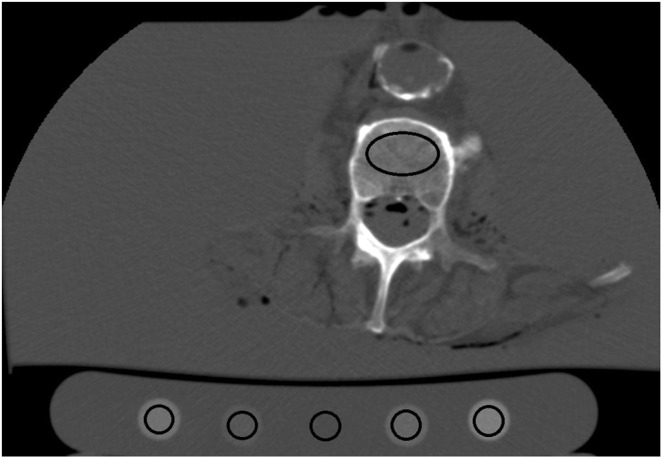
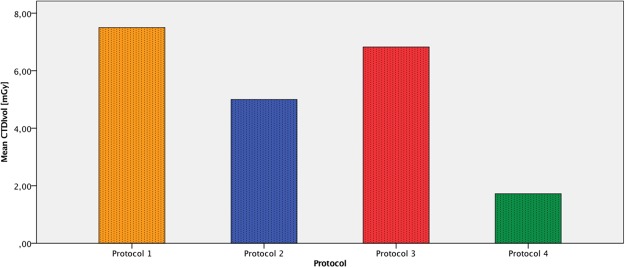
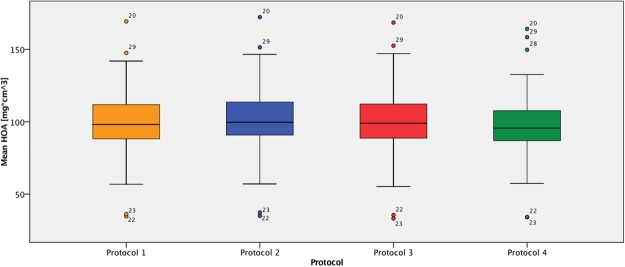
This study examines the influence of iterative reconstruction on bone mineral density (BMD) measurement by comparison with standard quantitative computed tomography (QCT; reference) and two other protocols based on filtered back projection. Ten human cadaver specimens of the lumbar spine with a hydroxyapatite calibration phantom underneath, were scanned with 4 protocols: 1. standard QCT, 2. volume scan with FBP, 3. helical scan with FBP, and 4. helical scan with IR (Adaptive Iterative Dose Reduction 3D (AIDR3D)). Radiation doses were recorded as CT dose index (CTDIvol) and BMD, signal-to-noise and contrast-to-noise ratio were calculated. Mean hydroxyapatite concentration (HOA) did not differ significantly between protocols, ranging from 98.58 ± 31.09 mg cm (protocol 4) to 100.47 ± 30.82 mg cm (protocol 2). Paired sample correlations of HOA values for protocol 4 and protocols 1, 2 and 3 were nearly perfect with coefficients of 0.980, 0.979 and 0.982, respectively (p < 0.004). CTDIvol were 7.50, 5.00, 6.82 (±2.03) and 1.72 (±0.50) mGy for protocols 1, 2, 3 and 4 respectively. Objective image quality was highest for protocol 4. The use of IR for BMD assessment significantly lowers radiation exposure compared to standard QCT and protocols with FBP while not degrading BMD measurement.
本研究通过与标准定量计算机断层扫描(QCT;参考)和两种基于滤波反投影的其他协议进行比较,考察了迭代重建对骨矿物质密度(BMD)测量的影响。10 个人体腰椎标本,下面有羟磷灰石校准体模,用 4 种方案进行扫描:1. 标准 QCT,2. 滤波反投影容积扫描,3. 滤波反投影螺旋扫描,4. 迭代重建(自适应迭代剂量降低 3D(AIDR3D))螺旋扫描。记录辐射剂量为 CT 剂量指数(CTDIvol),并计算 BMD、信噪比和对比噪声比。各组间羟磷灰石浓度(HOA)无显著差异,范围为 98.58±31.09mg/cm(方案 4)至 100.47±30.82mg/cm(方案 2)。方案 4 与方案 1、2、3 的 HOA 值配对样本相关系数近乎完美,系数分别为 0.980、0.979 和 0.982(p<0.004)。CTDIvol 分别为 1、2、3、4 方案的 7.50、5.00、6.82(±2.03)和 1.72(±0.50)mGy。方案 4 的客观图像质量最高。与标准 QCT 和 FBP 方案相比,使用 IR 进行 BMD 评估可显著降低辐射暴露,而不会降低 BMD 测量。