Chu Jian-Yuan, Yeh Kuang-Ting, Lee Ru-Ping, Yu Tzai-Chiu, Chen Ing-Ho, Peng Cheng-Huan, Liu Kuan-Lin, Wang Jen-Hung, Wu Wen-Tien
Department of Orthopedics, Hualien Tzu Chi Hospital, Buddhist Tzu Chi Medical Foundation, Hualien, Taiwan.
School of Medicine, Tzu Chi University, Hualien, Taiwan.
Tzu Chi Med J. 2018 Oct-Dec;30(4):242-246. doi: 10.4103/tcmj.tcmj_25_18.
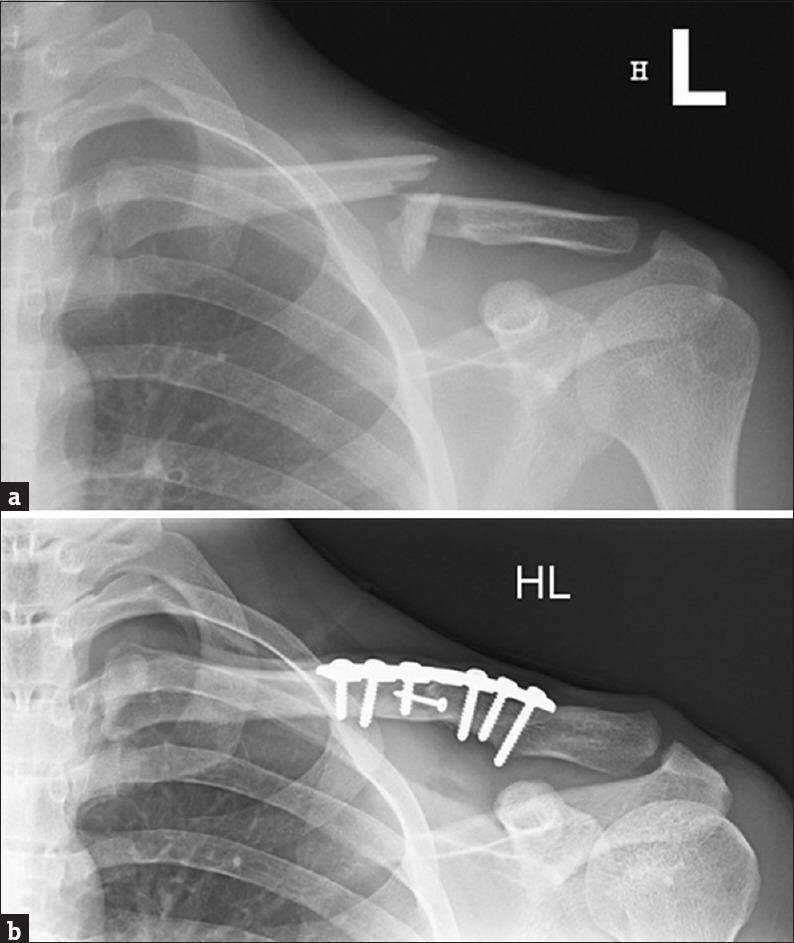
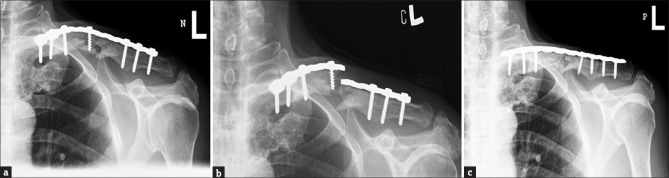
Midshaft clavicular fractures are increasingly treated operatively rather than nonoperatively. Studies have shown mixed results for both types of treatment. The aim of this study was to compare the early-stage functional status associated with open reduction and internal fixation (ORIF) with plating and that associated with conservative treatment for displaced midshaft clavicular fractures.
A single-center retrospective review of the results of 120 cases of displaced midshaft clavicular fractures in patients aged 30-65 years old was conducted. The primary outcome was fracture union status at 6 months. Other outcomes were subjective shoulder value (SSV) scores, visual analog scale (VAS) scores, and radiographic shortening at 6 weeks, 3 months, and 6 months. The complication rates in the operative and nonoperative groups were recorded.
The delayed union rate at 6-month postoperatively and VAS scores at 6 weeks, 3 months, and 6 months postinjury were significantly higher in the conservative treatment group than in the ORIF group. SSV scores were significantly improved at 6-month postinjury in the ORIF group.
This is the first study to discuss the importance of early-stage functional restoration after ORIF with plating for displaced midshaft clavicular fractures. This surgery leads to lower pain complications in the earlier stages of bone healing and lower delayed union rates compared with conservative treatment, in patients aged 30-65 years old.
锁骨中段骨折越来越多地采用手术治疗而非非手术治疗。研究表明,两种治疗方式的结果不一。本研究的目的是比较切开复位钢板内固定术(ORIF)与保守治疗移位型锁骨中段骨折的早期功能状态。
对120例年龄在30 - 65岁的移位型锁骨中段骨折患者的结果进行单中心回顾性研究。主要结局是6个月时的骨折愈合情况。其他结局包括主观肩关节评分(SSV)、视觉模拟评分(VAS)以及伤后6周、3个月和6个月时的影像学缩短情况。记录手术组和非手术组的并发症发生率。
保守治疗组术后6个月的延迟愈合率以及伤后6周、3个月和6个月时的VAS评分均显著高于ORIF组。ORIF组伤后6个月时SSV评分显著改善。
这是第一项探讨切开复位钢板内固定术治疗移位型锁骨中段骨折后早期功能恢复重要性的研究。与保守治疗相比,该手术在30 - 65岁患者的骨愈合早期导致的疼痛并发症更少,延迟愈合率更低。