Hosford Kate, Fuller Daniel, Lear Scott A, Teschke Kay, Gauvin Lise, Brauer Michael, Winters Meghan
Faculty of Health Sciences, Simon Fraser University, 8888 University Drive, Burnaby, BC V5A1S6, Canada.
Centre for Hip Health and Mobility, 2635 Laurel Street, Vancouver, BC V5Z 1M9, Canada.
Prev Med Rep. 2018 Oct 3;12:176-181. doi: 10.1016/j.pmedr.2018.09.014. eCollection 2018 Dec.
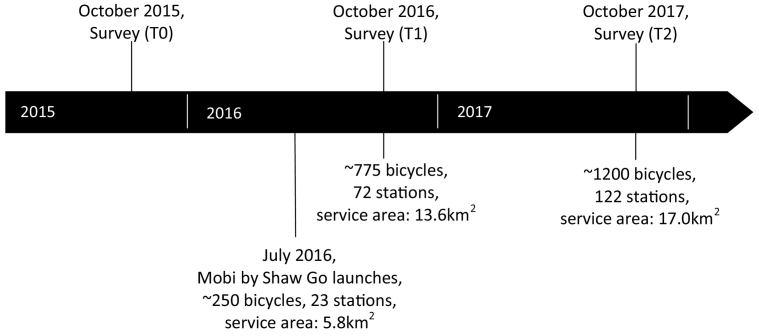
Public bicycle share programs have been implemented in cities around the world to encourage bicycling. However, there are limited evaluations of the impact of these programs on bicycling at the population level. This study examined the impact of a public bicycle share program on bicycling amongst residents of Vancouver, BC. Using an online panel, we surveyed a population-based sample of Vancouver residents three times: prior to the implementation of the public bicycle share program (T0, October 2015, = 1111); in the early phase of implementation (T1, October 2016, = 995); and one-year post implementation (T2, October 2017, = 966). We used difference in differences estimation to assess whether there was an increase in bicycling amongst those living and/or working in close proximity (≤500 m) to Vancouver's public bicycle share program, compared to those living and working outside this area. Results suggest that only living or only working inside the bicycle share service area was not associated with increases in bicycling at T1 or T2 relative to those outside the service area. Both living and working inside the bicycle share service area was associated with increases in bicycling at T1 (OR: 2.26, 95% CI: 1.07, 4.80), however not at T2 (OR: 1.37, 95% CI: 0.67, 2.83). These findings indicate that the implementation of a public bicycle share program may have a greater effect on bicycling for residents who both live and work within the service area, although this effect may not be sustained over time.
世界各地的城市都实施了公共自行车共享计划,以鼓励人们骑自行车。然而,这些计划对全体居民骑自行车行为的影响评估有限。本研究考察了不列颠哥伦比亚省温哥华市的一项公共自行车共享计划对该市居民骑自行车行为的影响。我们通过一个在线小组,对温哥华居民进行了三次基于人口的抽样调查:在公共自行车共享计划实施之前(T0,2015年10月,n = 1111);在实施的早期阶段(T1,2016年10月,n = 995);以及实施一年后(T2,2017年10月,n = 966)。我们使用差分估计法来评估,与居住和工作在该区域之外的人相比,居住和/或工作在距离温哥华公共自行车共享计划较近(≤500米)区域的人的骑自行车行为是否有所增加。结果表明,相对于服务区域外的人,仅居住或仅工作在自行车共享服务区域内,在T1或T2时与骑自行车行为的增加并无关联。居住和工作都在自行车共享服务区域内,在T1时与骑自行车行为的增加有关联(比值比:2.26,95%置信区间:1.07,4.80),但在T2时并非如此(比值比:1.37,95%置信区间:0.67,2.83)。这些发现表明,公共自行车共享计划的实施,对于那些居住和工作都在服务区域内的居民的骑自行车行为可能有更大影响,尽管这种影响可能不会随着时间持续下去。