Brix Nis, Ernst Andreas, Lauridsen Lea Lykke Braskhøj, Parner Erik, Støvring Henrik, Olsen Jørn, Henriksen Tine Brink, Ramlau-Hansen Cecilia Høst
Department of Public Health, Section for Epidemiology, Aarhus University, Aarhus, Denmark.
Department of Epidemiology, Fielding School of Public Health, University of California, Los Angeles, California, USA.
Paediatr Perinat Epidemiol. 2019 Jan;33(1):70-78. doi: 10.1111/ppe.12507. Epub 2018 Oct 11.
A secular trend towards earlier puberty has been observed in girls, while a similar trend has been more uncertain in boys. We estimated current ages at pubertal development in both boys and girls.
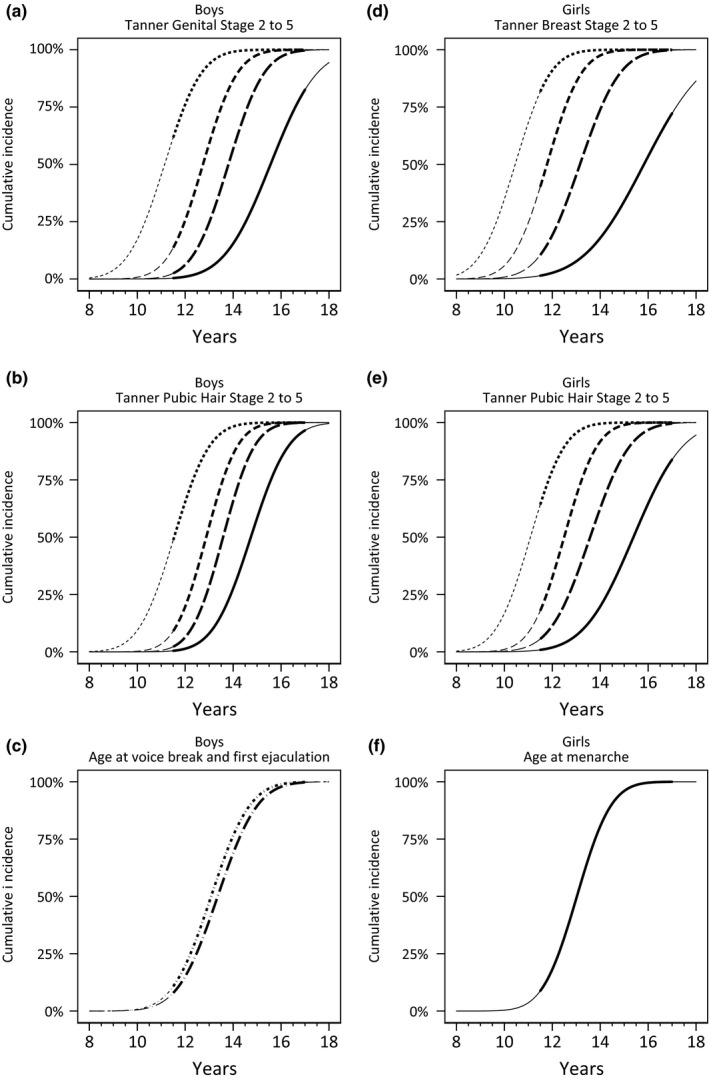
In this population-based cohort study, 14 759 of 22 439 invited boys and girls born from 2000 to 2003 in the Danish National Birth Cohort gave half-yearly self-reported information on puberty from the age of 11.5 years and throughout puberty. This late start of follow-up limits the estimation of age at onset of puberty but not later pubertal milestones. We estimated mean age at attaining the following pubertal milestones in years with 95% confidence intervals (CI): age at menarche, voice break, first ejaculation of semen and Tanner stages for pubic hair development and breast development or genital development. Further, the difference in mean age at menarche between mothers and daughters was estimated.
In boys, voice break occurred at 13.1 (95% CI 13.0, 13.1) years, first ejaculation of semen occurred at 13.4 (95% CI 13.3, 13.4) years, and Tanner Genital Stage 5 occurred at 15.6 (95% CI 15.5, 15.6) years. In girls, age at menarche occurred at 13.0 (95% CI 13.0, 13.1) years and Tanner Breast Stage 5 occurred at 15.8 (95% CI 15.7, 15.9) years. Daughters had menarche 3.6 (95% CI 3.1, 4.2) months earlier than their mothers had.
These data indicate that age at menarche has declined and to some extent support a decline in age at attaining other markers of pubertal development among boys.
已观察到女孩青春期有提前的长期趋势,而男孩是否有类似趋势则更不确定。我们估计了男孩和女孩青春期发育的当前年龄。
在这项基于人群的队列研究中,丹麦国家出生队列中2000年至2003年出生的22439名受邀男孩和女孩中有14759名从11.5岁起及整个青春期期间每半年自行报告一次青春期相关信息。这种随访的较晚开始限制了青春期开始年龄的估计,但不影响对青春期后期各阶段的估计。我们估计了达到以下青春期各阶段的平均年龄(岁)及95%置信区间(CI):月经初潮年龄、变声、首次射精以及阴毛发育和乳房发育或生殖器发育的坦纳分期。此外,还估计了母亲和女儿月经初潮平均年龄的差异。
在男孩中,变声发生在13.1岁(95%CI 13.0,13.1),首次射精发生在13.4岁(95%CI 13.3,13.4),坦纳生殖器5期发生在15.6岁(95%CI 15.5,15.6)。在女孩中,月经初潮年龄为13.0岁(95%CI 13.0,13.1),坦纳乳房5期发生在15.8岁(95%CI 15.7,15.9)。女儿月经初潮比母亲早3.6个月(95%CI 3.1,4.2)。
这些数据表明月经初潮年龄已下降,并且在一定程度上支持男孩达到其他青春期发育标志的年龄也有所下降。