Department of Human Development and Family Science, University of Georgia, 305 Sanford Drive, Athens, GA, 30602, USA.
Department of Preventive Medicine, Keck School of Medicine of the University of Southern California, 2001 North Soto Street, Office 302-02, Los Angeles, CA, 90089-9034, USA.
Drug Alcohol Depend. 2018 Nov 1;192:309-315. doi: 10.1016/j.drugalcdep.2018.08.022. Epub 2018 Oct 4.
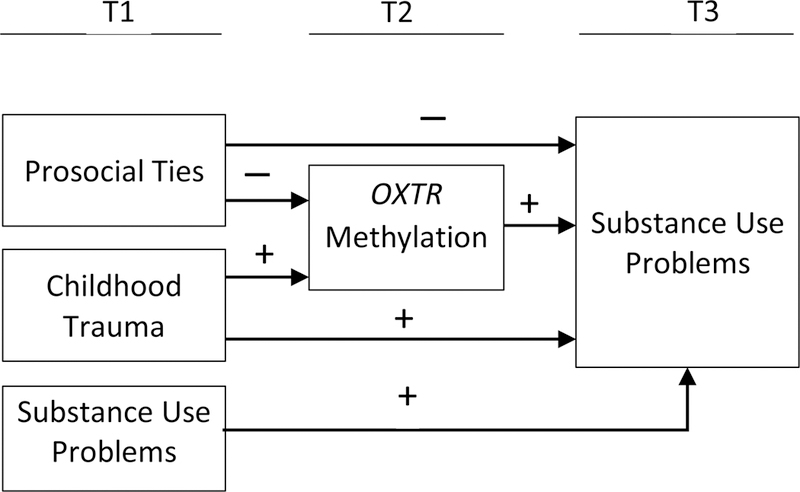
Stressful or supportive social environments promote biological changes with regulatory implications for future relationships and substance abuse. Recent research suggests links between adverse social environments, prosocial relationships, methylation at the oxytocin receptor gene (OXTR), and substance abuse. The potential for OXTR methylation to act as the mechanism linking social environments to substance abuse has yet to be investigated. We hypothesized that, for young African American men, childhood adversity increases, and supportive, prosocial bonds with parents, peers, partners, and community mentors decrease OXTR methylation levels, which in turn predict increases in substance-related symptoms.
A sample of 358 rural African American men (age 19 at baseline) provided self-report data at three time points separated by 18 months and a genetic specimen at Time 2.
Early adversity was associated with OXTR methylation indirectly via contemporary prosocial relationships. OXTR methylation was a proximal predictor of changes in substance-related symptoms. We found no evidence for a direct association of self-reported childhood trauma with OXTR methylation status.
Findings suggest that OXTR methylation is linked to substance use symptomatology, ostensibly resulting in increased expression of oxytocin (OT) in peripheral and central nervous systems. OXTR may act as a mechanism to explain how prosocial ties deter substance abuse and related problems. Despite conjectures in the literature that early adversity may become physiologically embedded via methylation in the OT system, direct effects were not evident. Rather, early adversity may affect OXTR methylation via influence on contemporary prosocial relationships.
压力或支持性的社会环境会引起生物学变化,对未来的人际关系和物质滥用具有调节作用。最近的研究表明,不良的社会环境、亲社会关系、催产素受体基因(OXTR)的甲基化以及物质滥用之间存在联系。OXTR 甲基化是否可以作为将社会环境与物质滥用联系起来的机制,这一点尚未得到研究。我们假设,对于年轻的非裔美国男性来说,童年逆境会增加,而与父母、同龄人、伴侣和社区导师的支持性、亲社会关系会减少 OXTR 甲基化水平,这反过来又会预测物质相关症状的增加。
一个由 358 名农村非裔美国男性组成的样本(基线时年龄为 19 岁)在 18 个月的时间内分三个时间点提供了自我报告数据,并在时间 2 点提供了遗传样本。
早期逆境通过当代亲社会关系与 OXTR 甲基化间接相关。OXTR 甲基化是物质相关症状变化的近端预测指标。我们没有发现自我报告的童年创伤与 OXTR 甲基化状态之间存在直接关联的证据。
研究结果表明,OXTR 甲基化与物质使用症状有关,显然导致外周和中枢神经系统中催产素(OT)的表达增加。OXTR 可能是一种解释亲社会关系如何阻止物质滥用和相关问题的机制。尽管文献中有猜测认为,早期逆境可能通过 OT 系统的甲基化而在生理上被嵌入,但直接效应并不明显。相反,早期逆境可能通过对当代亲社会关系的影响来影响 OXTR 甲基化。