Division of Breast Surgery, Department of Surgery, Taipei Medical University Hospital, Taipei 110, Taiwan.
Department of Surgery, School of Medicine, College of Medicine, Taipei Medical University, Taipei 110, Taiwan.
Int J Mol Sci. 2018 Oct 10;19(10):3096. doi: 10.3390/ijms19103096.
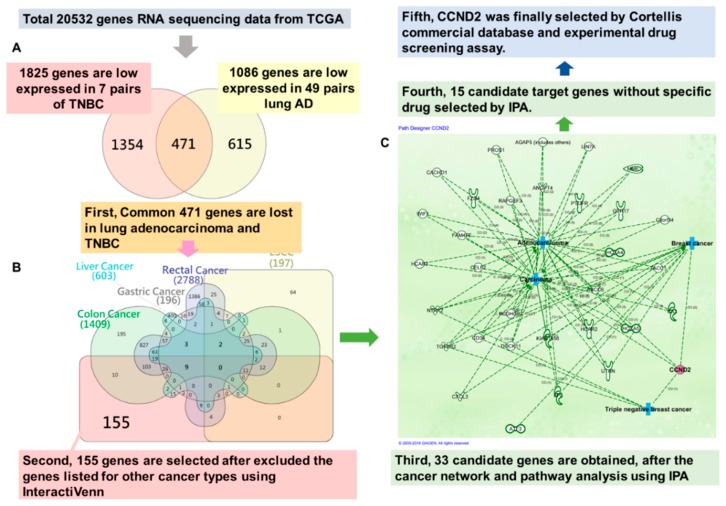
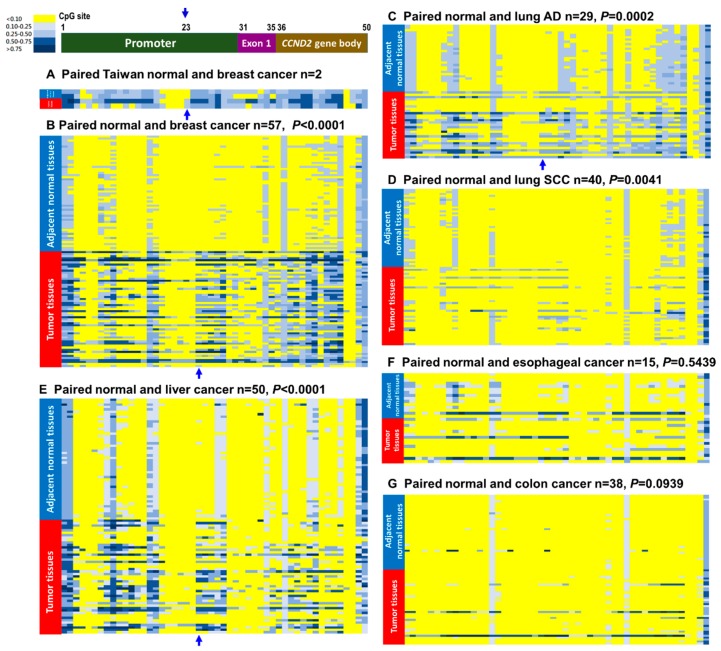
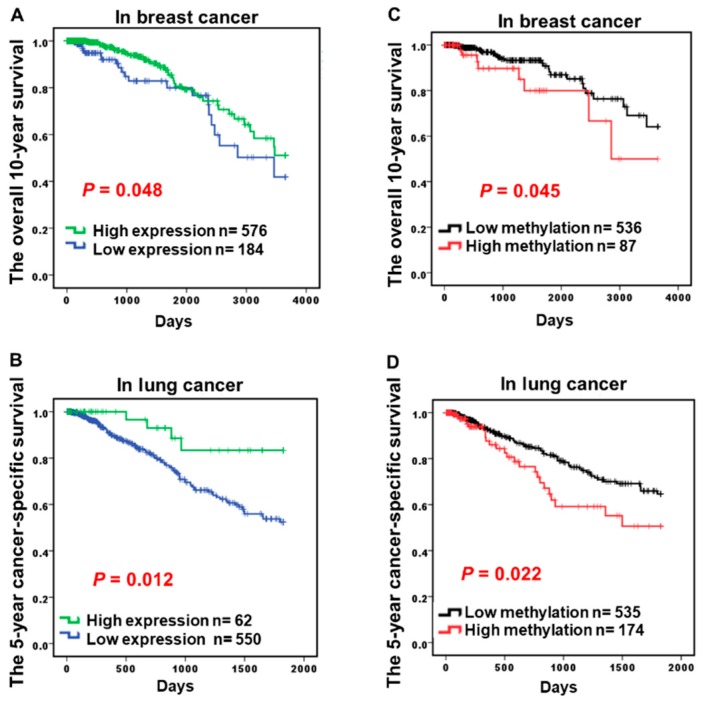
Lung and breast cancer are the leading causes of mortality in women worldwide. The discovery of molecular alterations that underlie these two cancers and corresponding drugs has contributed to precision medicine. We found that CCND2 is a common target in lung and breast cancer. Hypermethylation of the gene was reported previously; however, no comprehensive study has investigated the clinical significance of alterations and its applications and drug discovery. Genome-wide methylation and quantitative methylation-specific real-time polymerase chain reaction (PCR) showed promoter hypermethylation in Taiwanese breast cancer patients. As compared with paired normal tissues and healthy individuals, promoter hypermethylation was detected in 40.9% of breast tumors and 44.4% of plasma circulating cell-free DNA of patients. The western cohort of The Cancer Genome Atlas also demonstrated promoter hypermethylation in female lung cancer, lung adenocarcinoma, and breast cancer patients and that promoter hypermethylation is an independent poor prognostic factor. The cell model assay indicated that CCND2 expression inhibited cancer cell growth and migration ability. The demethylating agent antroquinonol D upregulated CCND2 expression, caused cell cycle arrest, and inhibited cancer cell growth and migration ability. In conclusion, hypermethylation of is a potential diagnostic, prognostic marker and drug target, and it is induced by antroquinonol D.
肺癌和乳腺癌是全球女性死亡的主要原因。对这两种癌症的分子改变的发现及其相应药物的发现促进了精准医学的发展。我们发现 CCND2 是肺癌和乳腺癌的共同靶点。先前已有报道该基因的异常甲基化;然而,尚无全面的研究来探究 改变的临床意义及其应用和药物发现。全基因组甲基化和定量甲基化特异性实时聚合酶链反应(PCR)显示,台湾乳腺癌患者存在 启动子的异常高甲基化。与配对的正常组织和健康个体相比,在 40.9%的乳腺癌肿瘤和 44.4%的患者血浆循环无细胞游离 DNA 中检测到 启动子的异常高甲基化。癌症基因组图谱的西方队列也证明了女性肺癌、肺腺癌和乳腺癌患者的 启动子异常高甲基化,并且 启动子异常高甲基化是独立的不良预后因素。细胞模型检测表明,CCND2 表达抑制了癌细胞的生长和迁移能力。去甲基化剂安特喹啉 D 上调了 CCND2 的表达,引起细胞周期停滞,并抑制了癌细胞的生长和迁移能力。总之, 的异常高甲基化是一个潜在的诊断、预后标志物和药物靶点,并且其受到安特喹啉 D 的诱导。