Liu Haiyang, Li Qiuping, Xing Yongzhong
National Key Laboratory of Crop Genetic Improvement and National Center of Plant Gene Research (Wuhan), Huazhong Agricultural University, Wuhan 430070, China.
Wuhan Life Origin Biotech Joint Stock Co., Ltd., Wuhan 430206, China.
Genes (Basel). 2018 Oct 10;9(10):489. doi: 10.3390/genes9100489.
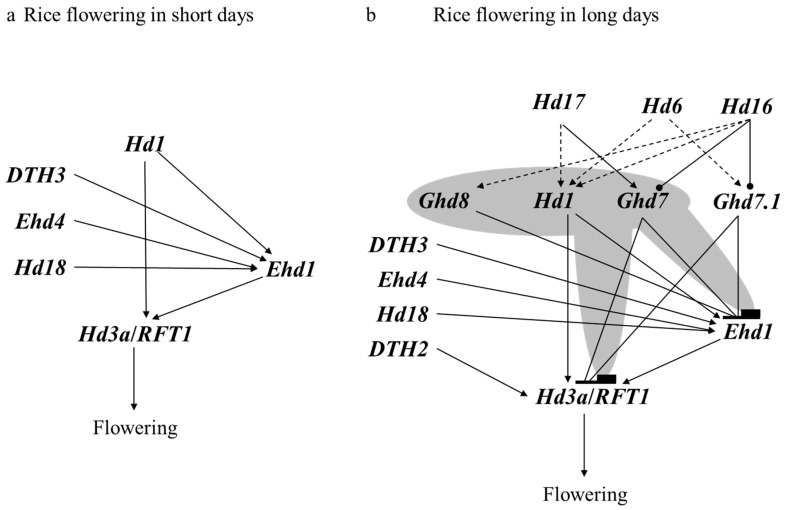
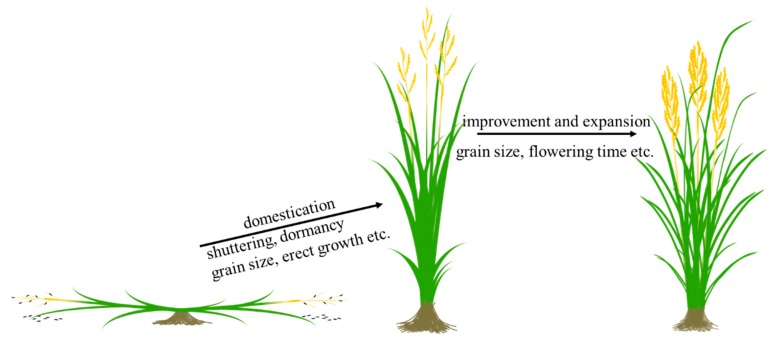
Asian rice () and African rice () are separately domesticated from their wild ancestors and , which are very sensitive to daylength. In the process of domestication, some traits that are favorable for the natural survival of wild rice such as seed dormancy and shattering have become favorable ones for human consumption due to the loss-of-function mutations in the genes that are underlying these traits. As a consequence, many genes that are related to these kinds of traits have been fixed with favorable alleles in modern cultivars by artificial selection. After domestication, cultivars gradually spread to temperate and cool regions from the tropics and subtropics due to the loss of their photoperiod sensitivity. In this paper, we review the characteristics of domestication-related seed traits and heading dates in rice, including the key genes controlling these traits, the differences in allelic diversity between wild rice and cultivars, the geographic distribution of alleles, and the regulatory pathways of these traits. A comprehensive comparison shows that these genes contributed to rice domestication and its global expansion. In addition, these traits have also experienced parallel evolution by artificial selection on the homologues of key genes in other cereals.
亚洲栽培稻()和非洲栽培稻()分别由其野生祖先和驯化而来,这两种野生祖先对日照长度非常敏感。在驯化过程中,一些有利于野生稻自然生存的性状,如种子休眠和易脱粒性,由于这些性状相关基因的功能丧失突变,变成了有利于人类食用的性状。因此,许多与这类性状相关的基因已通过人工选择在现代栽培品种中固定了有利等位基因。驯化后,由于光周期敏感性的丧失,栽培品种逐渐从热带和亚热带地区传播到温带和凉爽地区。在本文中,我们综述了水稻驯化相关种子性状和抽穗期的特征,包括控制这些性状的关键基因、野生稻和栽培品种之间等位基因多样性的差异、等位基因的地理分布以及这些性状的调控途径。综合比较表明,这些基因促进了水稻的驯化及其全球扩张。此外,通过对其他谷类作物关键基因同源物的人工选择,这些性状也经历了平行进化。