Hsieh Meng-Jer, Huang Shu-Yi, Yang Tsung-Ming, Tao Chi-Wei, Cheng Shih-Lung, Lee Chao-Hsien, Kuo Ping-Hung, Wu Yao-Kuang, Chen Ning-Hung, Hsu Wu-Huei, Hsu Jeng-Yuan, Lin Ming-Shian, Wang Chin-Chou, Wei Yu-Feng, Tsai Ying-Huang
Department of Pulmonary and Critical Care Medicine, Chiayi Chang Gung Memorial Hospital, Chang-Gung Medical foundation, Chiayi, Taiwan,
Department of Respiratory Therapy, School of Medicine, Chang-Gung University, Taoyuan, Taiwan,
Int J Chron Obstruct Pulmon Dis. 2018 Sep 25;13:2949-2959. doi: 10.2147/COPD.S176065. eCollection 2018.
This nationwide study was performed to evaluate the evolution of distributions of patients with COPD according to the 2011 and 2017 Global Initiative for Chronic Obstructive Pulmonary Disease (GOLD) guidelines and to assess the concordance between the prescribed medications and the pharmacological management recommended by the two distinct classification systems in Taiwan.
Data were retrospectively retrieved from stable COPD patients in 11 participating hospitals across Taiwan. Patients were grouped according to GOLD 2011 and 2017 guidelines respectively. Definitions of undertreatment and overtreatment were based on the pharmacological recommendations in the individual guidelines.
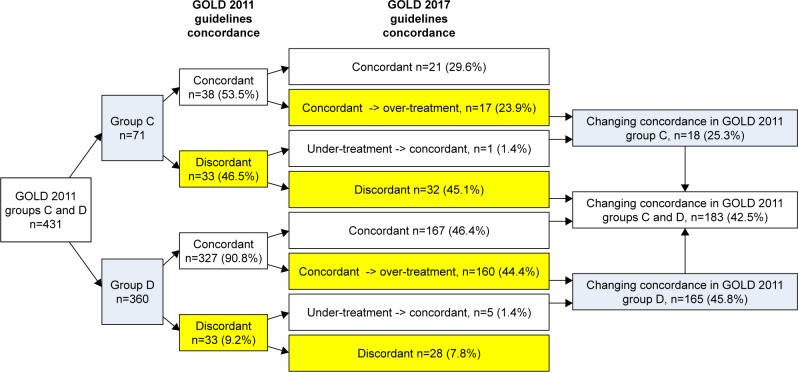
A total of 1,053 COPD patients were included. The percentages of patients in GOLD 2011 groups A, B, C and D were 18.4%, 40.6%, 6.7% and 34.2%, respectively. When reclassified according to the GOLD 2017, the percentages of group A and B increased to 23.3% and 63.2%, and groups C and D decreased to 1.9% and 11.6%, respectively. Up to 67% of patients in GOLD 2011 groups C and D were reclassified to GOLD 2017 groups A and B. The pharmacological concordance rate was 60.9% for GOLD 2011 and decreased to 44.9% for GOLD 2017. Overtreatment was found in 29.5% of patients according to GOLD 2011 and the rate increased to 46.1% when classified by the GOLD 2017. The major cause of overtreatment was unnecessary inhaled corticosteroids and the main cause of undertreatment was a lack of maintenance long-acting bronchodilators.
The distribution of COPD patients in Taiwan was more uneven with the GOLD 2017 than with the GOLD 2011. A pharmacological discordance to the guidelines was identified. Updated guidelines with reclassification of COPD patients resulted in more discordance between prescribed medications and the guidelines. Physicians should make proper adjustments of the prescriptions according to the updated guidelines to ensure the mostly appropriate treatment for COPD patients.
本全国性研究旨在根据2011年和2017年慢性阻塞性肺疾病全球倡议(GOLD)指南评估慢性阻塞性肺疾病(COPD)患者分布的演变情况,并评估台湾地区两种不同分类系统所推荐的药物治疗与药理学管理之间的一致性。
数据回顾性取自台湾11家参与研究医院的稳定期COPD患者。患者分别根据GOLD 2011和2017指南进行分组。治疗不足和治疗过度的定义基于各指南中的药理学建议。
共纳入1053例COPD患者。GOLD 2011分组中A、B、C和D组患者的百分比分别为18.4%、40.6%、6.7%和34.2%。按照GOLD 2017重新分类后,A组和B组的百分比分别增至23.3%和63.2%,C组和D组分别降至1.9%和11.6%。GOLD 2011分组中C组和D组高达67%的患者被重新分类至GOLD 2017分组的A组和B组。GOLD 2011的药理学一致性率为60.9%,而GOLD 2017降至44.9%。根据GOLD 2011,29.5%的患者存在治疗过度情况,按照GOLD 2017分类时该比例增至46.1%。治疗过度的主要原因是不必要的吸入性糖皮质激素,治疗不足的主要原因是缺乏维持性长效支气管扩张剂。
与GOLD 2011相比,台湾地区COPD患者的分布在GOLD 2017下更为不均衡。已确定存在与指南不符的药理学情况。COPD患者重新分类的更新指南导致处方药物与指南之间的不一致性增加。医生应根据更新后的指南对处方进行适当调整,以确保为COPD患者提供最恰当的治疗。