Institute for Learning & Brain Sciences, University of Washington, Seattle, WA, 98195, USA; Department of Speech and Hearing Sciences, University of Washington, Seattle, WA, 98195, USA.
Institute for Learning & Brain Sciences, University of Washington, Seattle, WA, 98195, USA; Department of Speech and Hearing Sciences, University of Washington, Seattle, WA, 98195, USA; Department of Psychology, Pusan National University, Busan, Republic of Korea.
Dev Cogn Neurosci. 2019 Apr;36:100593. doi: 10.1016/j.dcn.2018.09.003. Epub 2018 Sep 29.
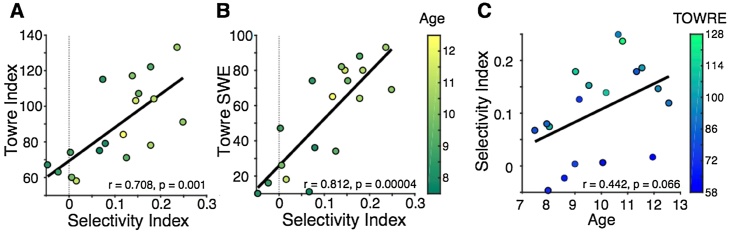
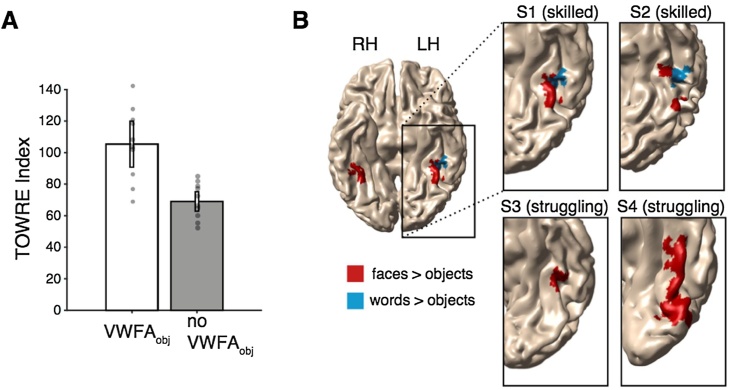
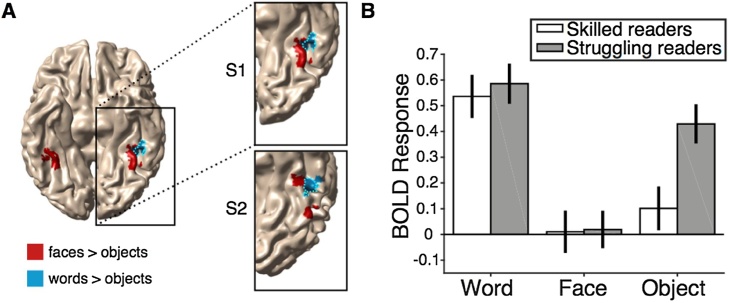
Word-selective neural responses in human ventral occipito-temporal cortex (VOTC) emerge as children learn to read, creating a visual word form area (VWFA) in the literate brain. It has been suggested that the VWFA arises through competition between pre-existing selectivity for other stimulus categories, changing the topography of VOTC to support rapid word recognition. Here, we hypothesized that competition between words and objects would be resolved as children acquire reading skill. Using functional magnetic resonance imaging (fMRI), we examined the relationship between responses to words and objects in VOTC in two ways. First, we defined the VWFA using a words > objects contrast and found that only skilled readers had a region that responded more to words than objects. Second, we defined the VWFA using a words > faces contrast and examined selectivity for words over objects in this region. We found that word selectivity strongly correlated with reading skill, suggesting reading skill-dependent tuning for words. Furthermore, we found that low word selectivity in struggling readers was not due to a lack of response to words, but to a high response to objects. Our results suggest that the fine-tuning of word-selective responses in VOTC is a critical component of skilled reading.
人类腹侧枕颞叶皮层(VOTC)中的单词选择性神经反应随着儿童学习阅读而出现,在有读写能力的大脑中形成了视觉单词形式区(VWFA)。有人认为,VWFA 是通过对其他刺激类别预先存在的选择性之间的竞争产生的,从而改变了 VOTC 的地形,以支持快速的单词识别。在这里,我们假设随着儿童获得阅读技能,单词和物体之间的竞争将得到解决。我们使用功能磁共振成像(fMRI)从两种方式检查了 VOTC 中单词和物体反应之间的关系。首先,我们使用单词>物体对比来定义 VWFA,并发现只有熟练的读者才有一个区域对单词的反应比对物体的反应更强烈。其次,我们使用单词>面孔对比来定义 VWFA,并在该区域检查了对单词的选择性。我们发现,单词选择性与阅读技能强烈相关,这表明单词的阅读技能依赖性调整。此外,我们发现,挣扎中的读者的低单词选择性不是由于对单词的反应不足,而是由于对物体的高反应。我们的结果表明,VOTC 中单词选择性反应的微调是熟练阅读的关键组成部分。