Guo Ruoyu, Liang Yantao, Xin Yu, Wang Long, Mou Shanli, Cao Chunjie, Xie Ruize, Zhang Chuanlun, Tian Jiwei, Zhang Yongyu
Key Laboratory of Biofuels, Shandong Provincial Key Laboratory of Energy Genetics, Qingdao Institute of Bioenergy and Bioprocess Technology, Chinese Academy of Sciences, Qingdao, China.
Physical Oceanography Laboratory/Qingdao Collaborative Innovation Center of Marine Science and Technology, Key Laboratory of Marine Chemistry Theory & Engineering, Ocean University of China, Qingdao, China.
Front Microbiol. 2018 Sep 26;9:2289. doi: 10.3389/fmicb.2018.02289. eCollection 2018.
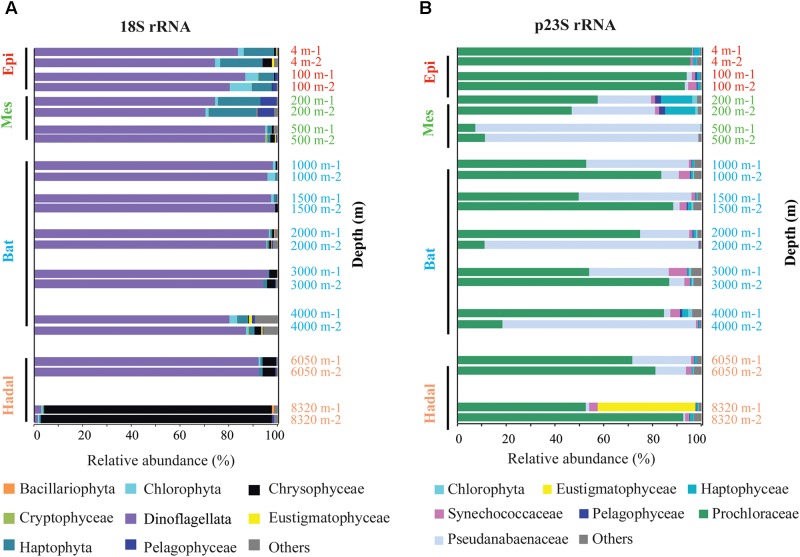
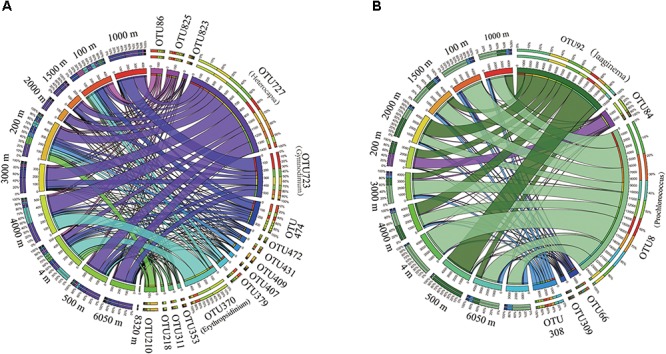
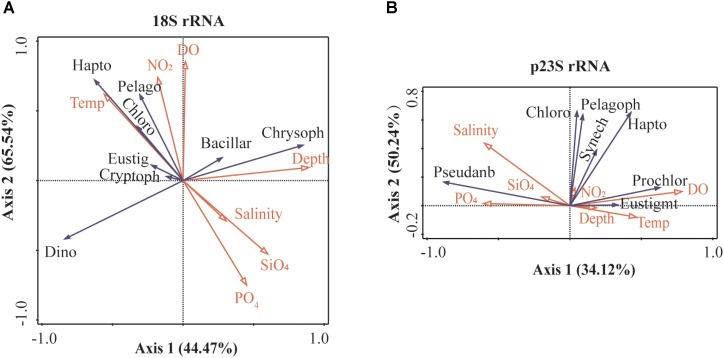
As photoautotrophs, phytoplankton are generally present in the euphotic zone of the ocean, however, recently healthy phytoplankton cells were found to be also ubiquitous in the dark deep sea, i.e., at water depths between 2000 and 4000 m. The distributions of phytoplankton communities in much deeper waters, such as the hadal zone, are unclear. In this study, the vertical distribution of the pico- and nano-phytoplankton (PN) communities from the surface to 8320 m, including the epipelagic, mesopelagic, bathypelagic, and hadal zones, were investigated via both 18S and p23S rRNA gene analysis in the Challenger Deep of the Mariana Trench. The results showed that Dinoflagellata, Chrysophyceae, Haptophyta, Chlorophyta, Prochloraceae, Pseudanabaenaceae, Synechococcaceae, and Eustigmatophyceae, etc., were the predominant PN in the Mariana Trench. Redundancy analyses revealed that depth, followed by temperature, was the most important environmental factors correlated with vertical distribution of PN community. In the hadal zone, the PN community structure was considerably different from those in the shallower zones. Some PN communities, e.g., Eustigmatophyceae and Chrysophyceae, which have the heterotrophic characteristics, were sparse in shallower waters, while they were identified with high relative abundance (94.1% and 20.1%, respectively) at the depth of 8320 m. However, the dinoflagellates and Prochloraceae were detected throughout the entire water column. We proposed that vertical sinking, heterotrophic metabolism, and/or the transition to resting stage of phytoplankton might contribute to the presence of phytoplankton in the hadal zone. This study provided insight into the PN community in the Mariana Trench, implied the significance of phytoplankton in exporting organic matters from the euphotic to the hadal zone, and also hinted the possible existence of some undetermined energy metabolism (e.g., heterotrophy) of phytoplankton making themselves adapt and survive in the hadal environment.
作为光合自养生物,浮游植物通常存在于海洋的光合层,但最近发现健康的浮游植物细胞在黑暗的深海中也普遍存在,即在水深2000至4000米之间。在更深的水域,如超深渊带,浮游植物群落的分布尚不清楚。在本研究中,通过对马里亚纳海沟挑战者深渊18S和p23S rRNA基因分析,研究了从表层到8320米(包括上层、中层、深层和超深渊带)的微微型和微型浮游植物(PN)群落的垂直分布。结果表明,甲藻、金藻、定鞭藻、绿藻、原绿球藻科、假鱼腥藻科、聚球藻科和真眼点藻科等是马里亚纳海沟中的主要PN。冗余分析表明,深度其次是温度,是与PN群落垂直分布相关的最重要环境因素。在超深渊带,PN群落结构与较浅区域有很大不同。一些具有异养特征的PN群落,如真眼点藻科和金藻,在较浅水域稀少,但在8320米深度处相对丰度较高(分别为94.1%和20.1%)。然而,在整个水柱中都检测到了甲藻和原绿球藻科。我们提出,浮游植物的垂直沉降、异养代谢和/或向休眠阶段的转变可能有助于浮游植物在超深渊带的存在。本研究深入了解了马里亚纳海沟中的PN群落,暗示了浮游植物在将有机物质从光合层输出到超深渊带中的重要性,也暗示了浮游植物可能存在一些未确定的能量代谢(如异养),使其能够在超深渊环境中适应和生存。