Division of Molecular Biology and Human Genetics, Faculty of Medicine and Health Sciences, DST-NRF Centre of Excellence for Biomedical Tuberculosis Research, South African Medical Research Council Centre for Tuberculosis Research, Stellenbosch University, Cape Town, South Africa.
Program in Infectious Diseases and Immunity in Global Health, The Research Institute of the McGill University Health Centre, Montreal, QC, Canada.
Front Immunol. 2018 Sep 27;9:2219. doi: 10.3389/fimmu.2018.02219. eCollection 2018.
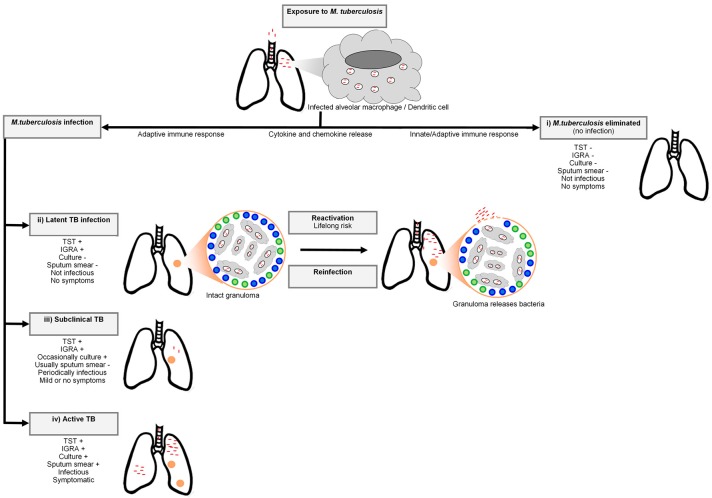
Natural history studies of tuberculosis (TB) have revealed a spectrum of clinical outcomes after exposure to s, the cause of TB. Not all individuals exposed to the bacterium will become diseased and depending on the infection pressure, many will remain infection-free. Intriguingly, complete resistance to infection is observed in some individuals (termed resisters) after intense, continuing exposure. After successful infection, the majority of individuals will develop latent TB infection (LTBI). This infection state is currently (and perhaps imperfectly) defined by the presence of a positive tuberculin skin test (TST) and/or interferon gamma release assay (IGRA), but no detectable clinical disease symptoms. The majority of healthy individuals with LTBI are resistant to clinical TB, indicating that infection is remarkably well-contained in these non-progressors. The remaining 5-15% of LTBI positive individuals will progress to active TB. Epidemiological investigations have indicated that the host genetic component contributes to these infection and disease phenotypes, influencing both susceptibility and resistance. Elucidating these genetic correlates is therefore a priority as it may translate to new interventions to prevent, diagnose or treat TB. The most successful approaches in resistance/susceptibility investigation have focused on specific infection and disease phenotypes and the resister phenotype may hold the key to the discovery of actionable genetic variants in TB infection and disease. This review will not only discuss lessons from epidemiological studies, but will also focus on the contribution of epidemiology and functional genetics to human genetic resistance to infection and disease.
结核病(TB)的自然史研究揭示了在接触结核分枝杆菌(导致结核病的细菌)后出现的一系列临床结果。并非所有接触过这种细菌的人都会患病,而且根据感染压力的不同,许多人将保持无感染状态。有趣的是,一些人(称为抵抗者)在强烈、持续的暴露后,对感染完全具有抵抗力。成功感染后,大多数人会发展为潜伏性结核病感染(LTBI)。目前(也许并不完美),这种感染状态通过结核菌素皮肤试验(TST)和/或干扰素γ释放试验(IGRA)的阳性来定义,但没有可检测到的临床疾病症状。大多数患有 LTBI 的健康个体对临床结核病具有抵抗力,这表明在这些非进展者中感染得到了很好的控制。剩下的 5-15%的 LTBI 阳性个体将发展为活动性结核病。流行病学研究表明,宿主遗传成分导致了这些感染和疾病表型,影响了易感性和抵抗力。因此,阐明这些遗传相关性是当务之急,因为它可能转化为预防、诊断或治疗结核病的新干预措施。在耐药性/易感性研究中最成功的方法集中在特定的感染和疾病表型上,而抵抗者表型可能是发现结核病感染和疾病中可操作遗传变异的关键。这篇综述不仅将讨论来自流行病学研究的经验教训,还将重点讨论流行病学和功能遗传学对人类遗传抵抗感染和疾病的贡献。