Jia Jianbo, Zhang Yi, Xin Yan, Jiang Cuijuan, Yan Bing, Zhai Shumei
Key Laboratory for Water Quality and Conservation of the Pearl River Delta, Ministry of Education, Institute of Environmental Research at Greater Bay, Guangzhou University, Guangzhou, China.
School of Chemistry and Chemical Engineering, Shandong University, Jinan, China.
Front Oncol. 2018 Sep 25;8:404. doi: 10.3389/fonc.2018.00404. eCollection 2018.
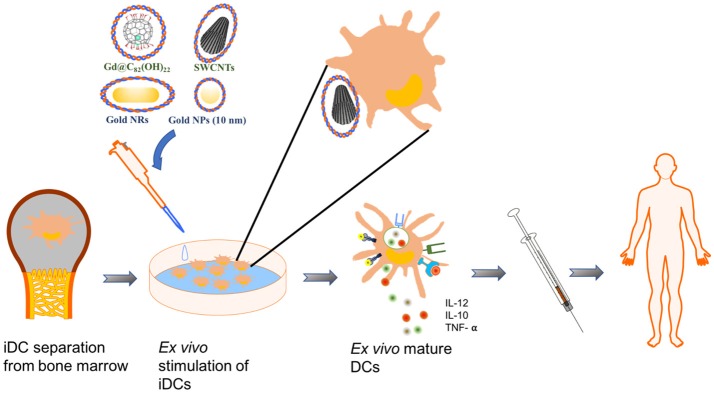
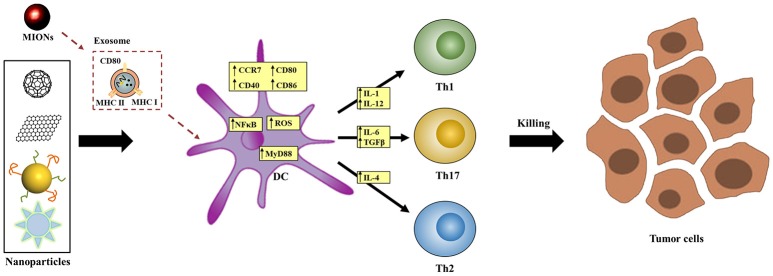
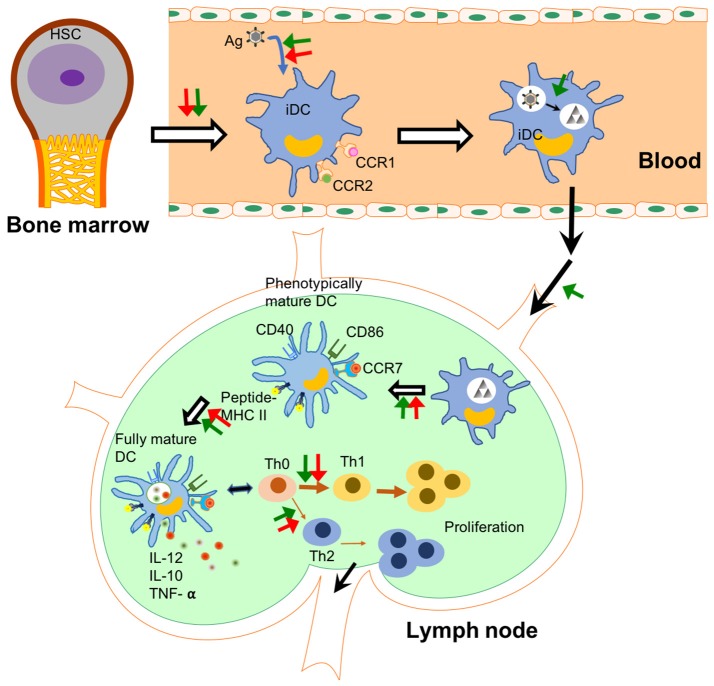
Dendritic cells (DCs) are the primary antigen-presenting cells and play key roles in the orchestration of the innate and adaptive immune system. Targeting DCs by nanotechnology stands as a promising strategy for cancer immunotherapy. The physicochemical properties of nanoparticles (NPs) influence their interactions with DCs, thus altering the immune outcome of DCs by changing their functions in the processes of maturation, homing, antigen processing and antigen presentation. In this review, we summarize the recent progress in targeting DCs using NPs as a drug delivery carrier in cancer immunotherapy, the recognition of NPs by DCs, and the ways the physicochemical properties of NPs affect DCs' functions. Finally, the molecular pathways in DCs that are affected by NPs are also discussed.
树突状细胞(DCs)是主要的抗原呈递细胞,在协调先天性和适应性免疫系统中发挥关键作用。通过纳米技术靶向DCs是一种很有前景的癌症免疫治疗策略。纳米颗粒(NPs)的物理化学性质会影响它们与DCs的相互作用,从而通过改变DCs在成熟、归巢、抗原处理和抗原呈递过程中的功能来改变免疫结果。在这篇综述中,我们总结了在癌症免疫治疗中使用NPs作为药物递送载体靶向DCs的最新进展、DCs对NPs的识别以及NPs的物理化学性质影响DCs功能的方式。最后,还讨论了受NPs影响的DCs中的分子途径。