Department of Cardiology, Renmin Hospital of Wuhan University, Wuhan, Hubei 430060, P.R. China.
Department of Respiratory Medicine, Renmin Hospital of Wuhan University, Wuhan, Hubei 430060, P.R. China.
Mol Med Rep. 2018 Dec;18(6):5009-5015. doi: 10.3892/mmr.2018.9546. Epub 2018 Oct 10.
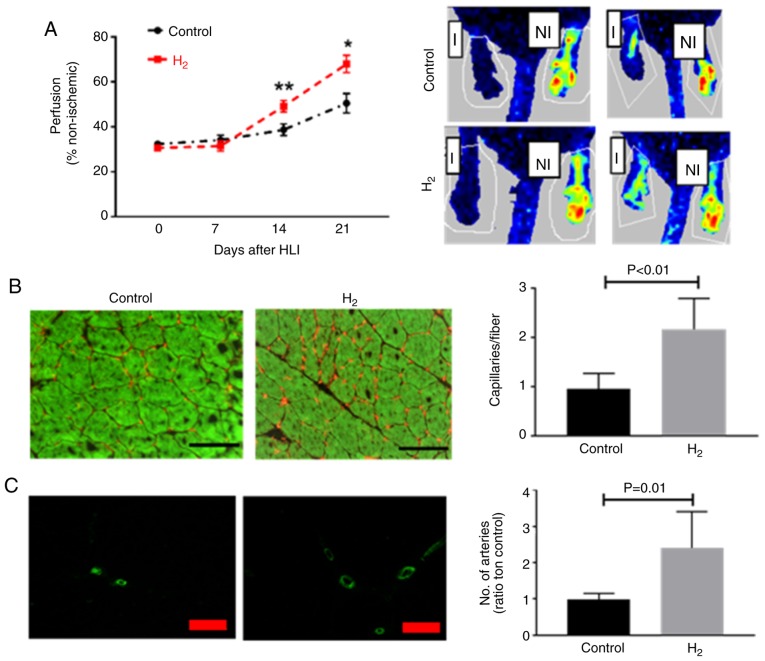
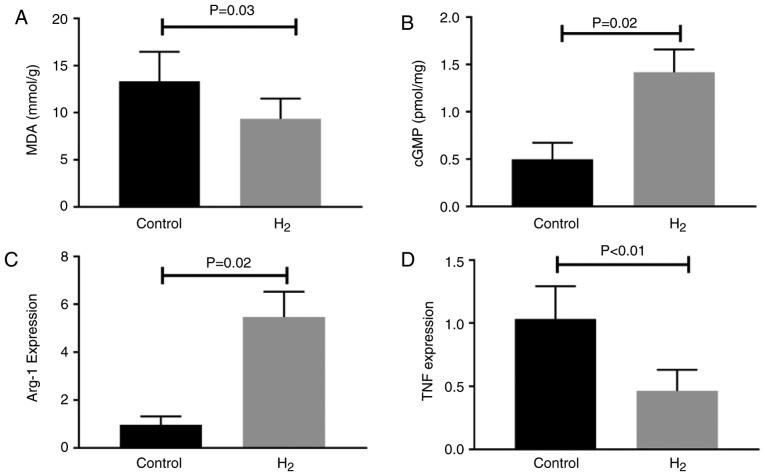
Reactive oxygen species (ROS) impair neovascularization and perfusion recovery following limb ischemia in patients with peripheral arterial disease (PAD). Hydrogen molecules (H2) comprise an antioxidant gas that has been reported to neutralize cytotoxic ROS. The present study investigated whether H2 may serve as a novel therapeutic strategy for PAD. H2‑saturated water or dehydrogenized water was supplied to mice with experimental PAD. Laser Doppler perfusion imaging demonstrated that H2‑saturated water improved perfusion recovery, decreased the rate of necrosis, increased the capillary density in the gastrocnemius muscle and increased the artery density in the abductor muscle in the ischemic limbs, at 14 and 21 days post‑hindlimb ischemia. Ischemic muscle tissue was harvested 7 days after experimental PAD for biochemical testing and H2 was observed to reduce the levels of malondialdehyde and increase the levels of cyclic guanine monophosphate (cGMP). In cultured endothelial cells, H2‑saturated culture medium resulted in reduced ROS levels, increased tube formation and increased cGMP levels. In macrophages, H2 decreased cellular ROS levels and promoted M2 polarization. H2‑saturated water increases angiogenesis and arteriogenesis and subsequently improves perfusion recovery in a mouse PAD model via reduction of ROS levels.
活性氧 (ROS) 会损害外周动脉疾病 (PAD) 患者肢体缺血后的新生血管形成和灌注恢复。氢气分子 (H2) 是一种抗氧化气体,据报道可中和细胞毒性 ROS。本研究探讨了 H2 是否可以作为 PAD 的一种新的治疗策略。实验性 PAD 小鼠给予 H2 饱和水或脱氢水。激光多普勒灌注成像显示,H2 饱和水可改善灌注恢复,降低坏死率,增加缺血肢体比目鱼肌中的毛细血管密度,并增加外展肌中的动脉密度,在缺血后 14 天和 21 天。实验性 PAD 后 7 天采集缺血肌肉组织进行生化检测,结果观察到 H2 降低了丙二醛水平,增加了环鸟苷单磷酸 (cGMP) 水平。在培养的内皮细胞中,H2 饱和培养基导致 ROS 水平降低,管形成增加,cGMP 水平增加。在巨噬细胞中,H2 降低了细胞内 ROS 水平并促进了 M2 极化。H2 饱和水通过降低 ROS 水平增加了小鼠 PAD 模型中的血管生成和动脉生成,随后改善了灌注恢复。