Department of Arctic and Marine Biology, UiT - The Arctic University of Norway, NO-9037, Tromsø, Norway.
Sci Rep. 2018 Oct 15;8(1):15252. doi: 10.1038/s41598-018-33443-6.
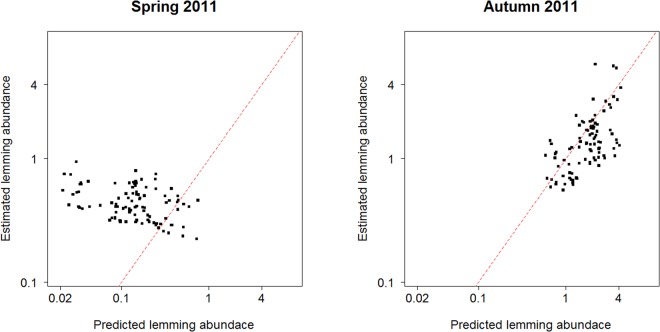
Ecological models have been criticized for a lack of validation of their temporal transferability. Here we answer this call by investigating the temporal transferability of a dynamic state-space model developed to estimate season-dependent biotic and climatic predictors of spatial variability in outbreak abundance of the Norwegian lemming. Modelled summer and winter dynamics parametrized by spatial trapping data from one cyclic outbreak were validated with data from a subsequent outbreak. There was a distinct difference in model transferability between seasons. Summer dynamics had good temporal transferability, displaying ecological models' potential to be temporally transferable. However, the winter dynamics transferred poorly. This discrepancy is likely due to a temporal inconsistency in the ability of the climate predictor (i.e. elevation) to reflect the winter conditions affecting lemmings both directly and indirectly. We conclude that there is an urgent need for data and models that yield better predictions of winter processes, in particular in face of the expected rapid climate change in the Arctic.
生态模型因缺乏对其时间可转移性的验证而受到批评。在这里,我们通过调查为估计挪威旅鼠爆发数量的空间变异性的季节性生物和气候预测因子而开发的动态状态空间模型的时间可转移性来响应这一呼吁。通过来自一个循环爆发的空间诱捕数据参数化的模型夏季和冬季动态,用来自随后爆发的数据进行了验证。季节之间的模型可转移性有明显的差异。夏季动态具有良好的时间可转移性,显示出生态模型在时间上具有可转移性的潜力。然而,冬季动态的转移效果较差。这种差异可能是由于气候预测因子(即海拔)反映直接和间接影响旅鼠的冬季条件的能力存在时间上的不一致性。我们的结论是,迫切需要数据和模型来更好地预测冬季过程,特别是在面对北极地区预期的快速气候变化的情况下。