Ferlian Olga, Cesarz Simone, Craven Dylan, Hines Jes, Barry Kathryn E, Bruelheide Helge, Buscot François, Haider Sylvia, Heklau Heike, Herrmann Sylvie, Kühn Paul, Pruschitzki Ulrich, Schädler Martin, Wagg Cameron, Weigelt Alexandra, Wubet Tesfaye, Eisenhauer Nico
German Centre for Integrative Biodiversity Research (iDiv) Halle-Jena-Leipzig, Deutscher Platz 5e, 04103 Leipzig, Germany.
Institute of Biology, Leipzig University, Deutscher Platz 5e, 04103 Leipzig, Germany.
Ecosphere. 2018 May 30;9(5):e02226. doi: 10.1002/ecs2.2226.
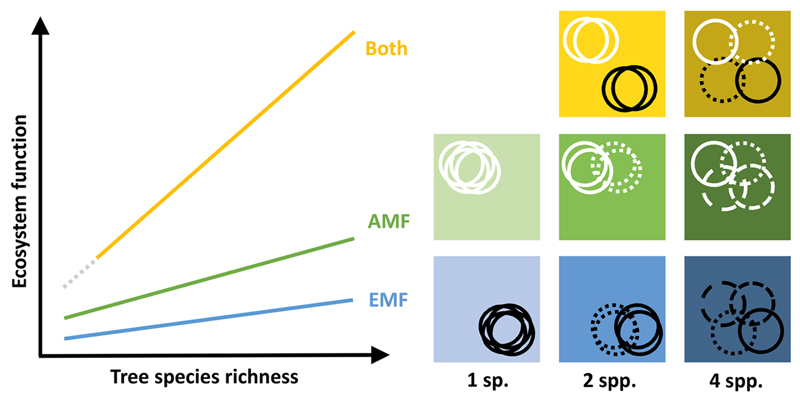
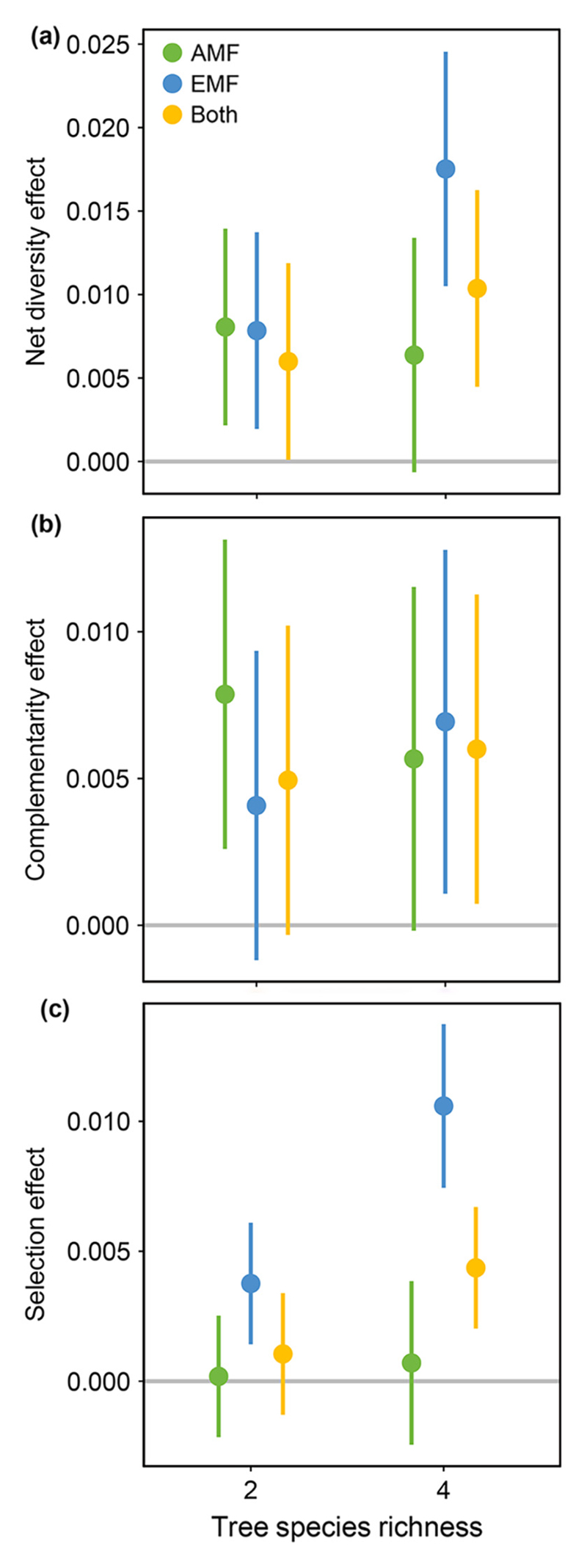
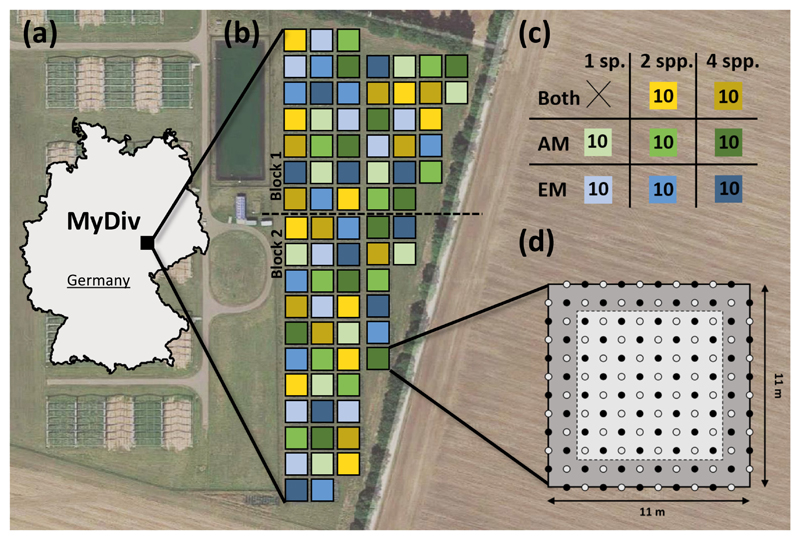
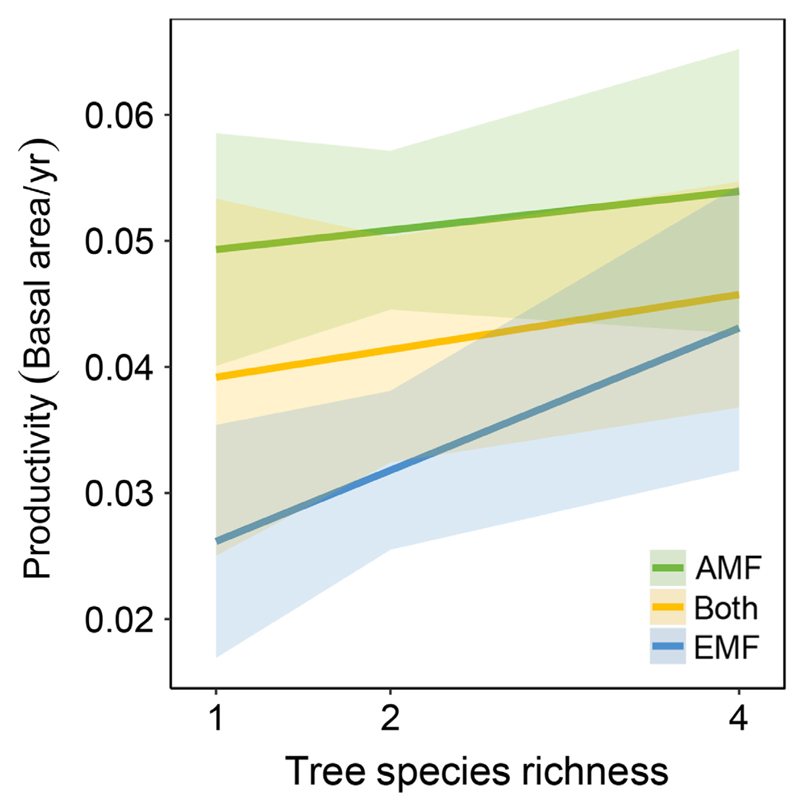
The widely observed positive relationship between plant diversity and ecosystem functioning is thought to be substantially driven by complementary resource use of plant species. Recent work suggests that biotic interactions among plants and between plants and soil organisms drive key aspects of resource use complementarity. Here, we provide a conceptual framework for integrating positive biotic interactions across guilds of organisms, more specifically between plants and mycorrhizal types, to explain resource use complementarity in plants and its consequences for plant competition. Our overarching hypothesis is that ecosystem functioning increases when more plant species associate with functionally dissimilar mycorrhizal fungi because differing mycorrhizal types will increase coverage of habitat space for and reduce competition among plants. We introduce a recently established field experiment (MyDiv) that uses different pools of tree species that associate with either arbuscular or ectomycorrhizal fungi to create orthogonal experimental gradients in tree species richness and mycorrhizal associations and present initial results. Finally, we discuss options for future mechanistic studies on resource use complementarity within MyDiv. We show how mycorrhizal types and biotic interactions in MyDiv can be used in the future to test novel questions regarding the mechanisms underlying biodiversity-ecosystem function relationships.
植物多样性与生态系统功能之间广泛存在的正相关关系,被认为主要是由植物物种对资源的互补利用驱动的。最近的研究表明,植物之间以及植物与土壤生物之间的生物相互作用驱动着资源利用互补性的关键方面。在此,我们提供一个概念框架,用于整合不同生物类群之间,更具体地说是植物与菌根类型之间的正向生物相互作用,以解释植物的资源利用互补性及其对植物竞争的影响。我们的总体假设是,当更多植物物种与功能不同的菌根真菌相关联时,生态系统功能会增强,因为不同的菌根类型会增加植物的栖息地空间覆盖并减少植物之间的竞争。我们介绍了一个最近开展的田间试验(MyDiv),该试验使用与丛枝菌根真菌或外生菌根真菌相关联的不同树种组合,在树种丰富度和菌根关联方面创建正交实验梯度,并展示了初步结果。最后,我们讨论了未来在MyDiv内进行资源利用互补性机制研究的选项。我们展示了MyDiv中的菌根类型和生物相互作用在未来如何用于测试有关生物多样性 - 生态系统功能关系潜在机制的新问题。