Department of Pathology and Molecular Medicine, McMaster University, Hamilton, Ontario, Canada.
National Institute of Hygiene and Epidemiology, Hanoi, Vietnam.
Influenza Other Respir Viruses. 2019 Mar;13(2):176-183. doi: 10.1111/irv.12615. Epub 2019 Jan 4.
It is uncertain whether vitamin D can reduce respiratory infection.
To determine whether vitamin D supplementation reduces influenza and other upper viral respiratory tract infections.
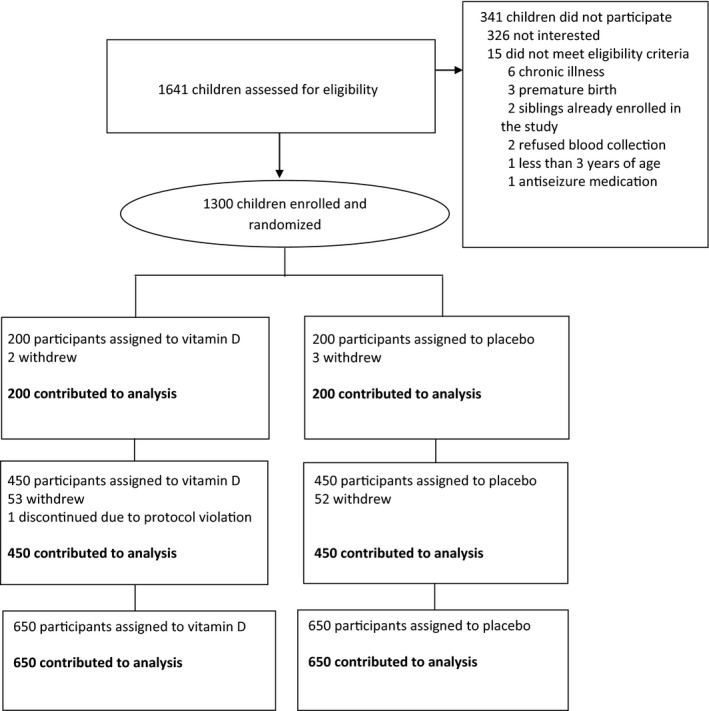
A total of 1300 healthy children and adolescents between the ages of 3 and 17 years were randomized to vitamin D (14 000 U weekly) or placebo for 8 months in Vietnam. The primary outcome was reverse transcriptase (RT)-PCR-confirmed influenza infection, and the coprimary outcome was multiplex PCR-confirmed non-influenza respiratory viruses. Participants, caregivers, and those assessing outcomes were blinded to group assignment.
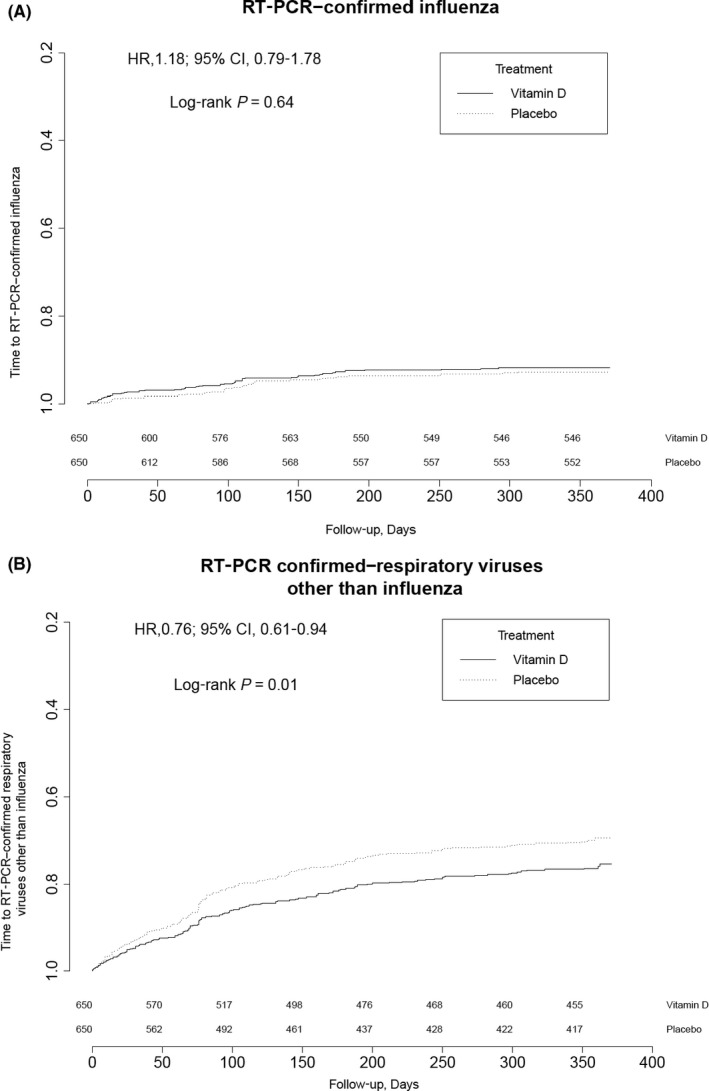
A total of 650 children and adolescents were randomly assigned to vitamin D and 650 to placebo. The mean baseline serum 25-hydroxyvitamin D levels were 65.7 nmol/L and 65.2 nmol/L in the intervention and placebo groups, respectively, with an increase to 91.8 nmol/L in the vitamin D group and no increase, 64.5 nmol/L, in the placebo group. All 1300 participants randomized contributed to the analysis. We observed RT-PCR-confirmed influenza A or B occurred in 50 children (7.7%) in the vitamin D group and in 43 (6.6%) in the placebo group (hazard ratio [HR]: 1.18, 95% CI: 0.79-1.78). RT-PCR-confirmed non-influenza respiratory virus infection occurred in 146 (22.5%) in the vitamin D group and in 185 (28.5%) in the placebo group (hazard ratio [HR]: 0.76, 95% CI: 0.61-0.94). When considering all respiratory viruses, including influenza, the effect of vitamin D in reducing infection was significant, HR: 0.81, 95% CI: 0.66-0.99.
Vitamin D supplementation did not reduce the incidence of influenza but moderately reduced non-influenza respiratory viral infection.
维生素 D 是否能减少呼吸道感染还不确定。
确定维生素 D 补充剂是否能减少流感和其他上呼吸道病毒感染。
在越南,共纳入 1300 名年龄在 3 至 17 岁之间的健康儿童和青少年,将其随机分为维生素 D(每周 14000U)或安慰剂组,干预 8 个月。主要结局是逆转录酶(RT)-PCR 确诊的流感感染,共同主要结局是多重 PCR 确诊的非流感呼吸道病毒。参与者、照料者和评估结局的人员对分组情况设盲。
共有 650 名儿童和青少年被随机分配到维生素 D 组,650 名被分配到安慰剂组。干预组和安慰剂组的基线血清 25-羟维生素 D 水平分别为 65.7nmol/L 和 65.2nmol/L,维生素 D 组增加至 91.8nmol/L,安慰剂组无增加,为 64.5nmol/L。所有 1300 名随机参与者均纳入分析。我们观察到,在维生素 D 组中,有 50 名(7.7%)儿童出现 RT-PCR 确诊的流感 A 或 B,而在安慰剂组中,有 43 名(6.6%)儿童出现 RT-PCR 确诊的流感 A 或 B(风险比[HR]:1.18,95%置信区间:0.79-1.78)。在维生素 D 组中,有 146 名(22.5%)儿童出现 RT-PCR 确诊的非流感呼吸道病毒感染,而在安慰剂组中,有 185 名(28.5%)儿童出现 RT-PCR 确诊的非流感呼吸道病毒感染(风险比[HR]:0.76,95%置信区间:0.61-0.94)。当考虑所有呼吸道病毒,包括流感时,维生素 D 对减少感染的效果显著,HR:0.81,95%置信区间:0.66-0.99。
维生素 D 补充剂并未降低流感发病率,但适度降低了非流感呼吸道病毒感染。