1Division of Cancer Prevention and Control, Centers for Disease Control and Prevention, Atlanta, Georgia.
2Battelle Memorial Institute, Columbus, Ohio.
Popul Health Manag. 2019 Aug;22(4):330-338. doi: 10.1089/pop.2018.0082. Epub 2018 Oct 17.
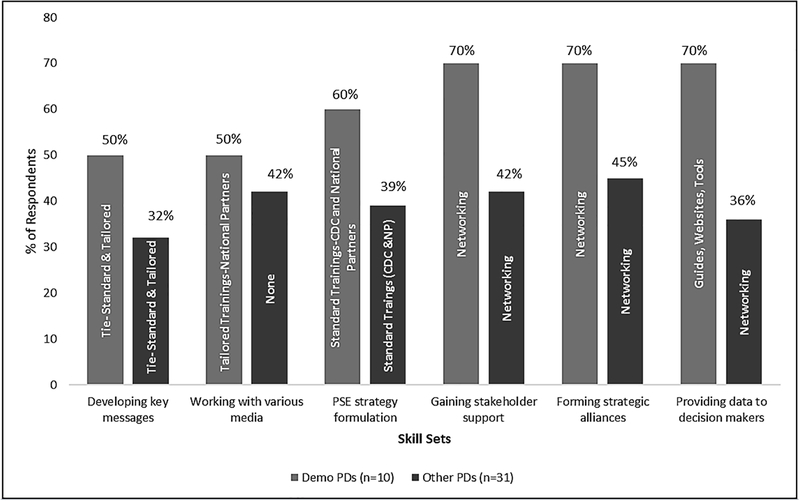
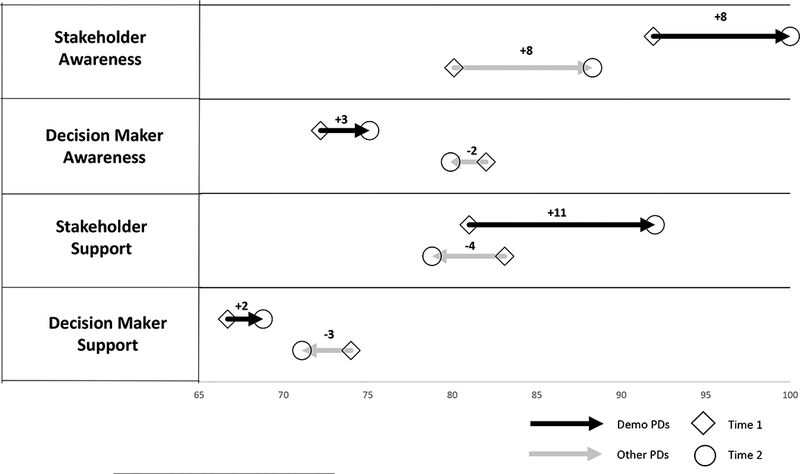
Policy, systems, and environmental (PSE) approaches are commonly used to improve population health. Cancer-related examples include providing data and education to stakeholders about policies that support healthy living, or health systems changes such as universal reminders about recommended cancer screening. The National Comprehensive Cancer Control Program (NCCCP) funds health departments to form cancer coalitions that develop and implement cancer plans. NCCCP initiated a demonstration program in 13 of 65 funded grantees to determine whether skilled, dedicated staffing and using a strategic process to examine data, form a workgroup, and develop an agenda would enhance their capacity to implement PSE approaches, recruit new partners, and provide data and education to stakeholders. The objective of this study was to compare demonstration program grantees to other NCCCP grantees on their ability to develop and implement PSE strategies, and the short-term results that were achieved. Program directors (PDs) from each NCCCP-funded jurisdiction completed web surveys at 2 time points during implementation to assess changes in their capacity for PSE approaches, identify implementation activities, and document short-term outcomes. Responses from demonstration program PDs and other PDs at both time points were compared in a descriptive analysis. Demonstration program grantees experienced greater increases in skills and capacity to address PSE approaches, engaged in necessary implementation activities more often, and achieved greater improvements in stakeholder and decision maker awareness and support for PSE strategies, compared to nonparticipating NCCCP grantees. These findings support continued implementation of PSE approaches for sustainable cancer prevention and control.
政策、系统和环境(PSE)方法常用于改善人群健康。癌症相关的例子包括向利益攸关方提供支持健康生活的政策数据和教育,或进行卫生系统改革,如普遍提醒建议的癌症筛查。国家综合癌症控制计划(NCCCP)资助卫生部门成立癌症联盟,制定和实施癌症计划。NCCCP 在 65 个受资助的赠款中选择了 13 个,启动了一个示范项目,以确定是否熟练、专注的人员配备以及使用战略性的流程来检查数据、组建工作组和制定议程,将增强其实施 PSE 方法、招募新合作伙伴以及向利益攸关方提供数据和教育的能力。本研究的目的是比较示范项目赠款接受者与 NCCCP 其他赠款接受者在制定和实施 PSE 策略方面的能力,以及取得的短期成果。在实施过程中的两个时间点,每个 NCCCP 资助的司法管辖区的项目主任(PD)都完成了网络调查,以评估他们在 PSE 方法方面的能力变化,确定实施活动,并记录短期结果。在描述性分析中比较了示范项目 PD 和其他 PD 在两个时间点的回复。与未参与的 NCCCP 赠款接受者相比,示范项目赠款接受者在解决 PSE 方法的技能和能力方面经历了更大的增长,更频繁地开展必要的实施活动,并在利益攸关者和决策者对 PSE 策略的认识和支持方面取得了更大的改善。这些发现支持继续实施 PSE 方法,以实现可持续的癌症预防和控制。