BC Children's Hospital Research Institute, Vancouver, BC V5Z 4H4, Canada.
Food, Nutrition, and Health Program, The University of British Columbia, Vancouver, BC V6T 1Z4, Canada.
Nutrients. 2018 Oct 16;10(10):1513. doi: 10.3390/nu10101513.
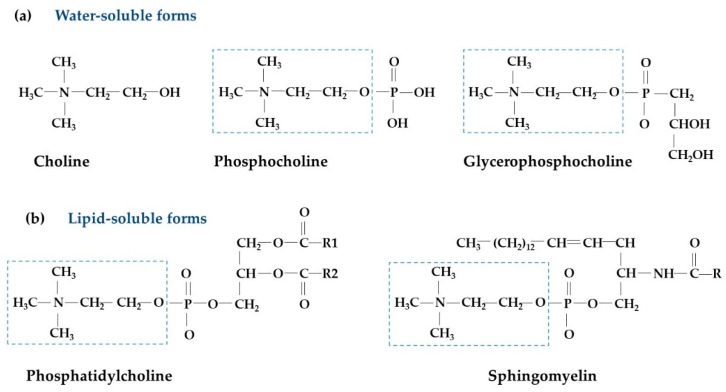
Choline, an essential dietary nutrient for humans, is required for the synthesis of the neurotransmitter, acetylcholine, the methyl group donor, betaine, and phospholipids; and therefore, choline is involved in a broad range of critical physiological functions across all stages of the life cycle. The current dietary recommendations for choline have been established as Adequate Intakes (AIs) for total choline; however, dietary choline is present in multiple different forms that are both water-soluble (e.g., free choline, phosphocholine, and glycerophosphocholine) and lipid-soluble (e.g., phosphatidylcholine and sphingomyelin). Interestingly, the different dietary choline forms consumed during infancy differ from those in adulthood. This can be explained by the primary food source, where the majority of choline present in human milk is in the water-soluble form, versus lipid-soluble forms for foods consumed later on. This review summarizes the current knowledge on dietary recommendations and assessment methods, and dietary choline intake from food sources across the life cycle.
胆碱是人类必需的膳食营养素,它是合成神经递质乙酰胆碱、甲基供体甜菜碱和磷脂所必需的;因此,胆碱参与了生命周期各个阶段的广泛的关键生理功能。目前的胆碱膳食推荐量已被确立为总胆碱的适宜摄入量 (AIs);然而,膳食中的胆碱以多种不同的形式存在,既有水溶性的(如游离胆碱、磷酸胆碱和甘油磷酸胆碱),也有脂溶性的(如磷脂酰胆碱和鞘磷脂)。有趣的是,婴儿期和成年期摄入的不同膳食胆碱形式有所不同。这可以用主要食物来源来解释,因为人乳中存在的大部分胆碱是以水溶性形式存在的,而后期食用的食物则是以脂溶性形式存在的。本综述总结了目前关于膳食推荐量和评估方法的知识,以及整个生命周期中从食物来源获取的膳食胆碱摄入量。