Van Parys Anthea, Karlsson Therese, Vinknes Kathrine J, Olsen Thomas, Øyen Jannike, Dierkes Jutta, Nygård Ottar, Lysne Vegard
Centre for Nutrition, Department of Clinical Science, University of Bergen, Bergen, Norway.
Department of Internal Medicine and Clinical Nutrition, The Sahlgrenska Academy, University of Gothenburg, Gothenburg, Sweden.
Front Nutr. 2021 May 14;8:676026. doi: 10.3389/fnut.2021.676026. eCollection 2021.
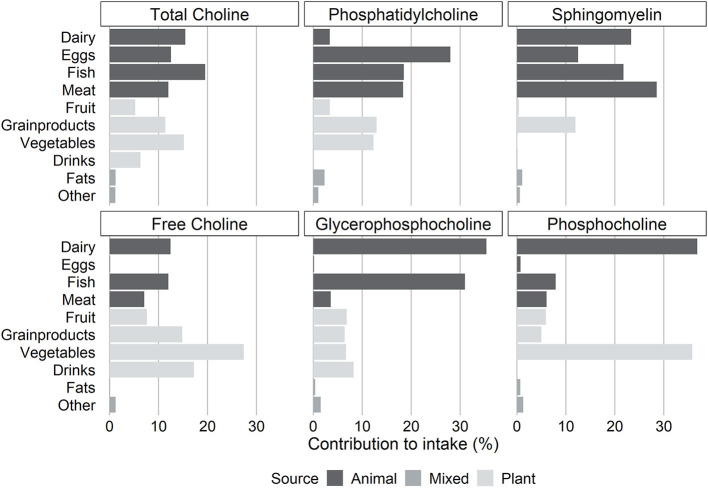
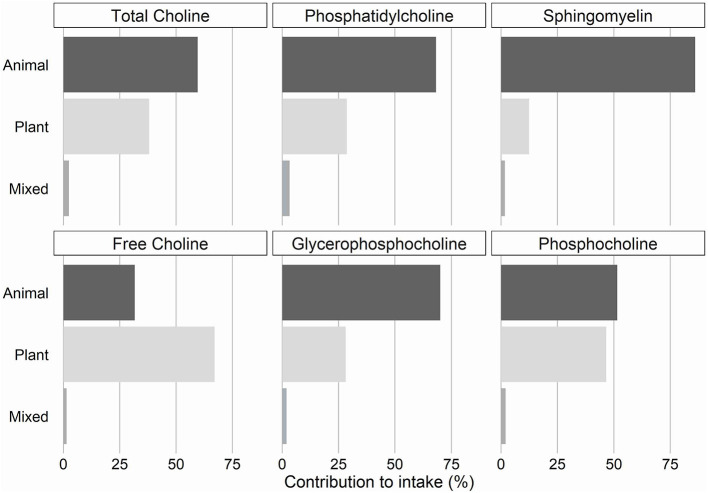
Choline is an essential nutrient involved in a wide range of physiological functions. It occurs in water- and lipid-soluble forms in the body and diet. Foods with a known high choline content are eggs, beef, chicken, milk, fish, and selected plant foods. An adequate intake has been set in the US and Europe, however, not yet in the Nordic countries. A higher intake of lipid-soluble choline forms has been associated with increased risk of acute myocardial infarction, highlighting the need for knowledge about food sources of the individual choline forms. In general, little is known about the habitual intake and food sources of choline, and individual choline forms. Investigate foods contributing to the intake of total choline and individual choline forms. The study population consisted of 1,929 patients with stable angina pectoris from the Western Norway B Vitamin Intervention Trial. Dietary intake data was obtained through a 169-item food frequency questionnaire. Intake of total choline and individual choline forms was quantified using the USDA database, release 2. The geometric mean (95% prediction interval) total choline intake was 287 (182, 437) mg/d. Phosphatidylcholine accounted for 42.5% of total choline intake, followed by free choline (25.8%) and glycerophosphocholine (21.2%). Phosphocholine and sphingomyelin contributed 4.2 and 4.5%, respectively. The main dietary choline sources were eggs, milk, fresh vegetables, lean fish, and bread. In general, animal food sources were the most important contributors to choline intake. This study is, to the best of our knowledge, the first to assess the intake of all choline forms and their dietary sources in a European population. Most choline was consumed in the form of phosphatidylcholine and animal food sources contributed most to choline intake. There is a need for accurate estimates of the dietary intake of this essential nutrient to issue appropriate dietary recommendations.
胆碱是一种必需营养素,参与多种生理功能。它在人体和饮食中以水溶性和脂溶性形式存在。已知胆碱含量高的食物有鸡蛋、牛肉、鸡肉、牛奶、鱼类以及某些植物性食物。美国和欧洲已设定了充足摄入量,但北欧国家尚未设定。脂溶性胆碱形式的摄入量较高与急性心肌梗死风险增加有关,这凸显了了解个体胆碱形式食物来源的必要性。总体而言,人们对胆碱及其个体胆碱形式的习惯性摄入量和食物来源知之甚少。调查对总胆碱和个体胆碱形式摄入量有贡献的食物。研究人群包括来自挪威西部B族维生素干预试验的1929例稳定型心绞痛患者。通过一份包含169项内容的食物频率问卷获取饮食摄入数据。使用美国农业部数据库第2版对总胆碱和个体胆碱形式的摄入量进行量化。总胆碱摄入量的几何平均值(95%预测区间)为287(182,437)毫克/天。磷脂酰胆碱占总胆碱摄入量的42.5%,其次是游离胆碱(25.8%)和甘油磷酸胆碱(21.2%)。磷酸胆碱和鞘磷脂分别占4.2%和4.5%。主要的膳食胆碱来源是鸡蛋、牛奶、新鲜蔬菜、瘦鱼和面包。一般来说,动物性食物来源是胆碱摄入的最重要贡献者。据我们所知,本研究是首次评估欧洲人群中所有胆碱形式的摄入量及其膳食来源。大多数胆碱以磷脂酰胆碱的形式摄入,动物性食物来源对胆碱摄入的贡献最大。需要准确估计这种必需营养素的膳食摄入量,以便给出适当的饮食建议。