Nowak Albina, Giger Rebekka S, Krayenbuehl Pierre-Alexandre
Department of Endocrinology and Clinical Nutrition, University Hospital Zurich.
Department of Internal Medicine, Psychiatric University Hospital Zurich, University of Zurich.
Medicine (Baltimore). 2018 Oct;97(42):e12886. doi: 10.1097/MD.0000000000012886.
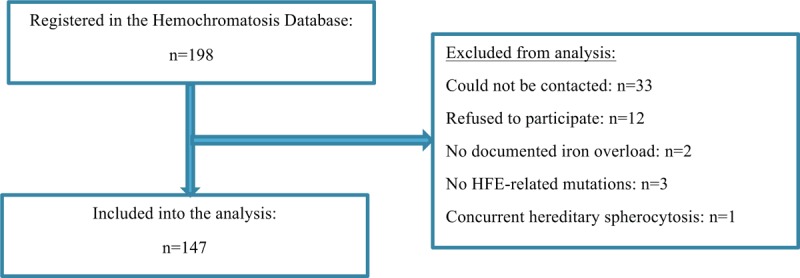
Hereditary hemochromatosis (HH) is the most common genetic disease in Caucasians which is characterized by an increased intestinal iron absorption, resulting into a progressive accumulation of iron in organs including liver, heart, and pancreas, leading to their progressive dysfunction. Hepatocellular carcinoma (HCC) is a long-term complication of HH, which contributes to increased mortality.We evaluated the risk factors of HCC in a prospective cohort of Swiss hemochromatosis patients with a long-term follow-up.We included 147 patients with the mean age at diagnosis of 48 years, in whom 70% were men. Overall, 9% of the patients developed HCC during the mean follow-up time of 14 years (range 1-40 years). Patients with HCC had higher age at diagnosis (61 ± 11 vs 47 ± 13 years, P = .003), more frequently liver cirrhosis on biopsy (90% vs 37.5%, P = .004), and higher serum ferritin levels [3704 (Q1:2025, Q3:4463) vs 1338 (Q1:691, Q3:2468) μg/L, P < .001], they needed more iron removed by phlebotomy until its depletion [8.9 (Q1:7.2, Q3:10.1) vs 3.8 (Q1:1.6, Q3:8.9) g, P = .029], compared to non-HCC patients. After adjustment for possible confounders, only higher age at diagnosis remained significantly associated with HCC development (odds ratio 1.19, 95% CI 0.056-0.397, P = .001, per year).Higher age at diagnosis showed the strongest association with the occurrence of HCC in Swiss hemochromatosis patients. Patients who were diagnosed at a higher age and with a high iron overload (serum ferritin levels >1000 μg/L) require regular screening even if they have no liver cirrhosis.
遗传性血色素沉着症(HH)是白种人中最常见的遗传性疾病,其特征是肠道铁吸收增加,导致铁在肝脏、心脏和胰腺等器官中逐渐积累,进而导致这些器官功能逐渐失调。肝细胞癌(HCC)是HH的一种长期并发症,会导致死亡率上升。我们对一组进行长期随访的瑞士血色素沉着症患者前瞻性队列进行研究,评估了HCC的危险因素。我们纳入了147例患者,诊断时的平均年龄为48岁,其中70%为男性。总体而言,在平均14年(范围1 - 40年)的随访时间里,9%的患者发生了HCC。发生HCC的患者诊断时年龄更大(61±11岁 vs 47±13岁,P = 0.003),活检时肝硬化的发生率更高(90% vs 37.5%,P = 0.004),血清铁蛋白水平更高[3704(四分位间距Q1:2025,Q3:4463)vs 1338(Q1:691,Q3:2468)μg/L,P < 0.001],与未发生HCC的患者相比,他们需要通过放血去除更多的铁直至铁耗竭[8.9(Q1:7.2,Q3:10.1)vs 3.8(Q1:1.6,Q3:8.9)g,P = 0.029]。在对可能的混杂因素进行校正后,仅诊断时年龄较大仍与HCC发生显著相关(比值比1.19,95%置信区间0.056 - 0.397,P = 0.001,每年)。在瑞士血色素沉着症患者中,诊断时年龄较大与HCC发生的关联最强。诊断时年龄较大且铁过载严重(血清铁蛋白水平>1000μg/L)的患者即使没有肝硬化也需要定期筛查。