Faculty of Medicine, Universidad Nacional San Luis Gonzaga, Ica, Perú.
Faculty of Medicine, Universidad Nacional Autónoma de Honduras, Tegucigalpa, Honduras.
PLoS One. 2018 Oct 18;13(10):e0205674. doi: 10.1371/journal.pone.0205674. eCollection 2018.
Motivation in medical students is positively associated with learning strategies. However, the evidence of a direct relationship between motivation and performance is vague. The objective of this study is to determine if the motivation that pushed students to choose the medical career is associated with their academic performance during their university years.
The study was conducted in 4,290 medical students from 10 countries in Latin America. The "Attribution Scale of General Achievement Motivation" was used to evaluate their general performance. The "Medical motivation Scale" test was used to measure social, altruist, economic, and prestige motivators. For statistical analyses, frequencies and percentages were described, and generalized linear models were used to establish statistical associations.
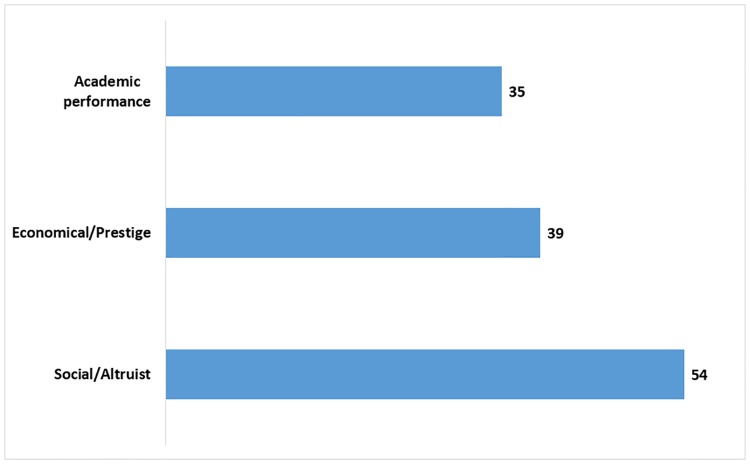
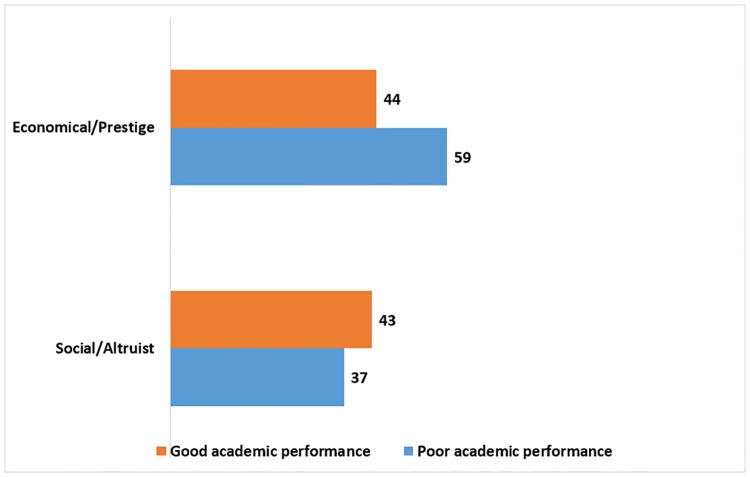
Fifty percent of the students surveyed were females and the mean student age was 21 years old. This study showed that male students had a higher social/altruist motivation (PR:1.11,95%CI: 1.03-1.18; p<0,01) than females. Those who had familial pressure had a lower social/altruist motivation (PR:0.17,95%CI:0.08-0.36; p<0,001). The positive vocational test was associated with a higher social/altruist motivation (PR:1.85,95%CI:1.03-3.30; p<0,05). Moreover, good grades at school were related with a higher economical/prestige motivation (PR:1.39,95%CI:1.05-1.83; p<0,05), but lower social/altruist motivation (PR:0.85,95%CI:0.74-0.98; p<0,05) and academic performance (PR:0.63,95%CI:0.50-0.79; p<0,001). We found a higher frequency in the general motivation was associated to a lowest social/altruist motivation (PR: 0.57; CI95%: 0.46-0.70; p<0.001), and that it increased according to the year of study (PR: 1.15; CI95%: 1.03-1.28; p:0.013) and was higher when pressure by the family was present (PR: 1.36; CI95%: 1.17-1.59; p<0.001).
This study indicated that male medical students and having a positive vocational test were associated with a higher social/altruist motivation. Conversely, those who had familial pressure and good grades at school had a lower social/altruist motivation. Is necessary to conduct further studies that assess other factors related to motivation as demographics, personality, and learning styles.
医学专业学生的学习动机与学习策略呈正相关。然而,动机与表现之间存在直接关系的证据尚不清楚。本研究的目的是确定推动学生选择医学职业的动机是否与他们在大学期间的学业成绩有关。
本研究在来自拉丁美洲 10 个国家的 4290 名医学生中进行。使用“一般成就动机归因量表”评估他们的一般表现。使用“医学动机量表”测试来衡量社会、利他、经济和声望动机。为了进行统计分析,描述了频率和百分比,并使用广义线性模型建立了统计关联。
调查的学生中有 50%是女性,平均学生年龄为 21 岁。本研究表明,男性学生的社会/利他动机更高(PR:1.11,95%CI:1.03-1.18;p<0.01)。那些有家庭压力的学生的社会/利他动机较低(PR:0.17,95%CI:0.08-0.36;p<0.001)。积极的职业测试与更高的社会/利他动机相关(PR:1.85,95%CI:1.03-3.30;p<0.05)。此外,学校成绩好与更高的经济/声望动机相关(PR:1.39,95%CI:1.05-1.83;p<0.05),但社会/利他动机较低(PR:0.85,95%CI:0.74-0.98;p<0.05)和学业成绩(PR:0.63,95%CI:0.50-0.79;p<0.001)。我们发现,一般动机的频率越高,社会/利他动机越低(PR:0.57;CI95%:0.46-0.70;p<0.001),而且随着学习年限的增加而增加(PR:1.15;CI95%:1.03-1.28;p:0.013),并且当存在家庭压力时更高(PR:1.36;CI95%:1.17-1.59;p<0.001)。
本研究表明,男医学生和积极的职业测试与更高的社会/利他动机有关。相反,那些有家庭压力和成绩好的学生的社会/利他动机较低。有必要进行进一步的研究,评估与动机相关的其他因素,如人口统计学、个性和学习风格。