Division of Pediatric Pulmonology, Department of Pediatrics, College of Physicians and Surgeons, Columbia University, New York, NY, USA.
Department of Environmental Health Sciences, Mailman School of Public Health, Columbia University, New York, NY, USA.
Pediatr Res. 2019 Jan;85(1):36-42. doi: 10.1038/s41390-018-0189-3. Epub 2018 Oct 18.
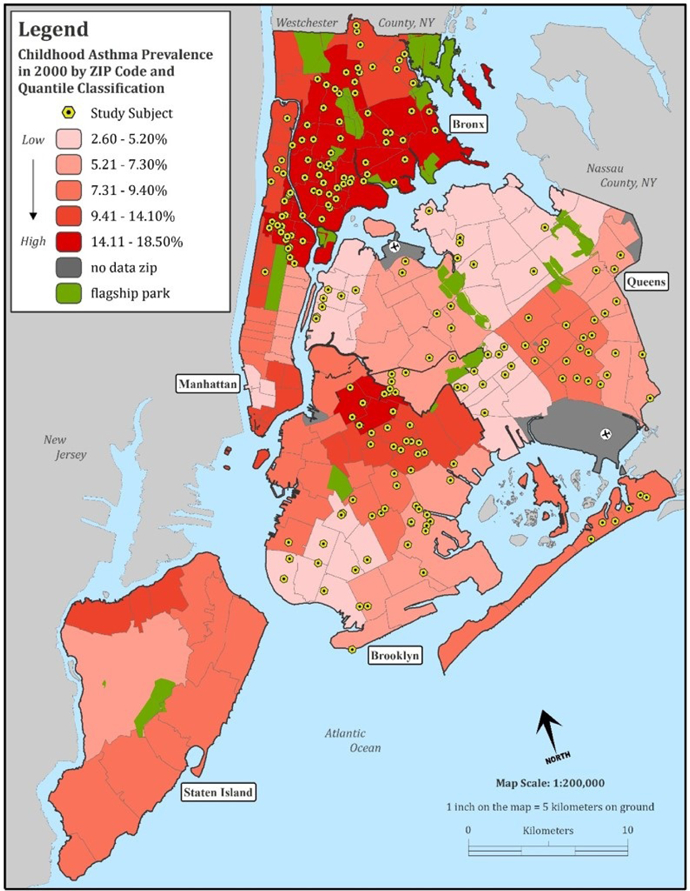
Social and environmental stressors may modify associations between environmental pollutants and asthma symptoms. We examined if neighborhood asthma prevalence (higher: HAPN vs. lower: LAPN), a surrogate for underlying risk factors for asthma, modified the relationship between pollutants and urgent asthma visits.
Through zip code, home addresses were linked to New York City Community Air Survey's land use regression model for street-level, annual average nitrogen dioxide (NO), particulate matter (PM), elemental carbon (EC), summer average ozone (O), winter average sulfur dioxide (SO) concentrations. Poisson regression models were fit to estimate the association (prevalence ratio, PR) between pollutant exposures and seeking urgent asthma care.
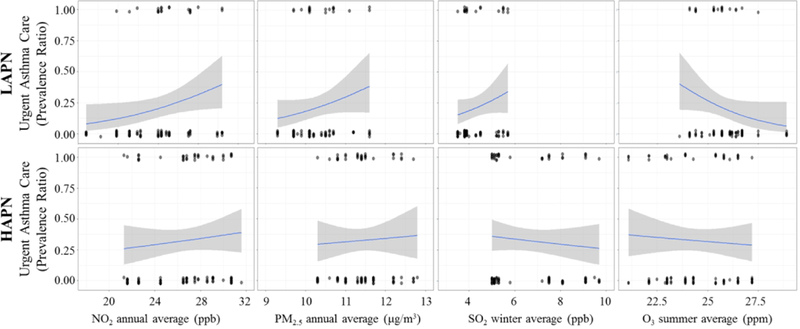
All pollutants, except O were higher in HAPN than LAPN (P < 0.01). Neighborhood asthma prevalence modified the relationship between pollutants and urgent asthma (P-interaction < 0.01, for NO and SO). Associations between pollutants and urgent asthma were observed only in LAPN (NO: PR = 1.38, P = 0.01; SO: PR = 1.85, P = 0.04). No association was observed between pollutants and urgent asthma among children in HAPN (P > 0.05).
Relationships between modeled street-level pollutants and urgent asthma were stronger in LAPN compared to HAPN. Social stressors that may be more prevalent in HAPN than LAPN, could play a greater role in asthma exacerbations in HAPN vs. pollutant exposure alone.
社会和环境压力因素可能会改变环境污染物与哮喘症状之间的关联。我们研究了邻里哮喘患病率(高:HAPN 与低:LAPN),即哮喘潜在风险因素的替代指标,是否会改变污染物与紧急哮喘就诊之间的关系。
通过邮政编码,将家庭住址与纽约市社区空气调查的街道水平、年平均二氧化氮(NO)、颗粒物(PM)、元素碳(EC)、夏季平均臭氧(O)、冬季平均二氧化硫(SO)浓度的土地使用回归模型相关联。采用泊松回归模型估计污染物暴露与紧急哮喘护理之间的关联(患病率比,PR)。
除 O 外,所有污染物在 HAPN 中的浓度均高于 LAPN(P<0.01)。邻里哮喘患病率改变了污染物与紧急哮喘之间的关系(P 交互<0.01,NO 和 SO)。仅在 LAPN 中观察到污染物与紧急哮喘之间存在关联(NO:PR=1.38,P=0.01;SO:PR=1.85,P=0.04)。在 HAPN 中,儿童中未观察到污染物与紧急哮喘之间存在关联(P>0.05)。
与模型化的街道水平污染物与紧急哮喘之间的关系在 LAPN 中比 HAPN 更强。HAPN 中比 LAPN 更普遍的社会压力因素可能在 HAPN 中比单独的污染物暴露更能导致哮喘恶化。