Lopez-Fernandez Ester, Sole Brisa, Jimenez Esther, Salagre Estela, Gimenez Anna, Murru Andrea, Bonnín Caterina Del Mar, Amann Benedikt Lorenz, Grande Iria, Vieta Eduard, Martínez-Aran Anabel
Unidad de Patología Dual, Hospital Santa Maria, Gestió de Serveis Sanitaris, Lleida, Spain.
Barcelona Bipolar Disorders Program, Institute of Neurosciences, IDIBAPS, CIBERSAM, Hospital Clinic, University of Barcelona, Barcelona, Spain.
Front Psychiatry. 2018 Oct 4;9:470. doi: 10.3389/fpsyt.2018.00470. eCollection 2018.
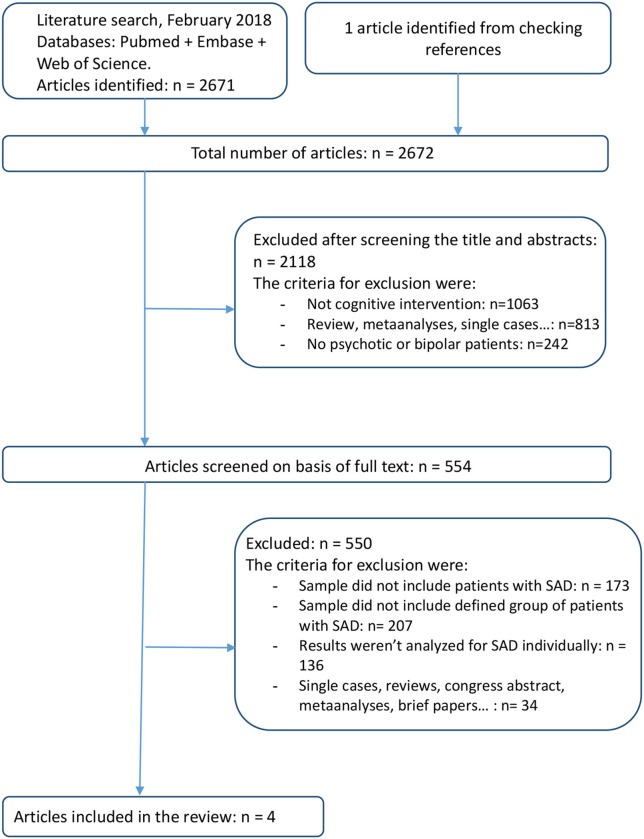
Patients with schizoaffective disorder (SAD) suffer from cognitive impairment, which negatively influences their functionality. Cognitive remediation (CR) interventions have been shown to be effective in patients with schizophrenia (SZ) and bipolar disorder (BD), but evidence in SAD is limited so far. The aim of this study is to systematically review the published data on CR interventions, either in neurocognition or social cognition, in patients with SAD. We conducted a comprehensive, computerized literature search using terms related to CR interventions in psychotic and affective disorders, and particularly in SAD. Pubmed, Embase, and Web of Knowledge databases were used up to February 28th, 2018 according to the Preferred Reporting Items for Systematic Reviews and Meta-Analyses (PRISMA) statement. The search returned 2672 articles of which four were finally selected meeting the inclusion criteria. Cognitive Enhancement Therapy, computerized Cognitive Remediation Therapy and Cognitive Training showed positive results in subsamples of patients with SAD regarding neurocognition and functioning in comparable terms to patients with schizophrenia as well as in a greater extent in quality of life. Benefits in social cognition were also described when Social Cognition Interaction Training was considered in patients with SAD. CR interventions seem to improve neurocognition and social cognition in patients with SAD as well as functioning and quality of life. However, further randomized controlled trials on CR interventions with an optimized design focusing on selected sample of patients with SAD are imperative.
分裂情感性障碍(SAD)患者存在认知障碍,这对他们的功能产生负面影响。认知康复(CR)干预已被证明对精神分裂症(SZ)和双相情感障碍(BD)患者有效,但目前SAD方面的证据有限。本研究的目的是系统回顾已发表的关于SAD患者神经认知或社会认知方面CR干预的数据。我们使用与精神病性和情感性障碍,特别是SAD中的CR干预相关的术语进行了全面的计算机文献检索。根据系统评价和Meta分析的首选报告项目(PRISMA)声明,截至2018年2月28日使用了PubMed、Embase和Web of Knowledge数据库。检索返回2672篇文章,最终选择了4篇符合纳入标准的文章。认知增强疗法、计算机化认知康复疗法和认知训练在SAD患者亚组的神经认知和功能方面显示出积极结果,与精神分裂症患者相当,并且在生活质量方面有更大程度的改善。当考虑对SAD患者进行社会认知互动训练时,也描述了在社会认知方面的益处。CR干预似乎能改善SAD患者的神经认知和社会认知以及功能和生活质量。然而,迫切需要针对SAD患者选定样本进行优化设计的CR干预的进一步随机对照试验。