Department of Endocrinology and Metabolism, The First Affiliated Hospital of School of Medicine, Zhejiang University, Hangzhou, China.
State Key Laboratory for Diagnosis and Treatment of Infectious Diseases, Collaborative Innovation Center for Diagnosis and Treatament of Infectious Diseases, The First Affiliated Hospital of School of Medicine, Zhejiang University, Hangzhou, China.
J Cell Mol Med. 2018 Dec;22(12):6167-6175. doi: 10.1111/jcmm.13902. Epub 2018 Oct 19.
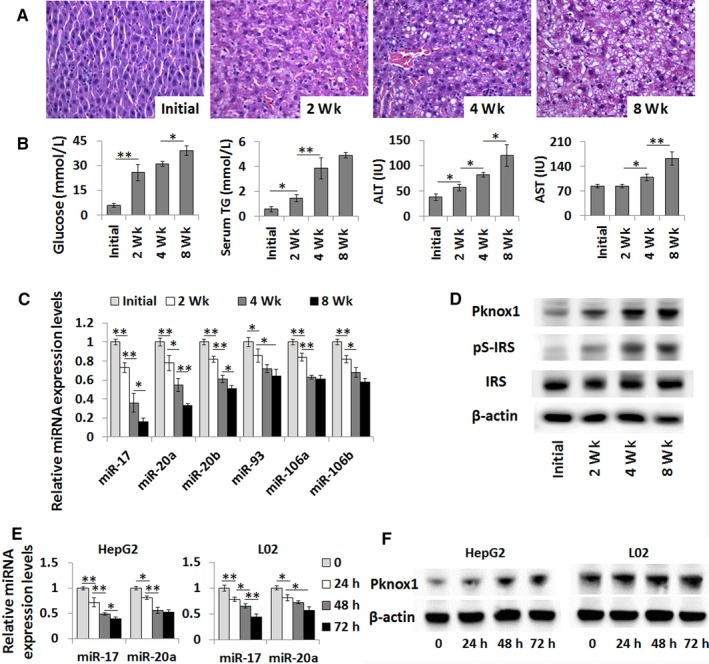
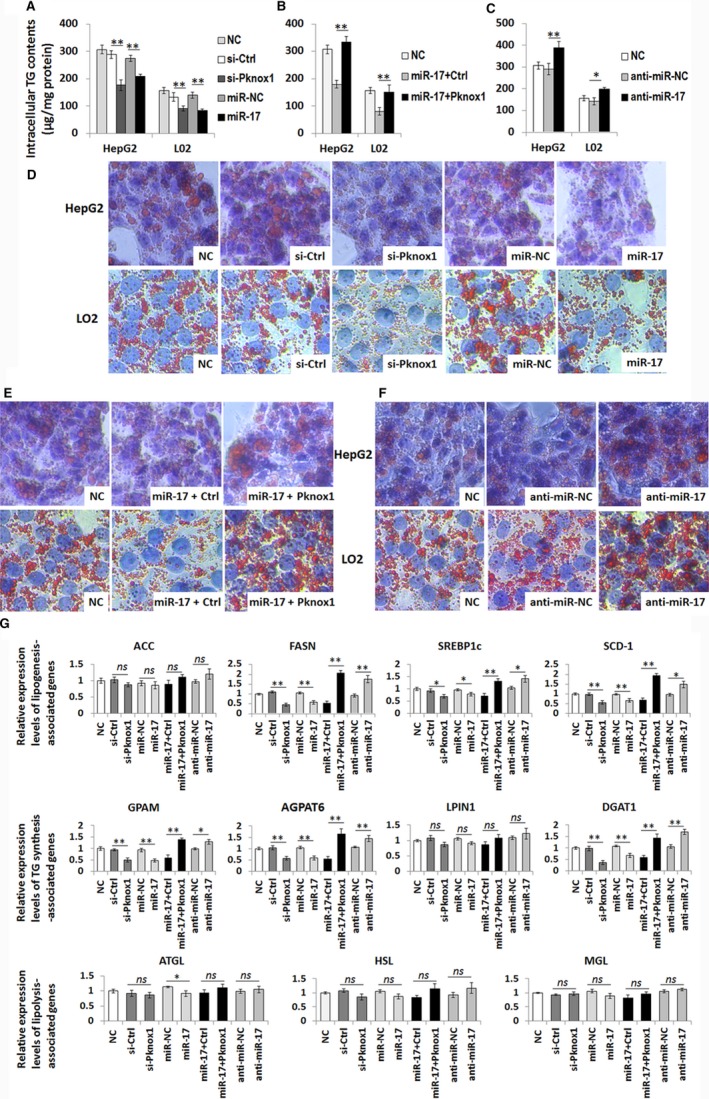
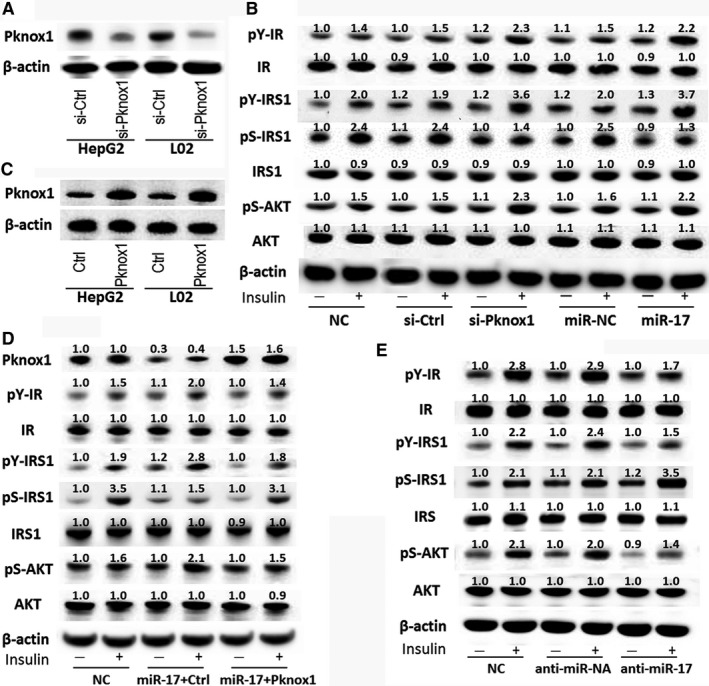
The aberrant expression of Pknox1 is associated with hepatic glucose and lipid dysmetabolism status of type 2 diabetes mellitus (T2DM) and nonalcoholic fatty liver disease (NAFLD). However, the underlying mechanism causing Pknox1 overexpression in this pathological status remains unclear. By using miRNA target prediction programs, we found that the 3'-UTR of the Pknox1 mRNA sequence contains highly conserved target sites of miR-17 family. In a rat model of streptozotocin and high-fat diet-induced T2DM and NAFLD complication, the increased hepatic expression of Pknox1 was consistent with decreased expressions of miR-17 family, especially miR-17 and miR-20a. Furthermore, an inverse correlation was observed between Pknox1 and miR-17 and miR-20a in free fatty acids-induced hepatocyte steatosis. Dual-luciferase reporter assay further showed that Pknox1 was a valid target gene of miR-17 family. The ectopic expression of miR-17 or miR-20a could markedly suppress Pknox1 expression in hepatocytes. MiR-17 or miR-20a overexpression also resulted in significantly enhanced insulin sensitivity and reduced hepatocyte steatosis in HepG2 and L02 cells, which were determined by altered phosphorylation on insulin receptor signaling pathway proteins and decreased intracellular triglyceride and lipid accumulation, respectively. These data implicate the upregulated hepatic expression of Pknox1 in T2DM complicated with NAFLD may be caused by the reduced expression of miR-17 family, indicating that developing miRNA-mediated regulation strategies on Pknox1 may provide new therapeutic options for metabolic disease.
Pknox1 的异常表达与 2 型糖尿病(T2DM)和非酒精性脂肪性肝病(NAFLD)的肝葡萄糖和脂质代谢紊乱状态有关。然而,导致这种病理状态下 Pknox1 过表达的潜在机制尚不清楚。通过使用 miRNA 靶标预测程序,我们发现 Pknox1 mRNA 序列的 3'-UTR 包含 miR-17 家族的高度保守靶标位点。在链脲佐菌素和高脂肪饮食诱导的 T2DM 和 NAFLD 并发症大鼠模型中,肝 Pknox1 表达增加与 miR-17 家族,尤其是 miR-17 和 miR-20a 的表达降低一致。此外,在游离脂肪酸诱导的肝细胞脂肪变性中观察到 Pknox1 与 miR-17 和 miR-20a 之间呈负相关。双荧光素酶报告基因检测进一步表明 Pknox1 是 miR-17 家族的有效靶基因。miR-17 或 miR-20a 的异位表达可显著抑制肝细胞中 Pknox1 的表达。miR-17 或 miR-20a 的过表达也导致 HepG2 和 L02 细胞中胰岛素敏感性显著增强,肝细胞脂肪变性减少,这是通过胰岛素受体信号通路蛋白磷酸化的改变和细胞内甘油三酯和脂质积累的减少来确定的。这些数据表明,T2DM 合并 NAFLD 时肝 Pknox1 的上调表达可能是由于 miR-17 家族表达降低所致,表明针对 Pknox1 的 miRNA 介导的调节策略可能为代谢性疾病提供新的治疗选择。