Lehrstuhl für Tissue Engineering und Regenerative Medizin, Universitätsklinikum Würzburg, Röntgenring 11, 97222 Würzburg, Germany.
Fraunhofer Institut für Silicatforschung, Translationszentrum TLZ-RT, Röntgenring 11, 97222 Würzburg, Germany.
Int J Mol Sci. 2018 Oct 18;19(10):3220. doi: 10.3390/ijms19103220.
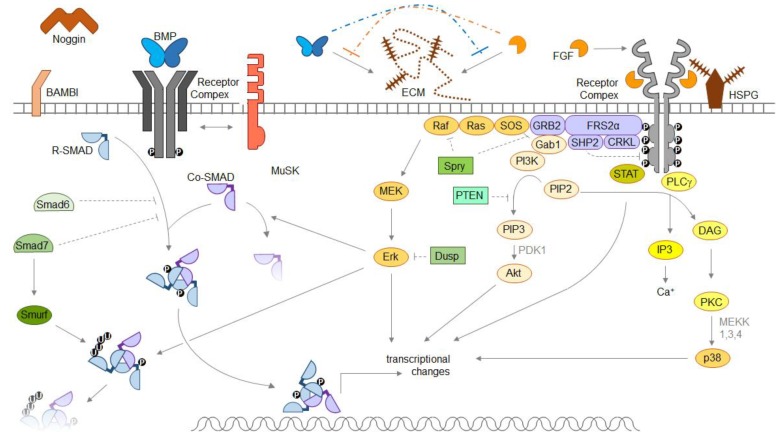
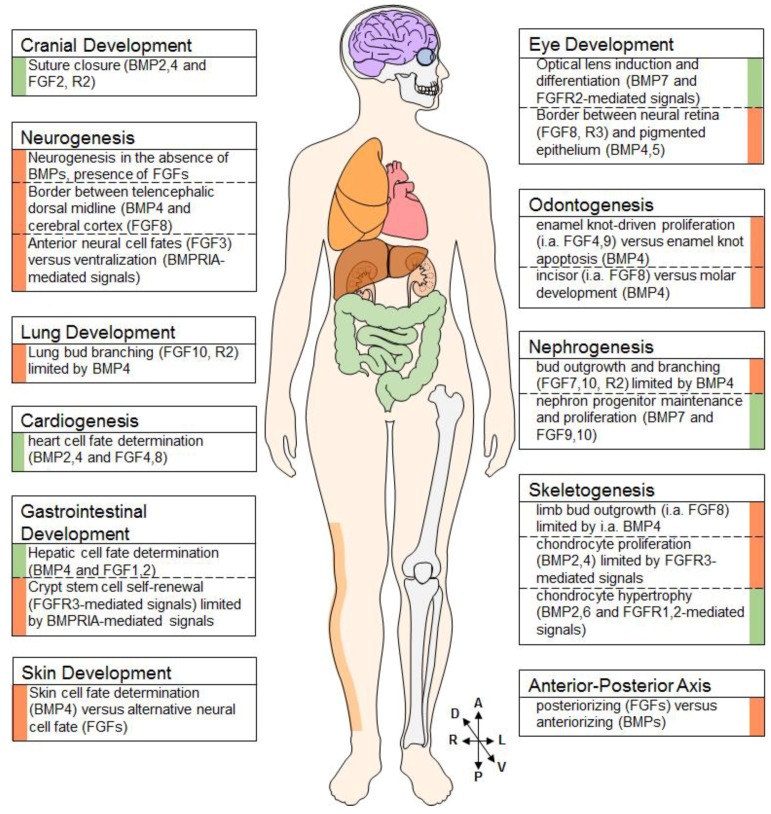
Ontogeny of higher organisms as well the regulation of tissue homeostasis in adult individuals requires a fine-balanced interplay of regulating factors that individually trigger the fate of particular cells to either stay undifferentiated or to differentiate towards distinct tissue specific lineages. In some cases, these factors act synergistically to promote certain cellular responses, whereas in other tissues the same factors antagonize each other. However, the molecular basis of this obvious dual signaling activity is still only poorly understood. Bone morphogenetic proteins (BMPs) and fibroblast growth factors (FGFs) are two major signal protein families that have a lot in common: They are both highly preserved between different species, involved in essential cellular functions, and their ligands vastly outnumber their receptors, making extensive signal regulation necessary. In this review we discuss where and how BMP and FGF signaling cross paths. The compiled data reflect that both factors synchronously act in many tissues, and that antagonism and synergism both exist in a context-dependent manner. Therefore, by challenging a generalization of the connection between these two pathways a new chapter in BMP FGF signaling research will be introduced.
高等生物的个体发生以及成体组织的稳态调控都需要精细平衡的调节因子相互作用,这些因子分别触发特定细胞的命运,使其保持未分化状态或分化为特定的组织谱系。在某些情况下,这些因子协同作用以促进某些细胞反应,而在其他组织中,相同的因子则相互拮抗。然而,这种明显的双重信号活性的分子基础仍知之甚少。骨形态发生蛋白(BMPs)和成纤维细胞生长因子(FGFs)是两个主要的信号蛋白家族,它们有很多共同点:它们在不同物种之间高度保守,参与基本的细胞功能,其配体远远超过其受体,这就需要广泛的信号调控。在这篇综述中,我们讨论了 BMP 和 FGF 信号通路在哪里以及如何交叉。综合数据表明,这两个因子在许多组织中同步作用,并且拮抗和协同作用都以依赖于上下文的方式存在。因此,通过挑战这两种途径之间联系的概括,BMP FGF 信号研究将进入一个新的篇章。