Haartman Institute, University of Helsinki, Helsinki, Finland.
Skin and Allergy Hospital, Helsinki University Hospital and University of Helsinki, Helsinki, Finland.
BMJ Open. 2018 Oct 18;8(10):e022173. doi: 10.1136/bmjopen-2018-022173.
Endoscopic sinus surgery (ESS) is a common operation typically performed due to chronic rhinosinusitis (CRS). There are limited data on the nationwide ESS rate and factors contributing to its regional variation. The aim was to evaluate factors causing variation of ESS rate.
Cross-sectional nationwide observational study.
A ll patients undergoing ESS in Finland 2013-2015.
Nationwide Finnish population aged 15 years or over.
ESS rate per 1000 inhabitants between 2013 and 2015 in all 21 hospital districts and independent factors for multilevel model analyses.
We used the Finnish register data of all patients with CRS who underwent ESS in 2013-2015. Patients aged under 15 years and those with ESS due to neoplasia were excluded. The age and gender standardised ESS rates were calculated, and multilevel Poisson regression models were used to evaluate variation in ESS in the 21 hospital districts. The likelihood ratio test was applied to assess the statistical significance of random components in the models.
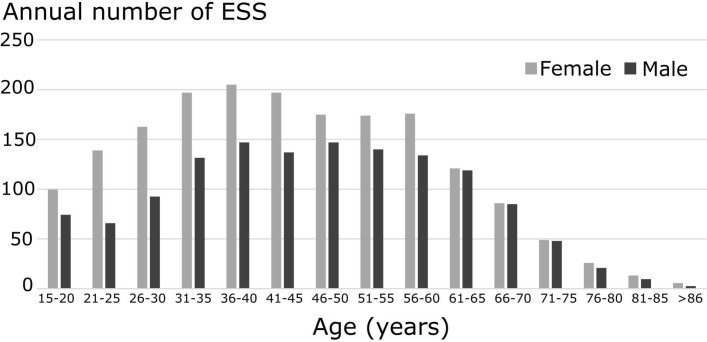
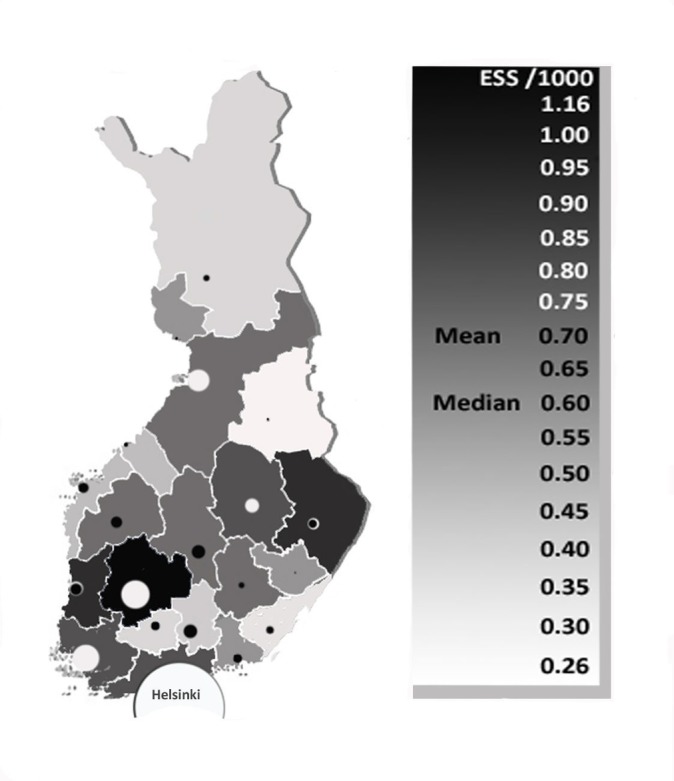
The nationwide annual rate of ESS is 0.71 per 1000 people in Finland. Hospital district rates varied from 0.25/1000 (95% CI 0.18 to 0.32) to 1.15/1000 (95% CI 1.09 1.21). Compared with males, females undergo ESS significantly more frequently (57% of the procedures), more often due to CRS without nasal polyps, and at a younger age (mean age 44.2 and 46.2 years, correspondingly). Multilevel analyses showed that lower age (between 24 years and 45 years) and availability/ease of medical services were independently associated with higher ESS rates.
This study confirms marked regional variation in the ESS rate in Finland, explained only in part by patients' age and differing availability of medical services. To analyse ESS across different CRS phenotypes or to compare quality registers on ESS properly, more research on regional variation is needed.
内镜鼻窦手术(ESS)是一种常见的手术,通常因慢性鼻-鼻窦炎(CRS)而行。关于全国 ESS 率及其区域差异的影响因素的数据有限。本研究旨在评估导致 ESS 率差异的因素。
全国性横断面观察性研究。
芬兰所有 2013-2015 年接受 ESS 的患者。
所有年龄在 15 岁及以上的芬兰人群。
2013 年至 2015 年期间所有 21 个医院区的每 1000 名居民的 ESS 率以及多水平模型分析的独立因素。
我们使用芬兰登记处的数据,纳入所有 2013-2015 年因 CRS 行 ESS 的患者。排除年龄<15 岁和因肿瘤而行 ESS 的患者。计算年龄和性别标准化 ESS 率,并使用多水平泊松回归模型评估 21 个医院区的 ESS 差异。应用似然比检验评估模型中随机成分的统计学意义。
芬兰全国 ESS 的年发生率为每 1000 人 0.71 例。医院区 ESS 率从 0.25/1000(95%CI 0.18 至 0.32)到 1.15/1000(95%CI 1.09 至 1.21)不等。与男性相比,女性行 ESS 的频率显著更高(57%的手术),更多是因为无鼻息肉的 CRS,且年龄更小(平均年龄 44.2 岁和 46.2 岁)。多水平分析显示,年龄较小(24 岁至 45 岁)和医疗服务的可及性/便利性与 ESS 率升高独立相关。
本研究证实了芬兰 ESS 率存在明显的区域差异,仅部分可由患者年龄和不同的医疗服务可及性解释。要对不同 CRS 表型的 ESS 进行分析或对 ESS 的质量登记进行适当比较,需要对区域差异进行更多研究。