Oregon Health & Science University, Portland.
Universitätsmedizin Berlin and German Rheumatism Research Centre, Berlin, Germany.
Arthritis Rheumatol. 2019 Apr;71(4):599-611. doi: 10.1002/art.40753. Epub 2019 Mar 8.
To investigate the efficacy and safety of ixekizumab in patients with active radiographic axial spondyloarthritis (SpA) and prior inadequate response to or intolerance of 1 or 2 tumor necrosis factor inhibitors (TNFi).
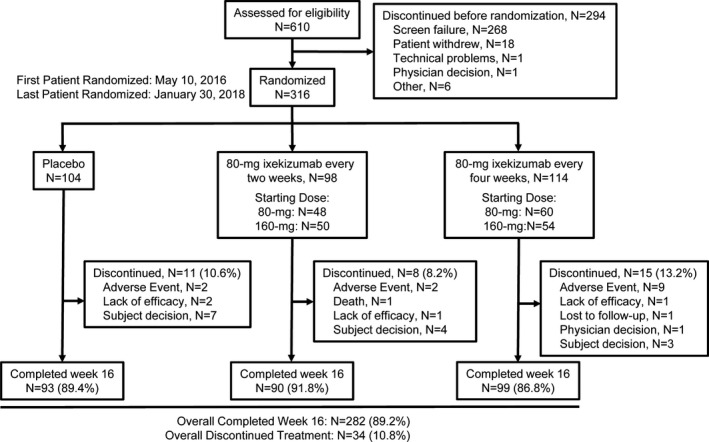
In this phase III randomized, double-blind, placebo-controlled trial, adult patients with an inadequate response to or intolerance of 1 or 2 TNFi and an established diagnosis of axial SpA (according to the Assessment of SpondyloArthritis international Society [ASAS] criteria for radiographic axial SpA, with radiographic sacroiliitis defined according to the modified New York criteria and ≥1 feature of SpA) were recruited and randomized 1:1:1 to receive placebo or 80-mg subcutaneous ixekizumab every 2 weeks (IXEQ2W) or 4 weeks (IXEQ4W), with an 80-mg or 160-mg starting dose. The primary end point was 40% improvement in disease activity according to the ASAS criteria (ASAS40) at week 16. Secondary outcomes and safety were also assessed.
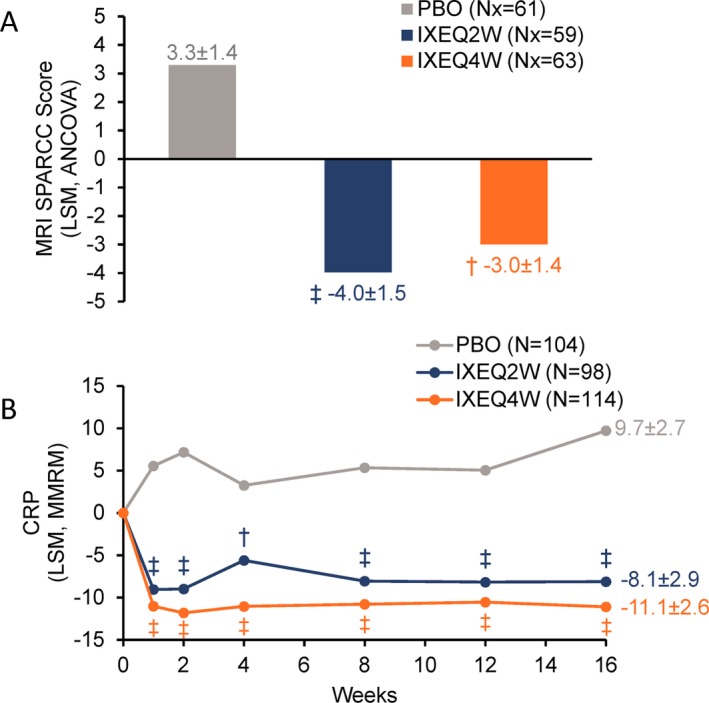
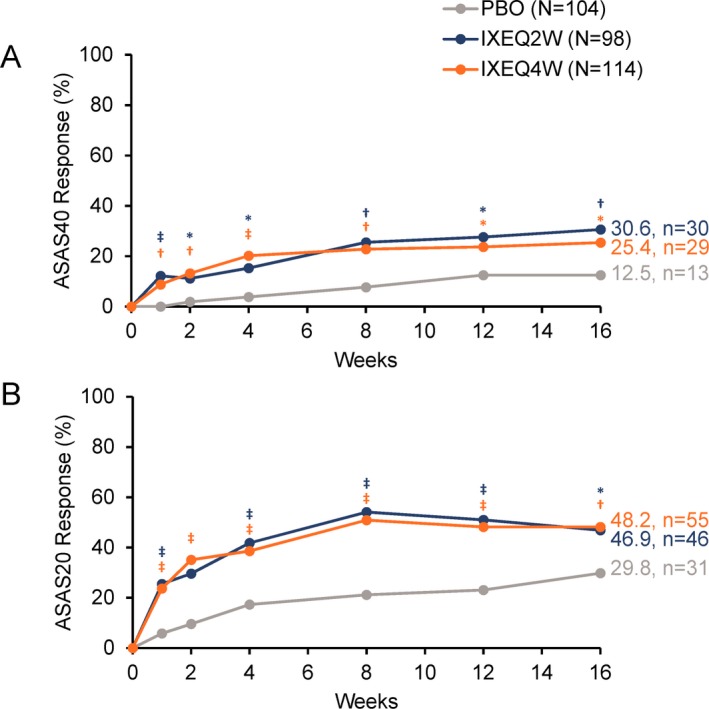
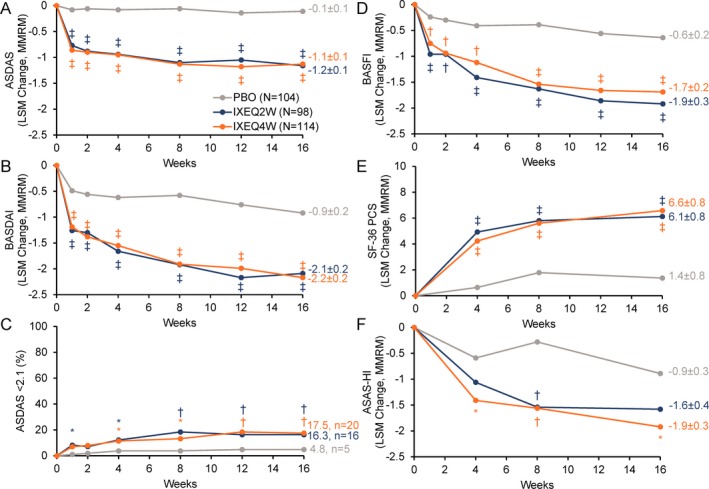
A total of 316 patients were randomized to receive placebo (n = 104), IXEQ2W (n = 98), or IXEQ4W (n = 114). At week 16, significantly higher proportions of IXEQ2W patients (n = 30 [30.6%]; P = 0.003) or IXEQ4W patients (n = 29 [25.4%]; P = 0.017) had achieved an ASAS40 response versus the placebo group (n = 13 [12.5%]), with statistically significant differences reported as early as week 1 with ixekizumab treatment. Statistically significant improvements in disease activity, function, quality of life, and spinal magnetic resonance imaging-evident inflammation were observed after 16 weeks of ixekizumab treatment versus placebo. Treatment-emergent adverse events (AEs) with ixekizumab treatment were more frequent than with placebo. Serious AEs were similar across treatment arms. One death was reported (IXEQ2W group).
Ixekizumab treatment for 16 weeks in patients with active radiographic axial SpA and previous inadequate response to or intolerance of 1 or 2 TNFi yields rapid and significant improvements in the signs and symptoms of radiographic axial SpA versus placebo.
评估依奇珠单抗在影像学中轴型脊柱关节炎(SpA)活跃且先前对 1 种或 2 种肿瘤坏死因子抑制剂(TNFi)反应不足或不耐受的患者中的疗效和安全性。
在这项 III 期随机、双盲、安慰剂对照试验中,招募了对 1 种或 2 种 TNFi 反应不足或不耐受且已确诊为中轴型 SpA(根据评估脊柱关节炎国际协会[ASAS]标准对影像学中轴型 SpA 的标准,改良纽约标准定义的放射性骶髂关节炎,以及≥1 项 SpA 特征)的成年患者,并将其以 1:1:1 的比例随机分配接受安慰剂或每 2 周(IXEQ2W)或 4 周(IXEQ4W)皮下注射 80mg 依奇珠单抗,起始剂量为 80mg 或 160mg。主要终点为第 16 周时 ASAS 标准(ASAS40)下疾病活动度改善 40%。还评估了次要结局和安全性。
共有 316 名患者被随机分配接受安慰剂(n = 104)、IXEQ2W(n = 98)或 IXEQ4W(n = 114)。在第 16 周时,IXEQ2W 组(n = 30 [30.6%];P = 0.003)或 IXEQ4W 组(n = 29 [25.4%];P = 0.017)的患者与安慰剂组(n = 13 [12.5%])相比,有更高比例的患者达到 ASAS40 缓解,且从依奇珠单抗治疗开始的第 1 周就有统计学显著差异。与安慰剂相比,在接受依奇珠单抗治疗 16 周后,患者的疾病活动度、功能、生活质量和脊柱磁共振成像显示的炎症均有显著改善。接受依奇珠单抗治疗的患者中治疗出现的不良事件(AE)比安慰剂组更常见。各治疗组的严重 AE 相似。报告了 1 例死亡(IXEQ2W 组)。
在影像学中轴型 SpA 活跃且先前对 1 种或 2 种 TNFi 反应不足或不耐受的患者中,依奇珠单抗治疗 16 周可快速显著改善影像学中轴型 SpA 的体征和症状,优于安慰剂。