Li Lei, Lv Yanping, Yan Dengfeng
Department of Respiration, Zhoukou Central Hospital, Zhoukou, Henan 466000, P.R. China.
Oncol Lett. 2018 Nov;16(5):5645-5654. doi: 10.3892/ol.2018.9391. Epub 2018 Sep 4.
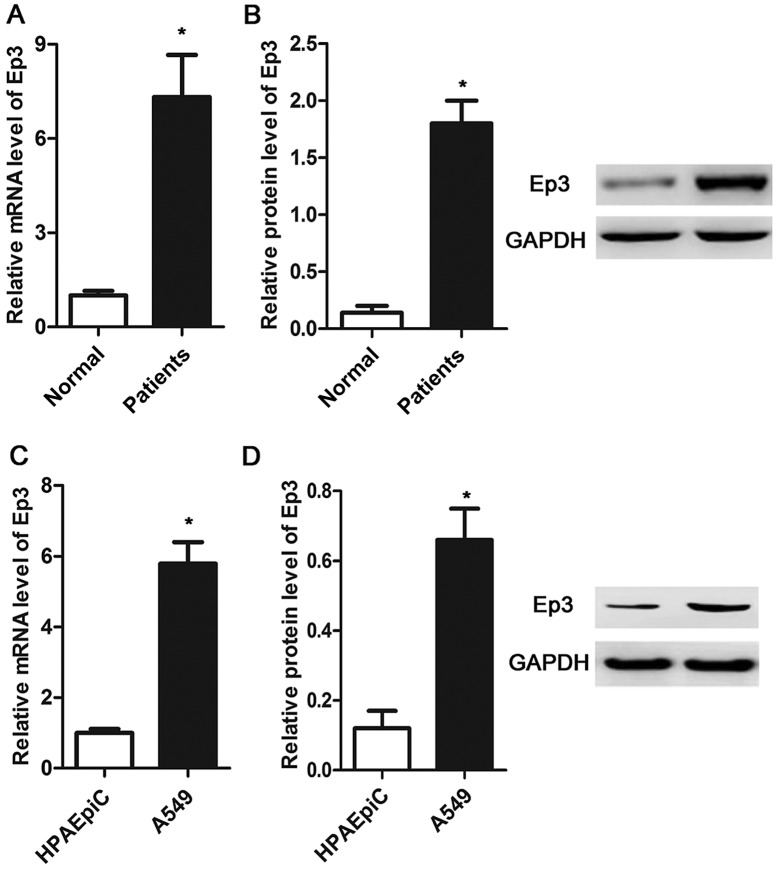
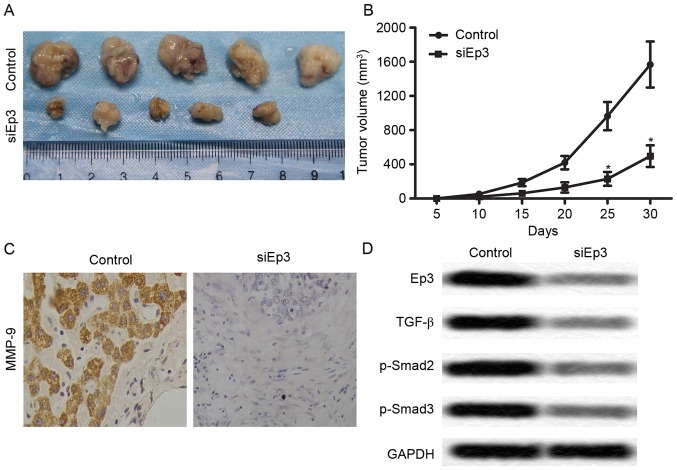
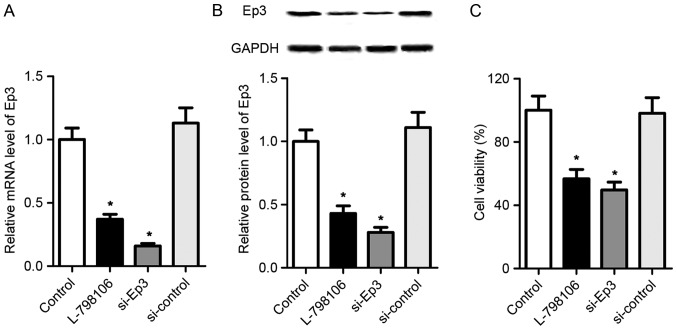
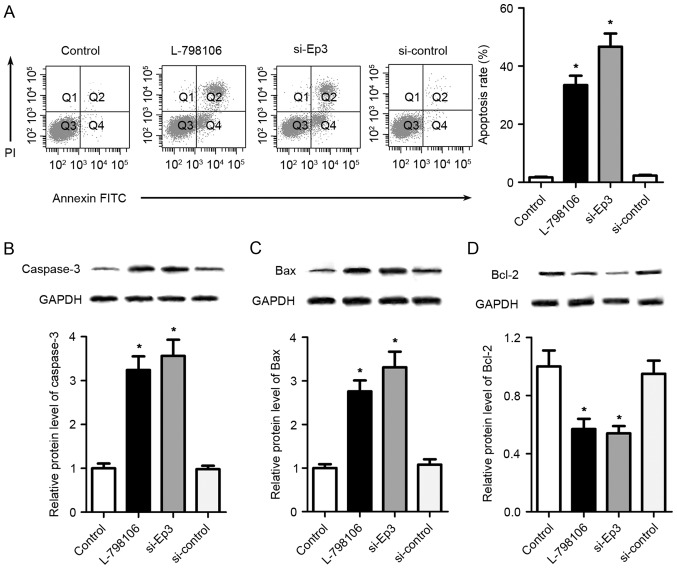
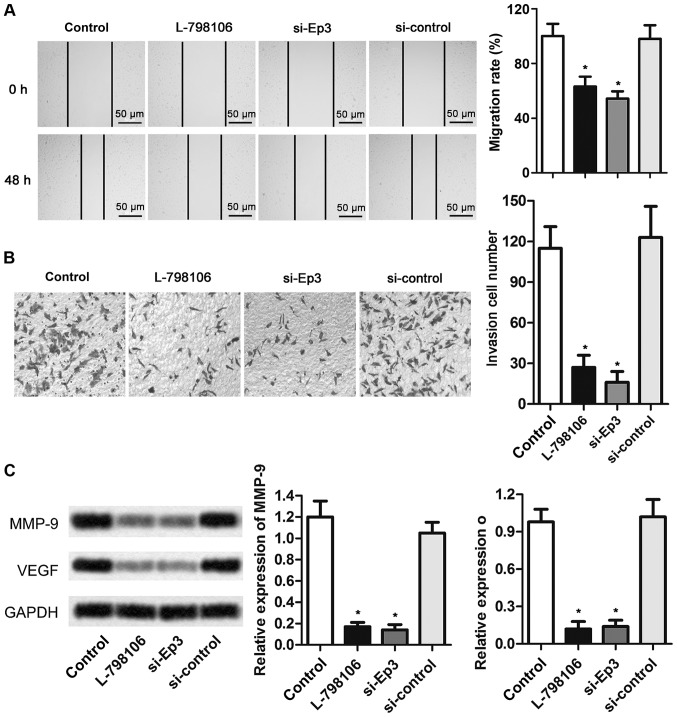
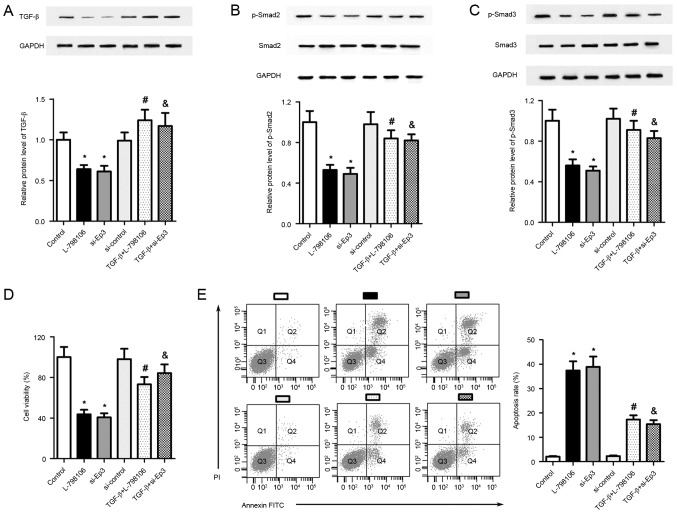
Non-small cell lung cancer (NSCLC) is the most common cause of cancer-associated mortality worldwide. Prostaglandin E2 (PGE2) regulates various biological processes, including invasion, proliferation and apoptosis. E-prostanoid 3 (Ep3) is a PGE2 receptor, and the functional role of Ep3 in the progression of NSCLC remains unresolved. The present study investigated the effects of Ep3 in A549 cells and explored the underlying molecular mechanisms. The results revealed that the mRNA and protein expression levels of Ep3 were significantly upregulated in NSCLC tissues and A549 cells. Pharmacological inhibition of Ep3 or RNA interference against Ep3 attenuated the cell viability, migration and invasion, and promoted apoptosis in A549 cells. Ep3 deficiency also decreased the expression of transforming growth factor (TGF)-β, phosphorylated (p)-Smad2 and p-Smad3. The transfection of TGF-β overexpression plasmids reversed the effects of Ep3 deficiency on the cell viability and apoptosis in A549 cells. Finally, an experiment revealed that Ep3-siRNA transfection strongly reduced the tumor growth and tumor volume. The Ep3-siRNA transfection also inhibited tumor metastasis via suppression of the expression of metastasis-associated proteins. Taken together, these findings indicate that inhibition of Ep3 attenuates the viability and migration, and promotes the apoptosis of NSCLC through suppression of the TGF-β/Smad signaling pathway. Targeting of the Ep3/TGF-β/Smad signaling pathway may be a novel therapeutic strategy for the prevention and treatment of NSCLC.
非小细胞肺癌(NSCLC)是全球癌症相关死亡的最常见原因。前列腺素E2(PGE2)调节多种生物学过程,包括侵袭、增殖和凋亡。前列腺素E受体3(Ep3)是一种PGE2受体,Ep3在NSCLC进展中的功能作用仍未明确。本研究调查了Ep3对A549细胞的影响,并探讨了其潜在的分子机制。结果显示,Ep3的mRNA和蛋白表达水平在NSCLC组织和A549细胞中显著上调。对Ep3的药理学抑制或针对Ep3的RNA干扰减弱了A549细胞的活力、迁移和侵袭,并促进了其凋亡。Ep3缺陷还降低了转化生长因子(TGF)-β、磷酸化(p)-Smad2和p-Smad3的表达。TGF-β过表达质粒的转染逆转了Ep3缺陷对A549细胞活力和凋亡的影响。最后,一项实验表明,Ep3-siRNA转染显著降低了肿瘤生长和肿瘤体积。Ep3-siRNA转染还通过抑制转移相关蛋白的表达抑制了肿瘤转移。综上所述,这些发现表明抑制Ep3可通过抑制TGF-β/Smad信号通路减弱NSCLC的活力和迁移,并促进其凋亡。靶向Ep3/TGF-β/Smad信号通路可能是预防和治疗NSCLC的一种新的治疗策略。