Department of Anesthesiology, Critical Care and Pain Medicine, The Second Affiliated Hospital and Yuying Children's Hospital of Wenzhou Medical University, Wenzhou, Zhejiang 325000, China.
Department of Orthopedics, Ningbo Yinzhou Second Hospital, Ningbo, Zhejiang 315100, China.
Biomed Res Int. 2018 Sep 24;2018:9658216. doi: 10.1155/2018/9658216. eCollection 2018.
Several investigators have sought risk factors for mortality in acute kidney injury (AKI). However, no epidemiological studies have investigated the impact of red blood cell distribution width (RDW) on prognosis for critically ill patients with AKI. The aim of this study was to investigate the association of RDW with mortality in these patients.
We analyzed data from the MIMIC-III. RDW was measured upon ICU admission. The association between RDW and mortality of AKI was determined using a multivariate logistic regression and was expressed as the adjusted odds ratio with associated 95% confidence interval (CI). We also conducted subgroup analyses to determine the consistency of this association.
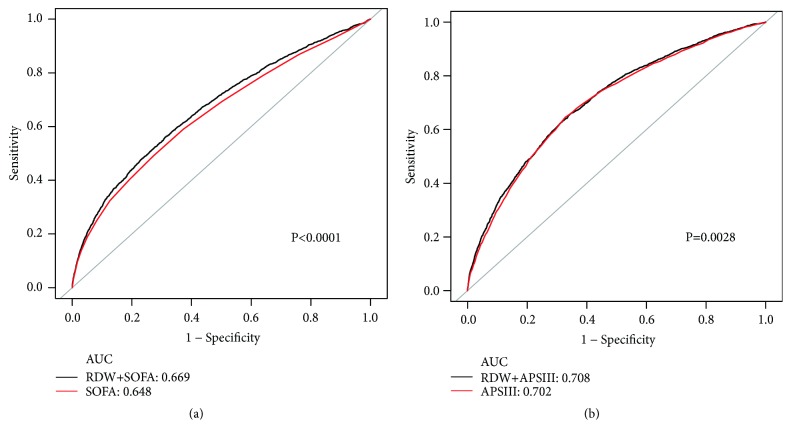
A total of 14,078 critically ill patients with AKI were eligible for this analysis. In multivariate analysis, adjusted for age and gender and compared with the reference group (RDW 11.1-13.4%) related to hospital mortality, the adjusted ORs (95% CIs) for RDW levels 13.5-14.3%, 14.4-15.6%, and 15.7-21.2% were 1.22 (1.05, 1.43), 1.56 (1.35, 1.81), and 2.66 (2.31, 3.06), respectively. After adjusting for confounding factors, with high RDW linked to an increase in mortality (RDW 15.7-21.2% versus 11.1-13.4%: OR, 1.57; 95% CI, 1.22 to 2.01; trend <0.0001). A similar trend was observed for 30-day mortality.
RDW appeared to be an independent prognostic marker in critically ill patients with AKI and higher RDW was associated with increased risk of mortality in these patients.
一些研究人员已经在寻找急性肾损伤(AKI)患者死亡的风险因素。然而,没有流行病学研究调查红细胞分布宽度(RDW)对 AKI 重症患者预后的影响。本研究旨在探讨 RDW 与这些患者死亡率之间的关系。
我们分析了 MIMIC-III 数据库的数据。在 ICU 入院时测量了 RDW。使用多变量逻辑回归确定 RDW 与 AKI 死亡率之间的关系,并表示为调整后的优势比及其相关的 95%置信区间(CI)。我们还进行了亚组分析,以确定这种关联的一致性。
共有 14078 例 AKI 重症患者符合本分析的条件。在多变量分析中,与年龄和性别调整后与医院死亡率相关的参考组(RDW 11.1-13.4%)相比,RDW 水平 13.5-14.3%、14.4-15.6%和 15.7-21.2%的调整后的比值比(95%CI)分别为 1.22(1.05,1.43)、1.56(1.35,1.81)和 2.66(2.31,3.06)。在调整混杂因素后,RDW 与死亡率增加相关(RDW 15.7-21.2%与 11.1-13.4%:OR,1.57;95%CI,1.22 至 2.01;趋势<0.0001)。30 天死亡率也观察到类似的趋势。
RDW 似乎是 AKI 重症患者的独立预后标志物,较高的 RDW 与这些患者的死亡率增加相关。