Department of Nephrology, Xuanwu Hospital, Capital Medical University, Changchun Street 45#, 100053, Beijing, China.
Department of Vascular Surgery, Xuanwu Hospital, Capital Medical University, Changchun Street 45#, 100053, Beijing, China.
Sci Rep. 2020 Mar 12;10(1):4563. doi: 10.1038/s41598-020-61516-y.
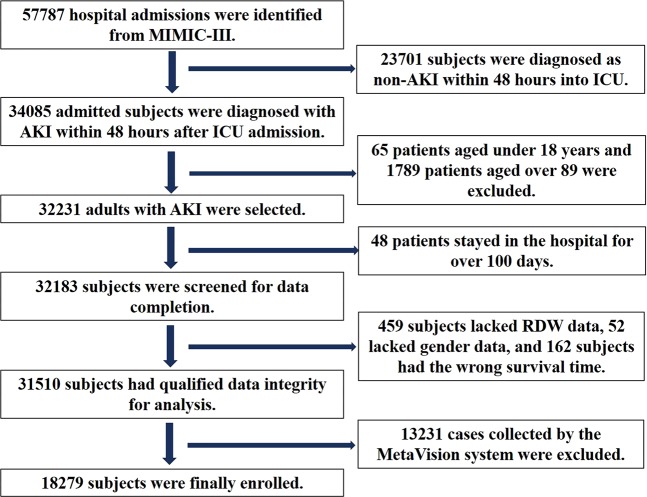
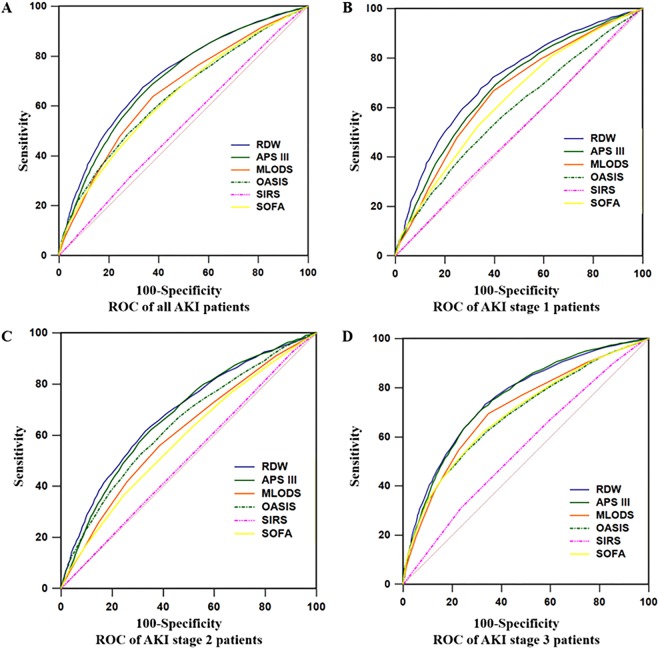
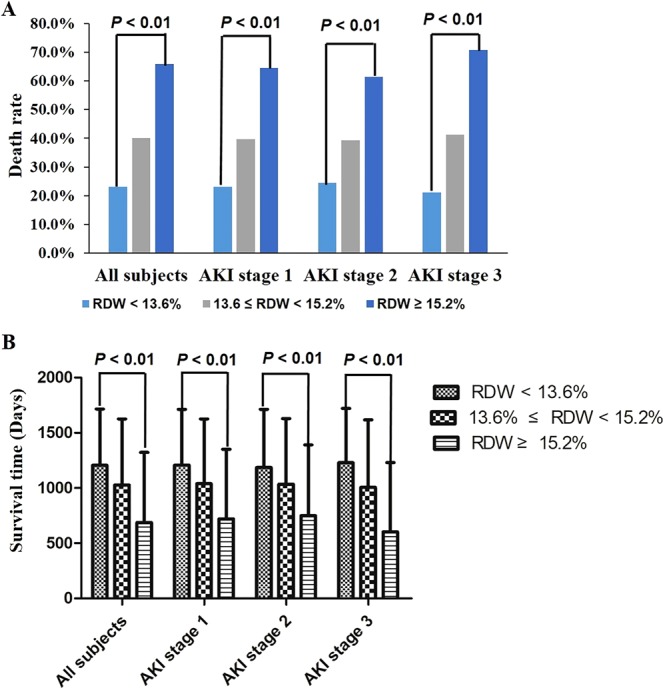
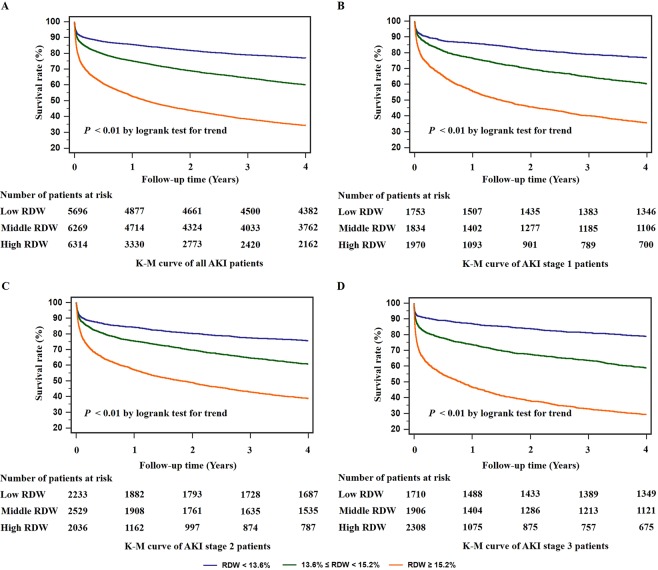
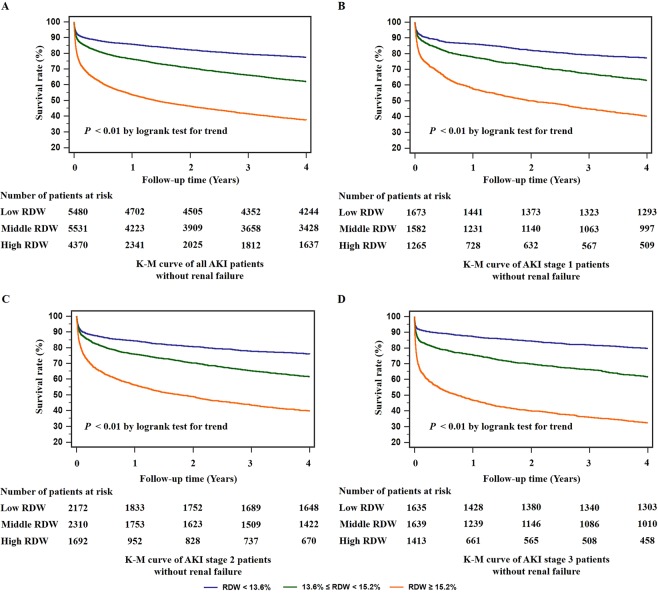
Acute kidney injury (AKI) is a serious complication in the intensive care unit (ICU), which may increase the mortality of critically ill patients. The red blood cell distribution width (RDW) has proved useful as a predictor of short-term prognosis in critically ill patients with AKI. However, it remains unknown whether RDW has a prognostic value of long-term all-cause mortality in these patients. The data of 18279 critically ill patients with AKI at first-time hospital admission were extracted from the Medical Information Mart for Intensive Care III (MIMIC-III) database. The tertiles of the RDW values were used to divide subjects into three groups, namely RDW < 13.6% for the low RDW group, 13.6% ≤ RDW < 15.2% for the middle RDW group and RDW ≥ 15.2% for the high RDW group. Demographic data, mortality, 4-year survival time and severity scale scores were compared among groups. The Kaplan-Meier analysis and the Cox regression analysis were performed to assess the impact of RDW on all-cause mortality in AKI patients. The receiver operating characteristic (ROC) curve analysis was done to evaluate the prognostic value of RDW on the long-term outcome of critically ill patients with AKI. The median age of the enrolled subjects was 65.6 years. AKI patients with a higher RDW value had significantly shorter survival time and higher death rate. By the Kaplan-Meier analysis, patients in the higher RDW group presented significantly shorter survival time and higher death rate. The Cox regression model indicated RDW as an independent risk factor of all-cause mortality of AKI patients (HR 1.219, 95% CI, 1.211 to 1.228). By the ROC analysis, RDW appeared more efficient in predicting long-term prognosis as compared with conventional severity scales. The AUC of RDW (95% CI, 0.712 to 0.725) was significantly higher than other severity scale scores. In conclusion, RDW is positively correlated to survival time of 4-year follow-up in critically ill patients with AKI, and RDW is an independent prognostic factor of long-term outcomes of these patients.
急性肾损伤 (AKI) 是重症监护病房 (ICU) 的严重并发症,可能增加危重病患者的死亡率。红细胞分布宽度 (RDW) 已被证明可作为预测 AKI 危重病患者短期预后的有用指标。然而,目前尚不清楚 RDW 是否对这些患者的长期全因死亡率具有预后价值。从 Medical Information Mart for Intensive Care III (MIMIC-III) 数据库中提取了首次住院的 18279 例 AKI 危重病患者的数据。RDW 值的三分位值用于将受试者分为三组,即 RDW < 13.6%为低 RDW 组,13.6%≤RDW < 15.2%为中 RDW 组,RDW≥15.2%为高 RDW 组。比较各组的人口统计学数据、死亡率、4 年生存时间和严重程度评分。进行 Kaplan-Meier 分析和 Cox 回归分析评估 RDW 对 AKI 患者全因死亡率的影响。进行受试者工作特征 (ROC) 曲线分析评估 RDW 对 AKI 危重病患者长期预后的预测价值。纳入受试者的中位年龄为 65.6 岁。RDW 值较高的 AKI 患者的生存时间明显更短,死亡率更高。通过 Kaplan-Meier 分析,RDW 较高组的患者生存时间明显更短,死亡率更高。Cox 回归模型表明 RDW 是 AKI 患者全因死亡率的独立危险因素 (HR 1.219,95%CI,1.211 至 1.228)。通过 ROC 分析,RDW 预测长期预后的效率明显高于传统严重程度评分。RDW 的 AUC(95%CI,0.712 至 0.725)明显高于其他严重程度评分。总之,RDW 与 AKI 危重病患者 4 年随访的生存时间呈正相关,RDW 是这些患者长期预后的独立预测因素。