Department of Microbiology and Immunology, University of Oklahoma Health Sciences Center, Oklahoma City, OK 73104, USA.
Arthritis and Clinical Immunology Program, Oklahoma Medical Research Foundation, Oklahoma City, OK 73104, USA.
Int J Mol Sci. 2018 Oct 19;19(10):3233. doi: 10.3390/ijms19103233.
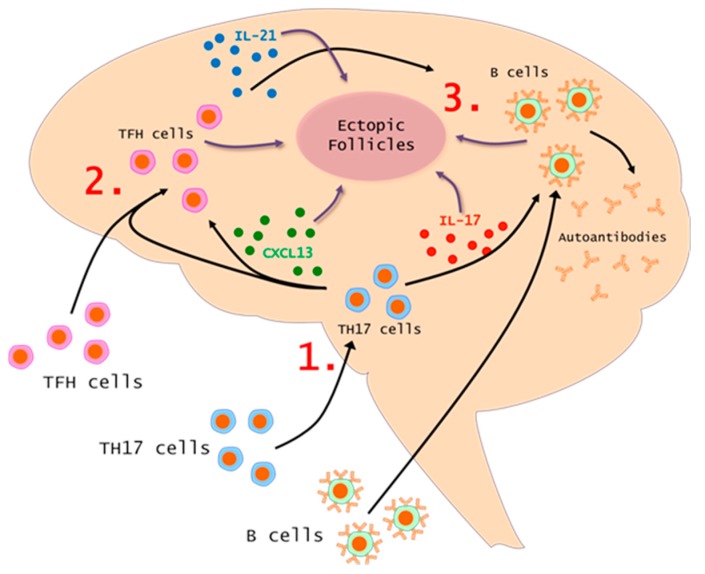
Multiple sclerosis (MS) is an autoimmune disorder where both T cells and B cells are implicated in pathology. However, it remains unclear how these two distinct populations cooperate to drive disease. There is ample evidence from studies in both MS patients and mouse models that Th17, B cells, and follicular T helper (TFH) cells contribute to disease. This review article describes the literature that identifies mechanisms by which Th17, TFH, and B cells cooperatively drive disease activity in MS and experimental autoimmune encephalomyelitis (EAE). The curation of this literature has identified that central nervous system (CNS) infiltrating TFH cells act with TH17 cell to contribute to an inflammatory B cell response in neuroinflammation. This demonstrates that TFH cells and their products are promising targets for therapies in MS.
多发性硬化症(MS)是一种自身免疫性疾病,其中 T 细胞和 B 细胞都与病理学有关。然而,目前尚不清楚这两种截然不同的细胞群如何合作以驱动疾病。在 MS 患者和小鼠模型的研究中都有充分的证据表明 Th17、B 细胞和滤泡辅助 T 细胞(TFH)细胞与疾病有关。这篇综述文章描述了文献中确定 Th17、TFH 和 B 细胞在 MS 和实验性自身免疫性脑脊髓炎(EAE)中协同驱动疾病活动的机制。对这些文献的整理表明,中枢神经系统(CNS)浸润的 TFH 细胞与 TH17 细胞一起作用,有助于神经炎症中炎症性 B 细胞反应。这表明 TFH 细胞及其产物是 MS 治疗的有希望的靶点。