Global Health Collaborative, Mbarara, Uganda.
Department of Medicine, Massachusetts General Hospital, 55 Fruit St, Boston, MA, 02114, USA.
Malar J. 2018 Oct 22;17(1):379. doi: 10.1186/s12936-018-2525-9.
Uganda has sought to address leading causes of childhood mortality: malaria, pneumonia and diarrhoea, through integrated community case management (iCCM). The success of this approach relies on community health worker (CHW) assessment and referral of sick children to a nearby health centre. This study aimed to determine rates of referral completion in an iCCM programme in rural Uganda.
This was a prospective observational study of referrals made by CHWs in 8 villages in rural western Uganda. All patient referrals by CHWs were tracked and health centre registers were reviewed for documentation of completed referrals. Caregivers of referred patients were invited to complete a survey 2-3 weeks after the referral with questions on the CHW visit, referral completion, and the patient's clinical condition.
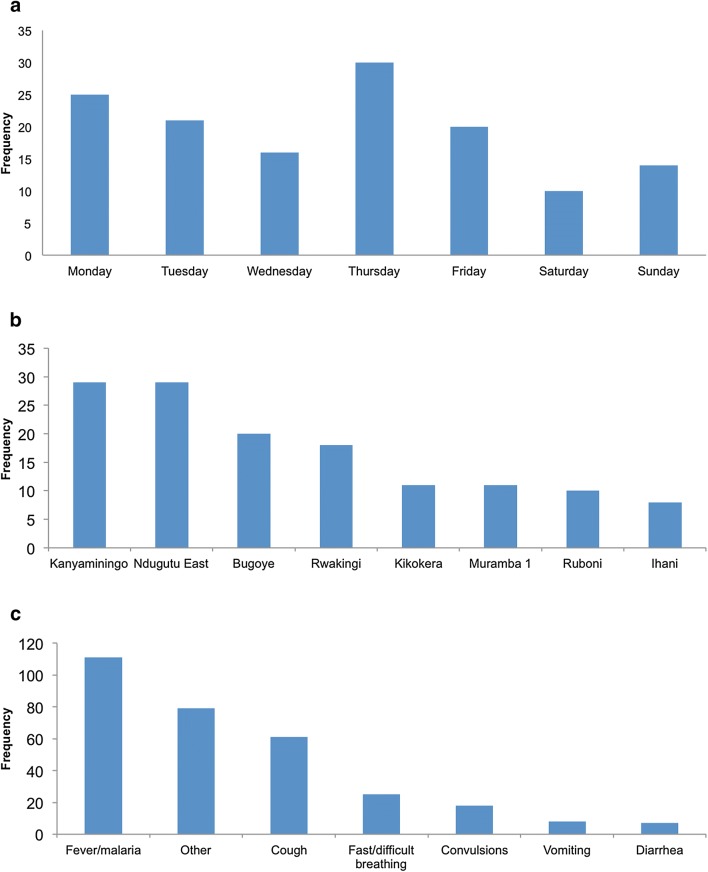
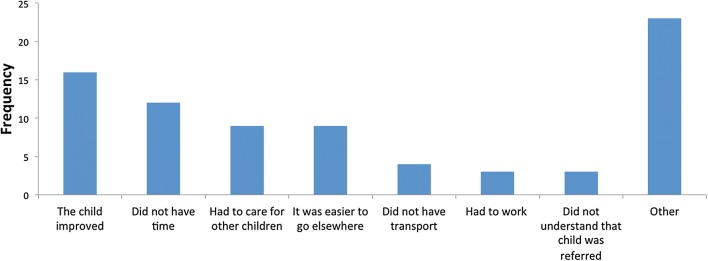
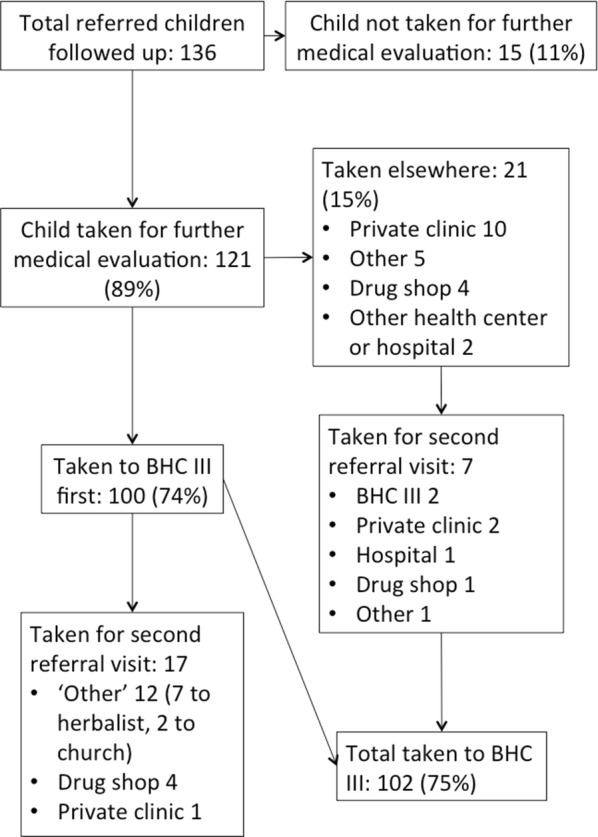
Among 143 total referrals, 136 (94%) caregivers completed the follow-up survey. Reasons for visiting the CHW were fever/malaria in 111 (82%) cases, cough in 61 (45%) cases, and fast/difficult breathing in 25 (18%) cases. Overall, 121 (89%) caregivers reported taking the referred child for further medical evaluation, of whom 102 (75% overall) were taken to the local public health centre. Ninety per cent of reported referral visits were confirmed in health centre documentation. For the 34 caregivers who did not complete referral at the local health centre, the most common reasons were improvement in child's health, lack of time, ease of going elsewhere, and needing to care for other children. Referrals were slightly more likely to be completed on weekdays versus weekends (p = 0.0377); referral completion was otherwise not associated with child's age or gender, caregiver age, or caregiver relationship to child. One village had a lower rate of referral completion than the others. Improvement in the child's health was not associated with completed referral or timing of the referral visit.
A high percentage of children referred to the health centre through iCCM in rural Uganda completed the referral. Barriers to referral completion included improvement in the child's health, time and distance. Interestingly, referral completion at the health centre was not associated with improvement in the child's health. Barriers to referral completion and clinical management at all stages of referral linkages warrant further study.
乌干达通过综合社区病例管理(iCCM)来解决儿童死亡的主要原因:疟疾、肺炎和腹泻。该方法的成功依赖于社区卫生工作者(CHW)对患病儿童的评估以及将其转介至附近卫生中心。本研究旨在确定乌干达农村 iCCM 项目中的转介完成率。
这是对乌干达西部农村 8 个村庄的 CHW 转介进行的前瞻性观察研究。所有 CHW 的患者转介都进行了跟踪,并审查了卫生中心的登记册,以记录完成的转介情况。在转介后 2-3 周,邀请转介患者的照顾者完成一项调查,其中包括关于 CHW 就诊、转介完成情况和患者临床状况的问题。
在 143 例总转介中,有 136 例(94%)照顾者完成了随访调查。111 例(82%)就诊原因是发热/疟疾,61 例(45%)是咳嗽,25 例(18%)是呼吸急促/困难。总体而言,121 例(89%)照顾者报告带被转介的孩子进行进一步的医疗评估,其中 102 例(总体 75%)被带到当地公共卫生中心。在卫生中心的文件中确认了 90%的报告转介就诊。对于 34 名未在当地卫生中心完成转介的照顾者,最常见的原因是孩子的健康状况改善、没有时间、去其他地方更方便,以及需要照顾其他孩子。与周末相比,工作日更有可能完成转介(p=0.0377);转介完成情况与儿童年龄或性别、照顾者年龄或与儿童的关系无关。一个村庄的转介完成率低于其他村庄。儿童健康状况的改善与转介完成或转介就诊时间无关。
乌干达农村通过 iCCM 转介至卫生中心的儿童中,很大比例的儿童完成了转介。转介完成的障碍包括儿童健康状况的改善、时间和距离。有趣的是,儿童健康状况的改善与儿童在卫生中心的转介完成情况无关。转介完成率低和在转介联系的各个阶段的临床管理障碍都需要进一步研究。