Division of Thoracic Surgery, City of Hope Medical Center, Duarte, CA, USA.
The Integrative Genomics Core lab of Department of Molecular Medicine, City of Hope National Medical Center, Duarte, CA, USA.
Mol Cancer. 2018 Oct 22;17(1):153. doi: 10.1186/s12943-018-0896-8.
Dysregulated histone methyltransferase G9a may represent a potential cancer therapeutic target. The roles of G9a in tumorigenesis and therapeutics are not well understood in non-small cell lung cancer (NSCLC). Here we investigated the impact of G9a on tumor growth and signaling pathways in NSCLC.
Immunohistochemistry analyzed G9a expression in NSCLC tissues. Both siRNA and selective inhibitor were used to target G9a. The impact of targeting G9a on key genes, signaling pathways and growth were investigated in NSCLC cells by RNA sequencing analysis, rescue experiments, and xenograft models.
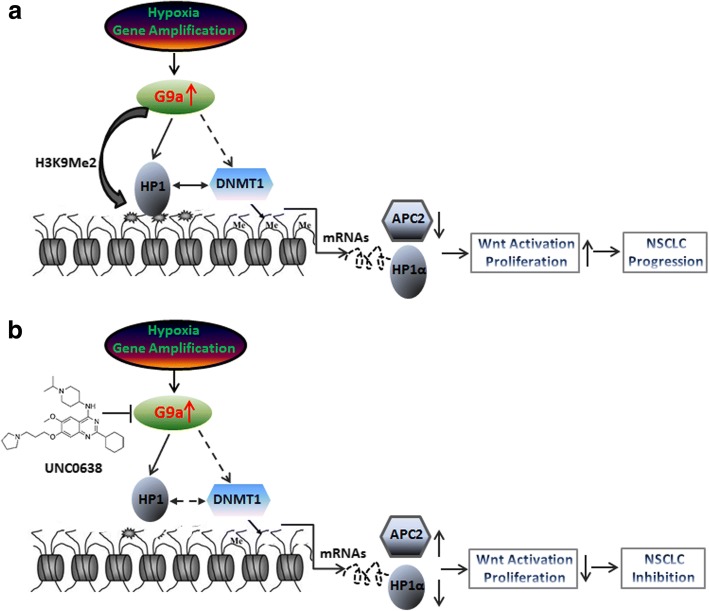
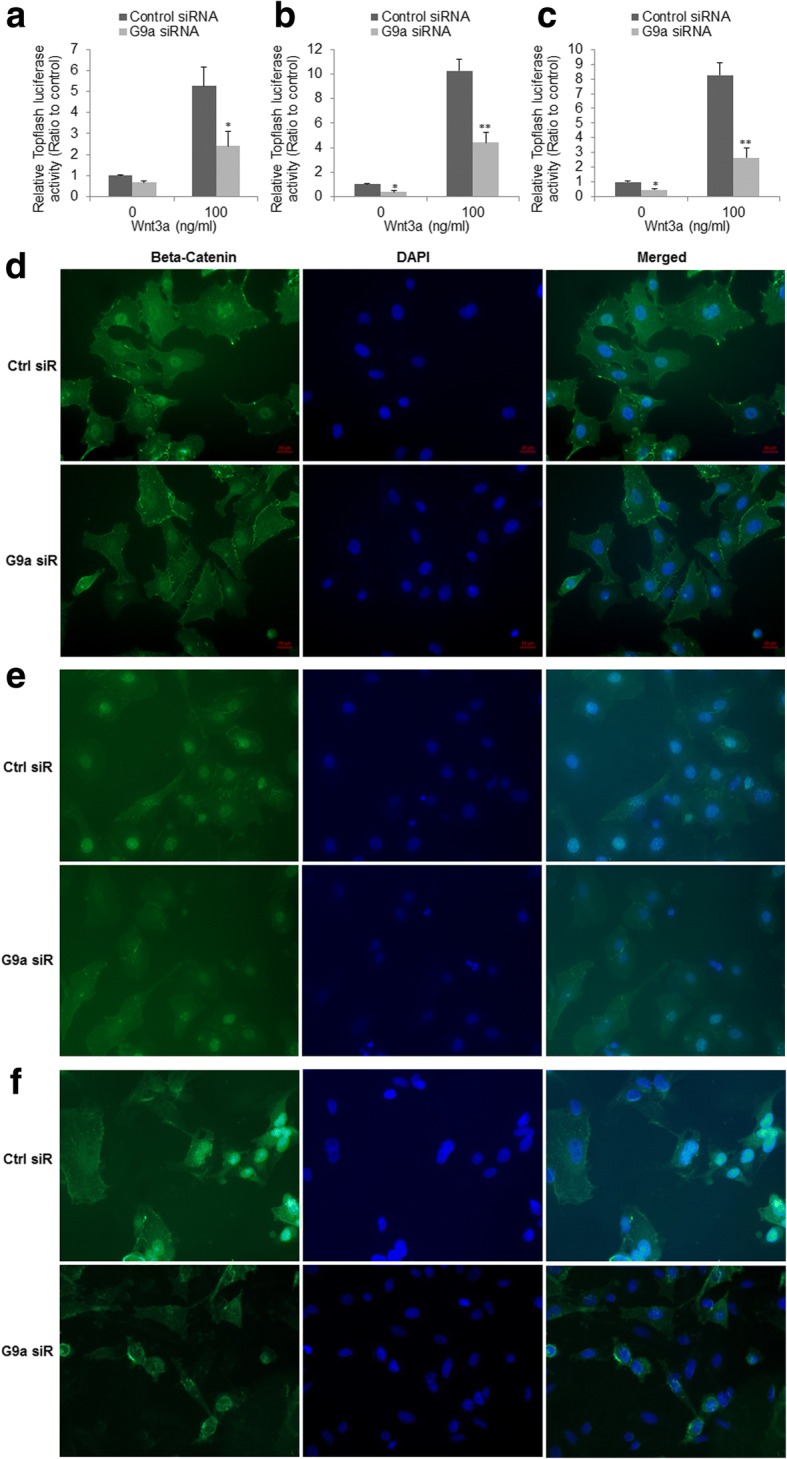
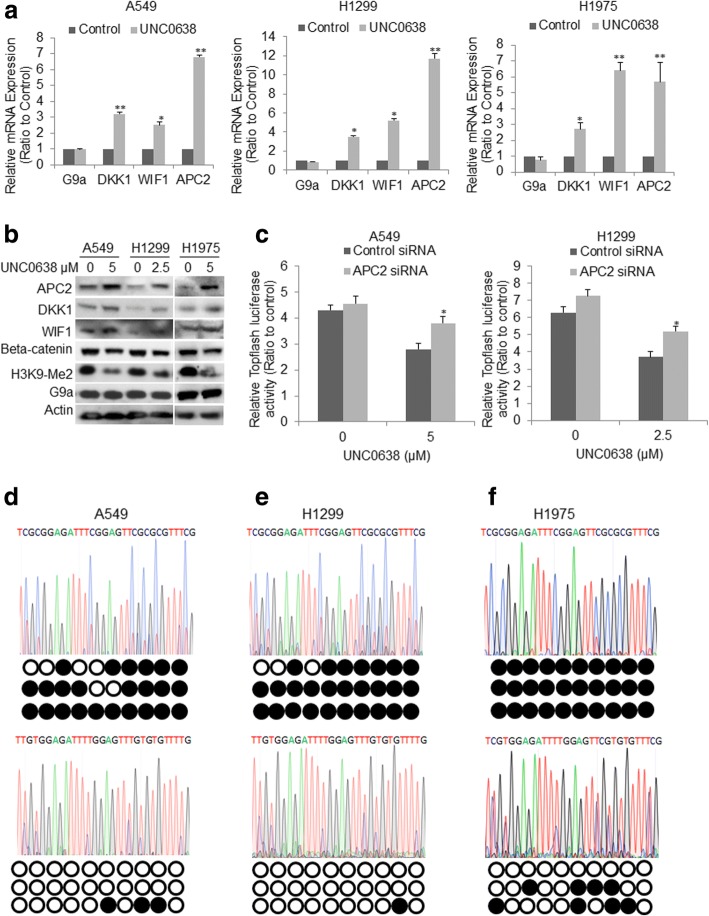
Overexpression of G9a (≥ 5% of cancer cells showing positive staining) was found in 43.2% of 213 NSCLC tissues. Multiple tumor-associated genes including HP1α, APC2 are differentially expressed; and signaling pathways involved in cellular growth, adhesion, angiogenesis, hypoxia, apoptosis, and canonical Wnt signaling pathways are significantly altered in A549, H1299, and H1975 cells upon G9a knockdown. Additionally, targeting G9a by siRNA-mediated knockdown or by a selective G9a inhibitor UNC0638 significantly inhibited tumor growth, and dramatically suppressed Wnt signaling pathway in vitro and in vivo. Furthermore, we showed that treatment with UNC0638 restores the expression of APC2 expression in these cells through promoter demethylation. Restoring HP1α and silencing APC2 respectively attenuated the inhibitory effects on cell proliferation and Wnt signaling pathway in cancer cells in which G9a was silenced or suppressed.
These findings demonstrate that overexpressed G9a represents a promising therapeutic target, and targeting G9a potentially suppresses growth and Wnt signaling pathway partially through down-regulating HP1α and epigenetically restoring these tumor suppressors such as APC2 that are silenced in NSCLC.
失调的组蛋白甲基转移酶 G9a 可能代表一个潜在的癌症治疗靶点。在非小细胞肺癌(NSCLC)中,G9a 在肿瘤发生和治疗中的作用还没有被很好地理解。在这里,我们研究了 G9a 对 NSCLC 肿瘤生长和信号通路的影响。
免疫组织化学分析 NSCLC 组织中的 G9a 表达。使用 siRNA 和选择性抑制剂来靶向 G9a。通过 RNA 测序分析、挽救实验和异种移植模型,研究了在 NSCLC 细胞中靶向 G9a 对关键基因、信号通路和生长的影响。
在 213 例 NSCLC 组织中,发现 43.2%的组织中 G9a 过表达(≥5%的癌细胞呈阳性染色)。多个肿瘤相关基因,包括 HP1α、APC2,表达差异;在 A549、H1299 和 H1975 细胞中,靶向 G9a 后,涉及细胞生长、黏附、血管生成、缺氧、凋亡和经典 Wnt 信号通路的信号通路显著改变。此外,通过 siRNA 介导的敲低或选择性 G9a 抑制剂 UNC0638 靶向 G9a 显著抑制肿瘤生长,并在体外和体内显著抑制 Wnt 信号通路。此外,我们表明,用 UNC0638 处理可通过启动子去甲基化恢复这些细胞中 APC2 的表达。在 G9a 沉默或抑制的癌细胞中,分别恢复 HP1α 和沉默 APC2 分别减弱了对细胞增殖和 Wnt 信号通路的抑制作用。
这些发现表明,过表达的 G9a 代表了一个有前途的治疗靶点,靶向 G9a 可能通过下调 HP1α 和表观遗传恢复 APC2 等在 NSCLC 中沉默的肿瘤抑制因子来抑制生长和 Wnt 信号通路。