Department of Experimental Radiation Oncology, The University of Texas MD Anderson Cancer Center, Houston, TX, USA.
CAS Key Laboratory of Separation Science for Analytical Chemistry, Scientific Research Center for Translational Medicine, Dalian Institute of Chemical Physics, Chinese Academy of Sciences, Dalian, China.
Nat Genet. 2018 Dec;50(12):1705-1715. doi: 10.1038/s41588-018-0252-3. Epub 2018 Oct 22.
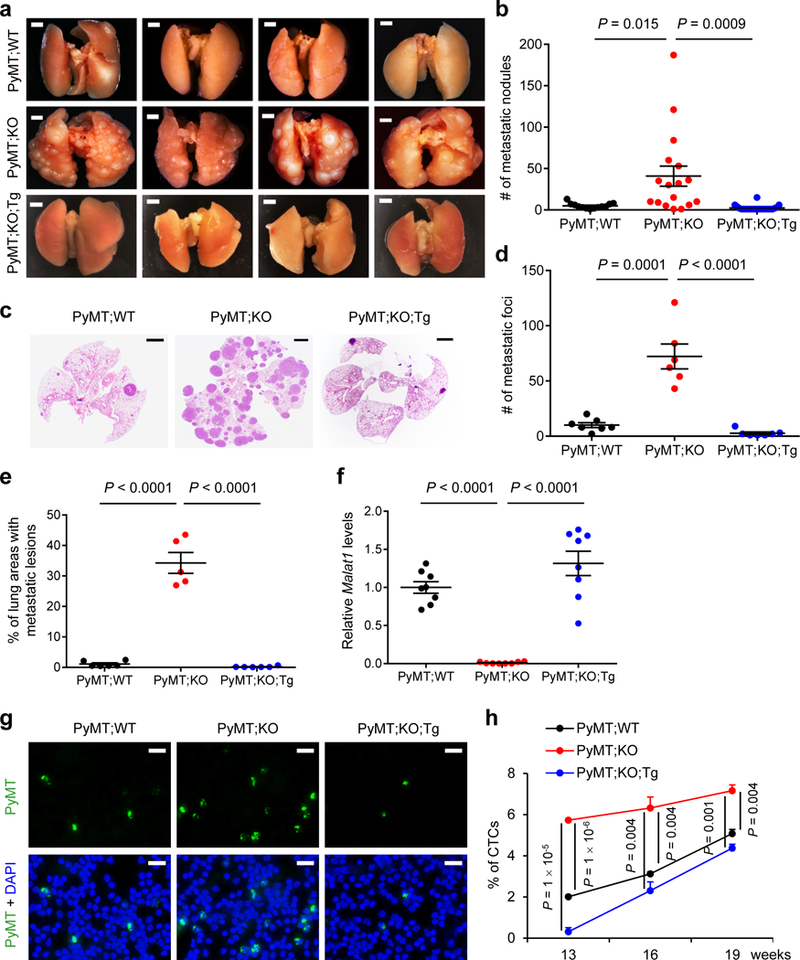
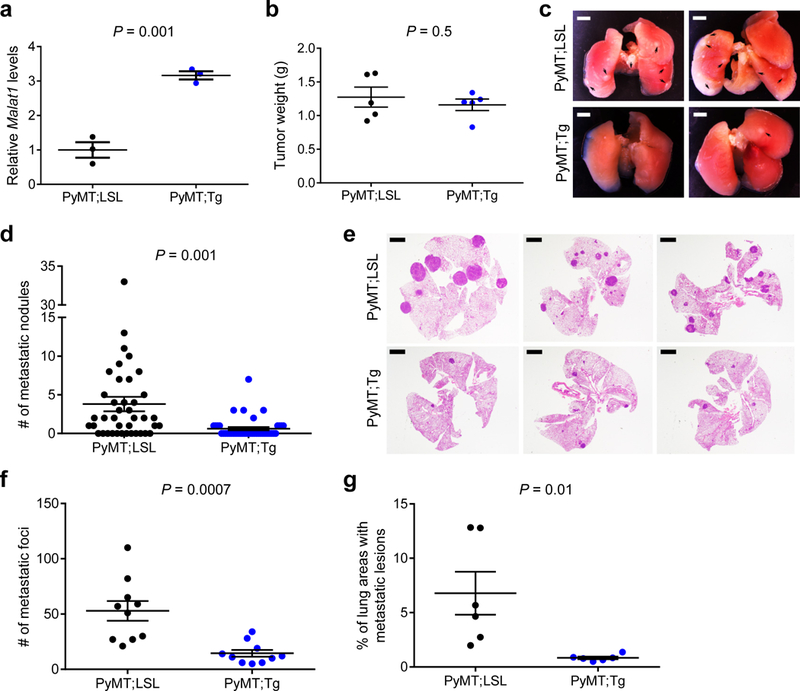
MALAT1 has previously been described as a metastasis-promoting long noncoding RNA (lncRNA). We show here, however, that targeted inactivation of the Malat1 gene in a transgenic mouse model of breast cancer, without altering the expression of its adjacent genes, promotes lung metastasis, and that this phenotype can be reversed by genetic add-back of Malat1. Similarly, knockout of MALAT1 in human breast cancer cells induces their metastatic ability, which is reversed by re-expression of Malat1. Conversely, overexpression of Malat1 suppresses breast cancer metastasis in transgenic, xenograft, and syngeneic models. Mechanistically, the MALAT1 lncRNA binds and inactivates the prometastatic transcription factor TEAD, preventing TEAD from associating with its co-activator YAP and target gene promoters. Moreover, MALAT1 levels inversely correlate with breast cancer progression and metastatic ability. These findings demonstrate that MALAT1 is a metastasis-suppressing lncRNA rather than a metastasis promoter in breast cancer, calling for rectification of the model for this highly abundant and conserved lncRNA.
MALAT1 先前被描述为一种促进转移的长链非编码 RNA(lncRNA)。然而,我们在这里表明,在乳腺癌的转基因小鼠模型中靶向敲除 Malat1 基因,而不改变其相邻基因的表达,会促进肺转移,而这种表型可以通过 Malat1 的基因回补来逆转。同样,敲除人乳腺癌细胞中的 MALAT1 会诱导其转移能力,而 Malat1 的重新表达可以逆转这种能力。相反,Malat1 的过表达会抑制转基因、异种移植和同基因模型中的乳腺癌转移。在机制上,MALAT1 lncRNA 结合并失活了促转移转录因子 TEAD,阻止了 TEAD 与其共激活因子 YAP 和靶基因启动子的结合。此外,MALAT1 的水平与乳腺癌的进展和转移能力呈负相关。这些发现表明,MALAT1 是一种抑制乳腺癌转移的 lncRNA,而不是促进转移的 lncRNA,这就需要对这种高度丰富和保守的 lncRNA 的模型进行修正。