Vassão Daniel Giddings, Wielsch Natalie, Gomes Ana Maria de Melo Moreira, Gebauer-Jung Steffi, Hupfer Yvonne, Svatoš Aleš, Gershenzon Jonathan
Department of Biochemistry, Max Planck Institute for Chemical Ecology, Jena, Germany.
Research Group Mass Spectrometry/Proteomics, Max Planck Institute for Chemical Ecology, Jena, Germany.
Front Plant Sci. 2018 Oct 8;9:1389. doi: 10.3389/fpls.2018.01389. eCollection 2018.
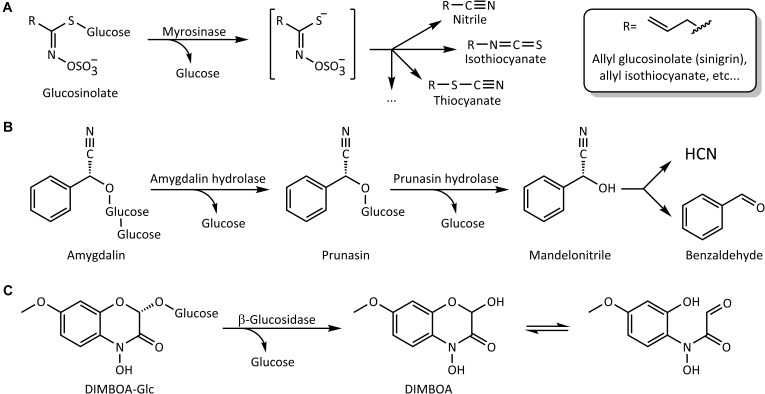
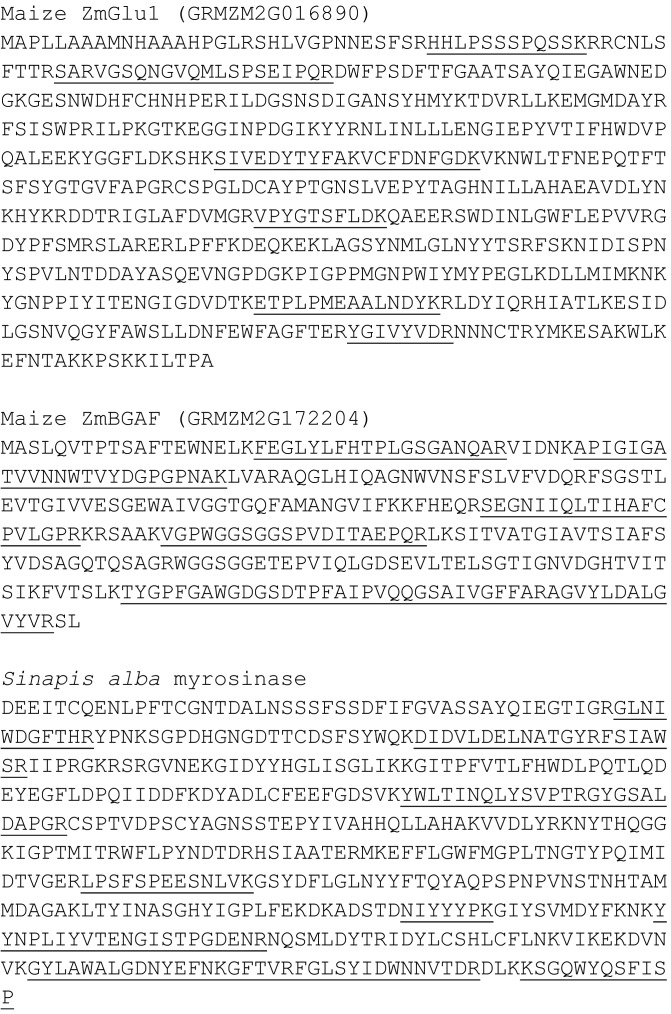
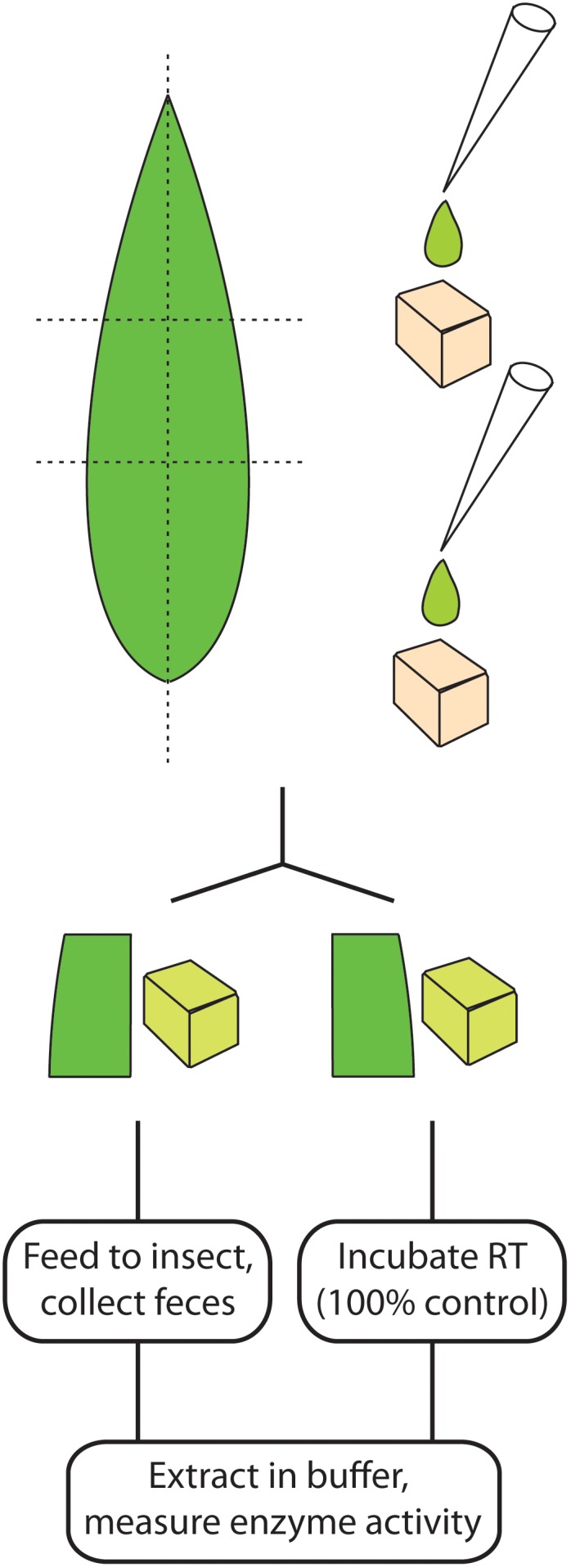
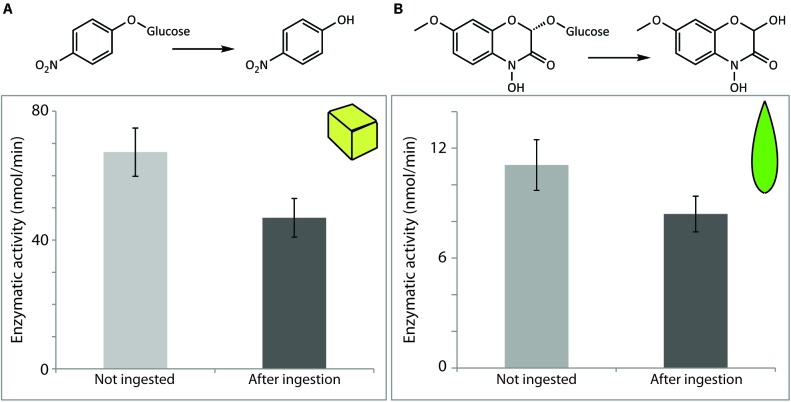
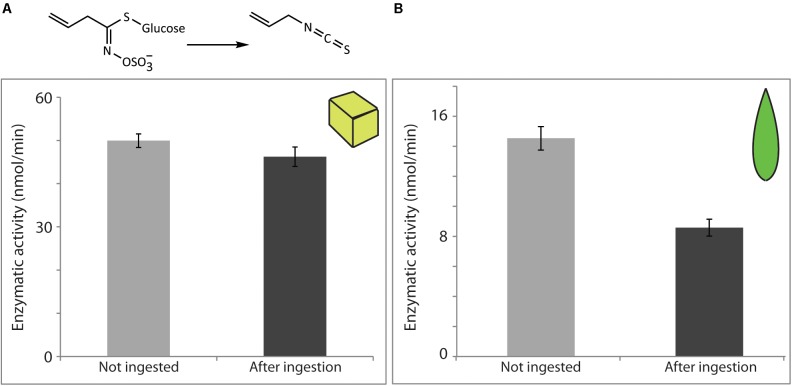
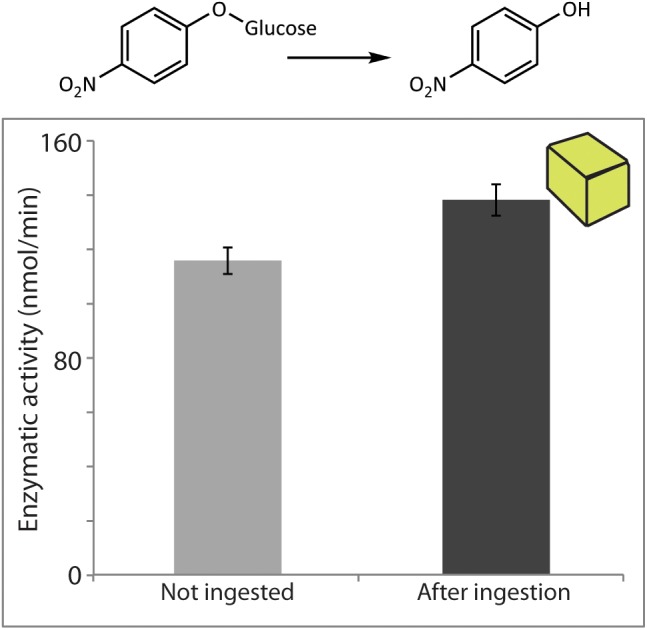
Two-component activated chemical defenses are a major part of many plants' strategies to disrupt herbivory. The activation step is often the β-glucosidase-catalyzed removal of a glucose moiety from a pro-toxin, leading to an unstable and toxic aglycone. While some β-glucosidases have been well studied, several aspects of their roles , such as their precise sites of enzymatic activity during and after ingestion, and the importance of particular isoforms in plant defense are still not fully understood. Here, plant defensive β-glucosidases from maize, white mustard and almonds were shown to resist digestion by larvae of the generalist lepidopteran , and the majority of the ingested activities toward both general and plant pro-toxic substrates was recovered in the frass. Among other proteins potentially involved in defense, we identified specific plant β-glucosidases and a maize β-glucosidase aggregating factor in frass from plant-fed insects using proteomic methods. We therefore found that, while larvae efficiently degraded bulk food protein during digestion, β-glucosidases were among a small number of plant defensive proteins that resist insect digestive proteolysis. These enzymes remain intact in the gut lumen and frass and can therefore further catalyze the activation of plant defenses after ingestion, especially in pH-neutral regions of the digestive system. As most of the ingested enzymatic activity persists in the frass, and only particular β-glucosidases were detected via proteomic analyses, our data support the involvement of specific isoforms (maize ZmGlu1 and MA1 myrosinase) in defense .
双组分激活化学防御是许多植物抵御食草动物策略的重要组成部分。激活步骤通常是β-葡萄糖苷酶催化从原毒素上去除葡萄糖部分,从而产生不稳定的有毒苷元。虽然一些β-葡萄糖苷酶已得到充分研究,但其作用的几个方面,如摄食期间和之后其酶活性的确切位点,以及特定同工型在植物防御中的重要性仍未完全了解。在这里,来自玉米、白芥和杏仁的植物防御性β-葡萄糖苷酶被证明能抵抗多食性鳞翅目幼虫的消化,并且在粪便中回收了大部分对一般和植物原毒素底物的摄食活性。在其他可能参与防御的蛋白质中,我们使用蛋白质组学方法从取食植物的昆虫粪便中鉴定出了特定的植物β-葡萄糖苷酶和一种玉米β-葡萄糖苷酶聚集因子。因此我们发现,虽然幼虫在消化过程中能有效降解大量食物蛋白,但β-葡萄糖苷酶是少数抵抗昆虫消化蛋白水解的植物防御蛋白之一。这些酶在肠腔和粪便中保持完整,因此在摄食后可进一步催化植物防御的激活,尤其是在消化系统的pH中性区域。由于大部分摄食的酶活性存在于粪便中,并且通过蛋白质组学分析仅检测到特定的β-葡萄糖苷酶,我们的数据支持特定同工型(玉米ZmGlu1和MA1黑芥子酶)参与防御。