Baek Han Bit, Lombard Alan P, Libertini Stephen J, Fernandez-Rubio Aleida, Vinall Ruth, Gandour-Edwards Regina, Nakagawa Rachel, Vidallo Kathleen, Nishida Kristine, Siddiqui Salma, Wettersten Hiromi, Landesman Yosef, Weiss Robert H, Ghosh Paramita M, Mudryj Maria
Veterans Affairs-Northern California Health Care System, Mather, CA, USA.
Department of Medical Microbiology and Immunology, University of California Davis, Davis, CA, USA.
Oncotarget. 2018 Oct 2;9(77):34567-34581. doi: 10.18632/oncotarget.26179.
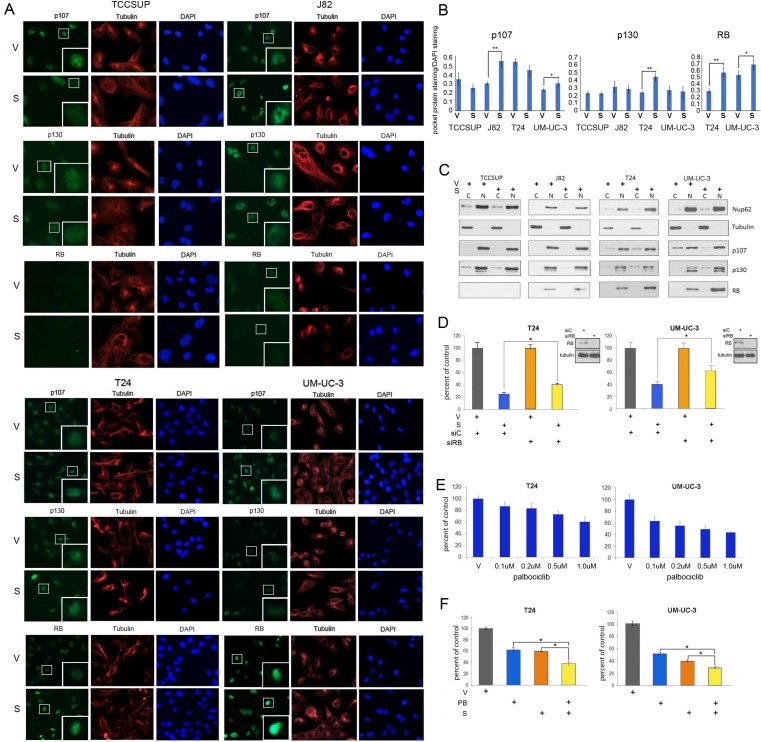
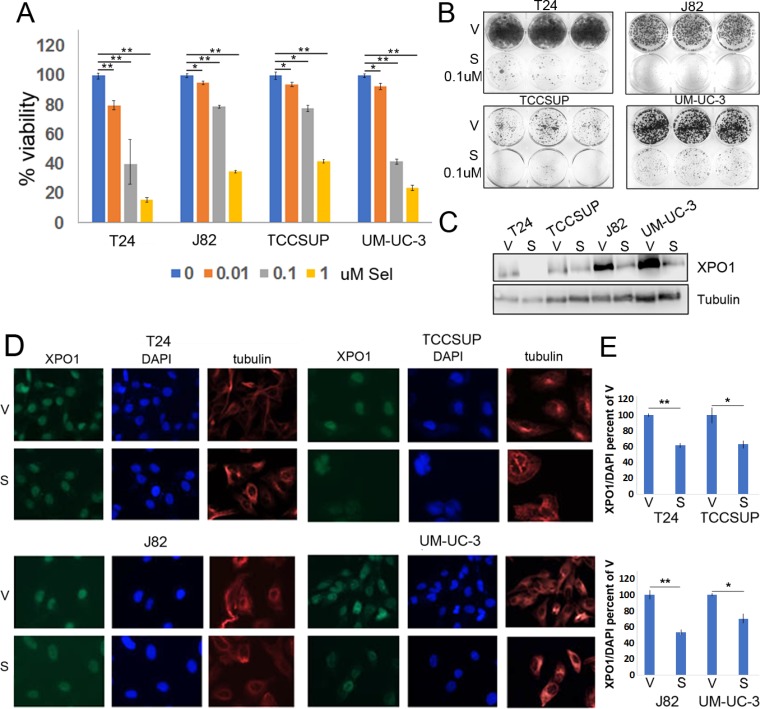
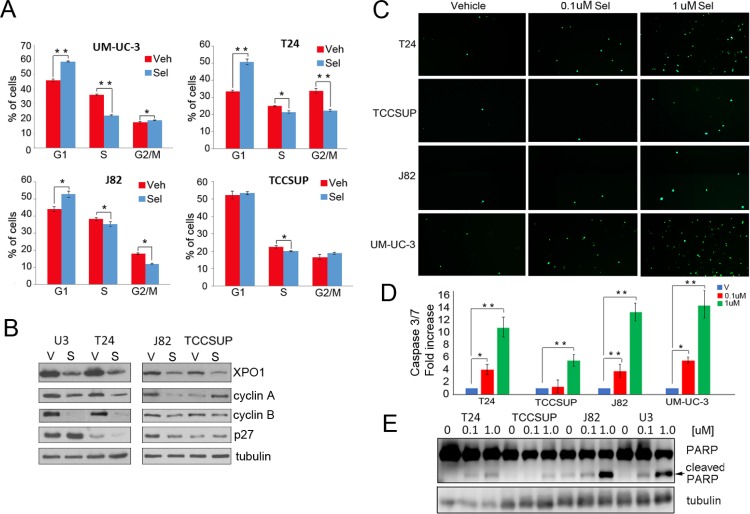
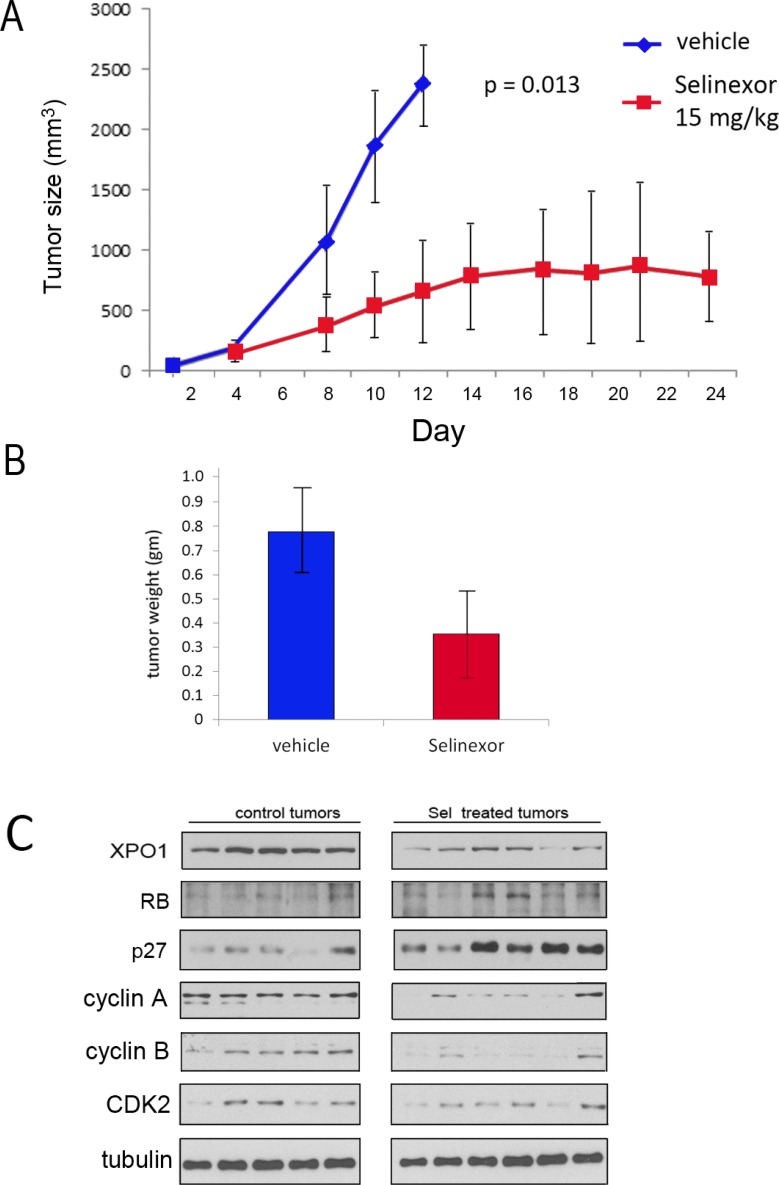
Treatment options for high grade urothelial cancers are limited and have remained largely unchanged for several decades. Selinexor (KPT-330), a first in class small molecule that inhibits the nuclear export protein XPO1, has shown efficacy as a single agent treatment for numerous different malignancies, but its efficacy in limiting bladder malignancies has not been tested. In this study we assessed selinexor-dependent cytotoxicity in several bladder tumor cells and report that selinexor effectively reduced XPO1 expression and limited cell viability in a dose dependent manner. The decrease in cell viability was due to an induction of apoptosis and cell cycle arrest. These results were recapitulated in studies where selinexor decreased tumor growth. Tumors treated with selinexor expressed lower levels of XPO1, cyclin A, cyclin B, and CDK2 and increased levels of RB and CDK inhibitor p27, a result that is consistent with growth arrest. Cells expressing wildtype RB, a potent tumor suppressor that promotes growth arrest and apoptosis, were most susceptible to selinexor. Cell fractionation and immunofluorescence studies showed that selinexor treatment increased nuclear RB levels and mechanistic studies revealed that RB ablation curtailed the response to the drug. Conversely, limiting CDK4/6 dependent RB phosphorylation by palbociclib was additive with selinexor in reducing bladder tumor cell viability, confirming that RB activity has a role in the response to XPO1 inhibition. These results provide a rationale for XPO1 inhibition as a novel strategy for the treatment of bladder malignancies.
高级别尿路上皮癌的治疗选择有限,并且几十年来基本没有变化。塞利尼索(KPT-330)是一种新型小分子,可抑制核输出蛋白XPO1,已显示出对多种不同恶性肿瘤的单药治疗效果,但尚未测试其在限制膀胱恶性肿瘤方面的疗效。在本研究中,我们评估了塞利尼索对几种膀胱肿瘤细胞的细胞毒性,并报告塞利尼索能有效降低XPO1表达,并以剂量依赖方式限制细胞活力。细胞活力的降低是由于诱导了细胞凋亡和细胞周期停滞。在塞利尼索降低肿瘤生长的研究中也得到了这些结果。用塞利尼索治疗的肿瘤表达较低水平的XPO1、细胞周期蛋白A、细胞周期蛋白B和CDK2,以及较高水平的RB和CDK抑制剂p27,这一结果与生长停滞一致。表达野生型RB的细胞,RB是一种促进生长停滞和细胞凋亡的有效肿瘤抑制因子,对塞利尼索最敏感。细胞分级分离和免疫荧光研究表明,塞利尼索治疗增加了细胞核RB水平,机制研究表明,RB缺失会削弱对该药物的反应。相反,用帕博西尼限制CDK4/6依赖性RB磷酸化与塞利尼索在降低膀胱肿瘤细胞活力方面具有相加作用,证实RB活性在对XPO1抑制的反应中起作用。这些结果为抑制XPO1作为治疗膀胱恶性肿瘤的新策略提供了理论依据。