Julius Center for Health Sciences and Primary Care, University Medical Center Utrecht, Utrecht, the Netherlands.
Department of Epidemiology & Biostatistics, Amsterdam Public Health Research Institute, Vrije Universiteit University Medical Center, Amsterdam, the Netherlands.
Diabetes. 2019 Jan;68(1):220-225. doi: 10.2337/db18-0543. Epub 2018 Oct 23.
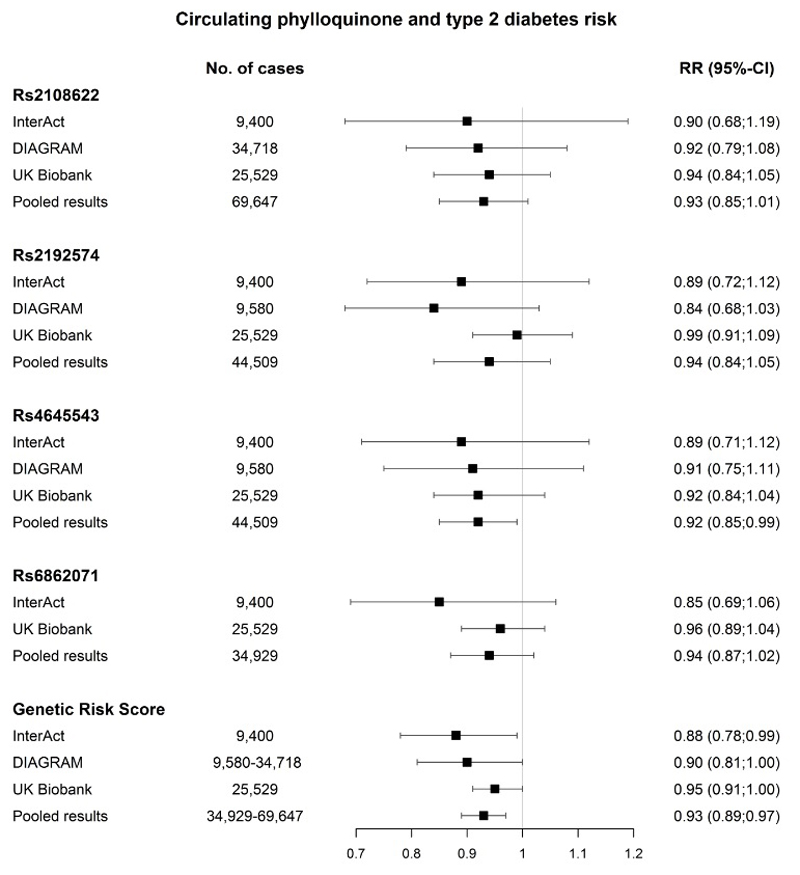
This study investigated the causal relation between circulating phylloquinone (vitamin K) concentrations and type 2 diabetes by using a Mendelian randomization (MR) approach. We used data from three studies: the European Prospective Investigation into Cancer and Nutrition (EPIC)-InterAct case-cohort study, Diabetes Genetics Replication and Meta-analysis (DIAGRAM), and the UK Biobank, resulting in 69,647 subjects with type 2 diabetes. We calculated a weighted genetic risk score including four genetic variants previously found to be associated with circulating phylloquinone concentrations. Inverse-variance weighted analysis was used to obtain a risk ratio (RR) for the causal relation between circulating phylloquinone concentrations and risk of type 2 diabetes. Presence of pleiotropy and the robustness of the results were assessed using MR-Egger and weighted-median analyses. Genetically predicted concentrations of circulating phylloquinone were associated with lower risk of type 2 diabetes with an RR of 0.93 (95% CI 0.89; 0.97) per every natural logarithm (Ln)-nmol/L-unit increase in circulating phylloquinone. The MR-Egger and weighted median analyses showed RRs of 0.94 (0.86; 1.02) and 0.93 (0.88; 0.98), respectively, indicating no pleiotropy. In conclusion, our study supports that higher circulating phylloquinone may be causally related with lower risk of type 2 diabetes, highlighting the importance of sufficient phylloquinone in the human diet.
本研究采用孟德尔随机化(MR)方法探讨了循环叶绿醌(维生素 K)浓度与 2 型糖尿病之间的因果关系。我们使用了三项研究的数据:欧洲癌症前瞻性调查与营养(EPIC)-InterAct 病例对照研究、糖尿病遗传学复制与荟萃分析(DIAGRAM)以及英国生物库,共纳入 69647 例 2 型糖尿病患者。我们计算了一个包含四个先前发现与循环叶绿醌浓度相关的遗传变异的加权遗传风险评分。采用逆方差加权分析获得了循环叶绿醌浓度与 2 型糖尿病风险之间因果关系的风险比(RR)。采用 MR-Egger 和加权中位数分析评估了存在偏倚的可能性和结果的稳健性。遗传预测的循环叶绿醌浓度与 2 型糖尿病风险降低相关,每增加一个自然对数(Ln)-nmol/L 单位的循环叶绿醌,RR 为 0.93(95%CI 0.89;0.97)。MR-Egger 和加权中位数分析分别显示 RR 为 0.94(0.86;1.02)和 0.93(0.88;0.98),表明不存在偏倚。总之,本研究支持较高的循环叶绿醌可能与较低的 2 型糖尿病风险存在因果关系,突出了人类饮食中足够的叶绿醌的重要性。