Department of Pediatrics, Faculty of Medicine, University of Montreal, Montreal, Quebec, Canada.
Research Center of the Sainte-Justine University Hospital, Montreal, Quebec, Canada.
PLoS Med. 2021 Feb 25;18(2):e1003536. doi: 10.1371/journal.pmed.1003536. eCollection 2021 Feb.
Vitamin D deficiency has been associated with type 1 diabetes in observational studies, but evidence from randomized controlled trials (RCTs) is lacking. The aim of this study was to test whether genetically decreased vitamin D levels are causally associated with type 1 diabetes using Mendelian randomization (MR).
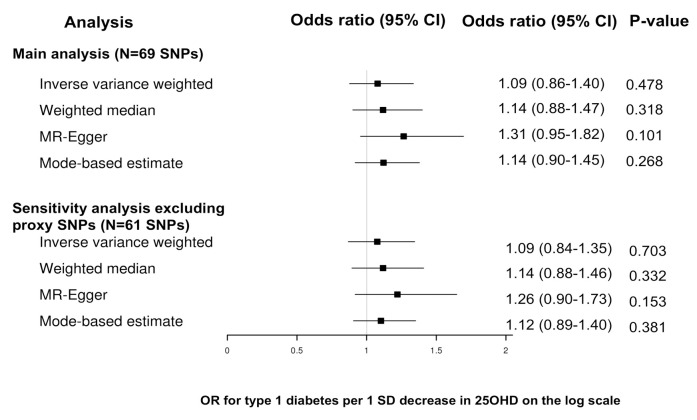
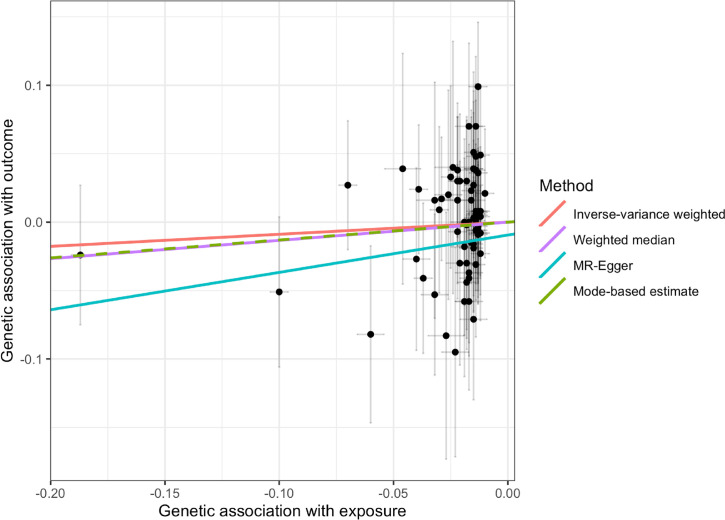
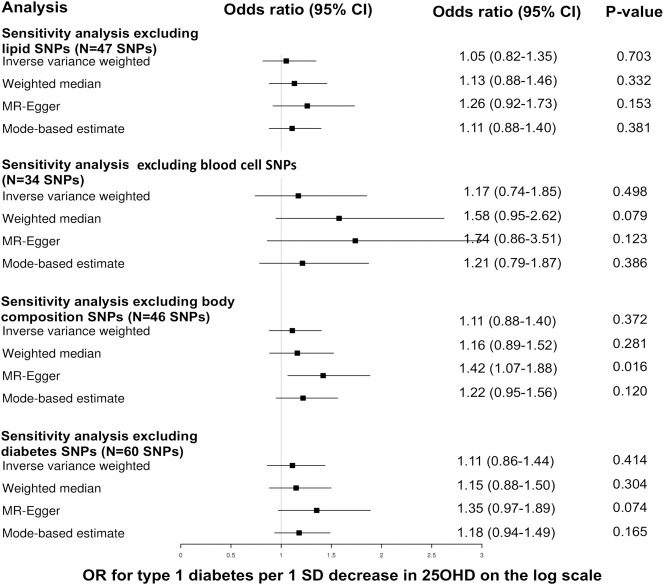
For our two-sample MR study, we selected as instruments single nucleotide polymorphisms (SNPs) that are strongly associated with 25-hydroxyvitamin D (25OHD) levels in a large vitamin D genome-wide association study (GWAS) on 443,734 Europeans and obtained their corresponding effect estimates on type 1 diabetes risk from a large meta-analysis of 12 type 1 diabetes GWAS studies (Ntot = 24,063, 9,358 cases, and 15,705 controls). In addition to the main analysis using inverse variance weighted MR, we applied 3 additional methods to control for pleiotropy (MR-Egger, weighted median, and mode-based estimate) and compared the respective MR estimates. We also undertook sensitivity analyses excluding SNPs with potential pleiotropic effects. We identified 69 lead independent common SNPs to be genome-wide significant for 25OHD, explaining 3.1% of the variance in 25OHD levels. MR analyses suggested that a 1 standard deviation (SD) decrease in standardized natural log-transformed 25OHD (corresponding to a 29-nmol/l change in 25OHD levels in vitamin D-insufficient individuals) was not associated with an increase in type 1 diabetes risk (inverse-variance weighted (IVW) MR odds ratio (OR) = 1.09, 95% CI: 0.86 to 1.40, p = 0.48). We obtained similar results using the 3 pleiotropy robust MR methods and in sensitivity analyses excluding SNPs associated with serum lipid levels, body composition, blood traits, and type 2 diabetes. Our findings indicate that decreased vitamin D levels did not have a substantial impact on risk of type 1 diabetes in the populations studied. Study limitations include an inability to exclude the existence of smaller associations and a lack of evidence from non-European populations.
Our findings suggest that 25OHD levels are unlikely to have a large effect on risk of type 1 diabetes, but larger MR studies or RCTs are needed to investigate small effects.
在观察性研究中,维生素 D 缺乏与 1 型糖尿病有关,但缺乏随机对照试验(RCT)的证据。本研究旨在使用孟德尔随机化(MR)方法来检验遗传上降低的维生素 D 水平是否与 1 型糖尿病有关。
对于我们的两样本 MR 研究,我们选择了与 443734 名欧洲人 25-羟维生素 D(25OHD)水平密切相关的单核苷酸多态性(SNP)作为工具,并从 12 项 1 型糖尿病 GWAS 研究的大型荟萃分析中获得了这些 SNP 对 1 型糖尿病风险的相应效应估计值(Ntot = 24063,9358 例,15705 例对照)。除了使用逆方差加权 MR 的主要分析外,我们还应用了 3 种额外的方法来控制 pleiotropy(MR-Egger、加权中位数和基于模式的估计),并比较了各自的 MR 估计值。我们还进行了敏感性分析,排除了可能具有 pleiotropic 效应的 SNP。我们确定了 69 个主要独立的常见 SNP,这些 SNP 对 25OHD 具有全基因组显著性,解释了 25OHD 水平变异的 3.1%。MR 分析表明,标准化自然对数转换后的 25OHD 标准偏差(SD)降低 1 个单位(相当于维生素 D 不足个体中 25OHD 水平降低 29 nmol/L)与 1 型糖尿病风险增加无关(逆方差加权(IVW)MR 比值比(OR)= 1.09,95%CI:0.86 至 1.40,p = 0.48)。我们使用 3 种抗 pleiotropy 的稳健 MR 方法和排除与血清脂质水平、身体成分、血液特征和 2 型糖尿病相关的 SNP 的敏感性分析得到了类似的结果。我们的研究结果表明,在研究人群中,维生素 D 水平降低对 1 型糖尿病的风险没有显著影响。研究局限性包括无法排除较小关联的存在和缺乏非欧洲人群的证据。
我们的研究结果表明,25OHD 水平不太可能对 1 型糖尿病的风险有很大影响,但需要更大规模的 MR 研究或 RCT 来研究较小的影响。