Department of Child Health, TNO, Leiden, The Netherlands.
Global Medical, Safety & CMO, Merck KGaA, Darmstadt, Germany.
PLoS One. 2018 Oct 24;13(10):e0206009. doi: 10.1371/journal.pone.0206009. eCollection 2018.
Quantifying the association between adherence and the growth response to growth hormone (GH) treatment is hampered by suboptimal methods of measuring adherence, confounders associated with the growth response, and restriction of the outcome parameters to yearly growth velocities.
To investigate the effect of adherence on the two-year growth response to GH treatment in prepubertal children with idiopathic isolated growth hormone deficiency (GHD) participating in the easypod connect observational study (ECOS), a 5-year, Phase IV open-label study to continuously assess real-world adherence via the easypod electronic drug-delivery device.
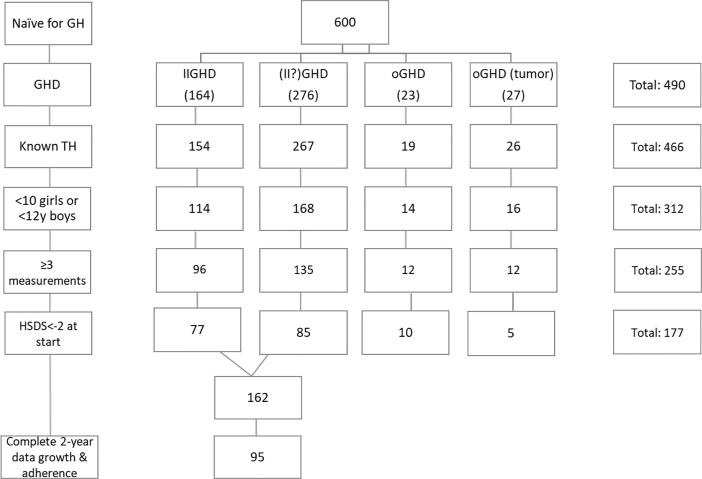
Outcome measures were change in height standard deviation score (ΔHSDS), index of responsiveness (IoR), and parameters of two catch-up growth (CUG) curve functions (monomolecular growth curve and second degree polynomial) with adj-HSDS (HSDS minus Target height (TH) SDS) as dependent variable. Inclusion criteria were GHD, naïve to GH treatment, known TH, age <10y in girls and <12y in boys, ≥3 measurements, HSDS <-2 at start, complete data on growth and adherence in the first and second year. Linear regression analyses were performed to test the association between adherence (continuous and high vs. low) and the outcome measures, also adjusted for potential clinical confounders (age at start, adj-HSDS at start, birth weight SDS, gestational age (<37 weeks vs ≥37 weeks), GH dose, GH max (n = 58)). The formula of IoR already adjusts for confounders.
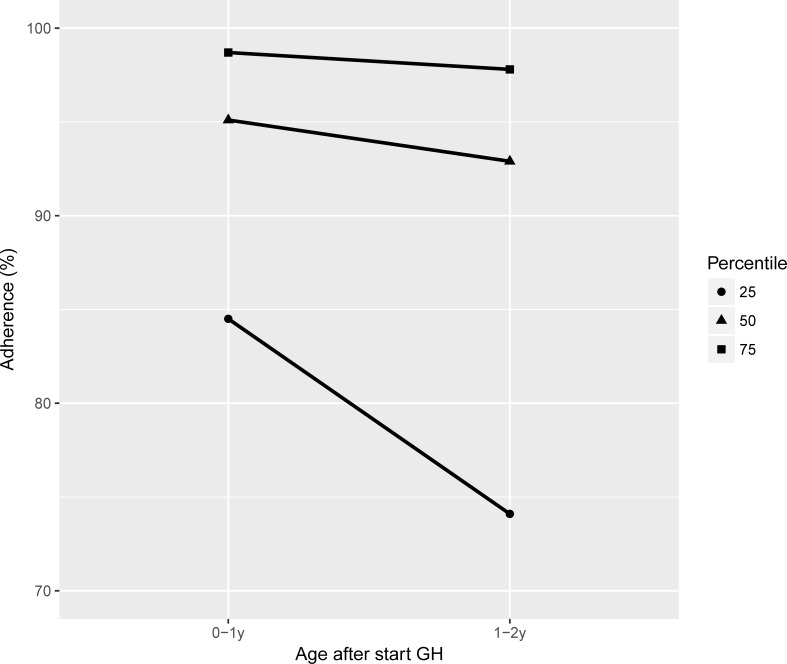
In total, 95 patients complied with the inclusion criteria. The strongest associations were found between high adherence in the second year (≥91% as cut-off value) and IoR 2y (+0.62), and average adherence and high adherence (≥78%) in the first two years and ΔHSDS 0-2y (+0.11 SD per 1 injection/week, and +0.34 SD for high vs. low adherence).
Suboptimal adherence negatively affected the growth response in the first two years of GH treatment.
由于测量依从性的方法不理想、与生长反应相关的混杂因素以及将结果参数限制为每年的生长速度,因此难以量化依从性与生长激素(GH)治疗反应之间的关系。
通过 easypod 电子药物输送设备连续评估真实世界的依从性,研究接受 easypod connect 观察性研究(ECOS)的青春期前特发性孤立性生长激素缺乏症(GHD)患儿的依从性对 GH 治疗两年生长反应的影响。ECOS 是一项为期 5 年的 IV 期开放性研究。
观察指标为身高标准差评分(ΔHSDS)变化、反应指数(IoR)和两种追赶生长(CUG)曲线函数的参数(单分子生长曲线和二次多项式),以调整后的 HSDS(HSDS 减去目标身高(TH) SDS)为因变量。纳入标准为 GHD、首次接受 GH 治疗、已知 TH、女孩年龄<10 岁、男孩年龄<12 岁、≥3 次测量、开始时 HSDS <-2、第一年和第二年的生长和依从性数据完整。进行线性回归分析,以检验依从性(连续和高 vs. 低)与观察指标之间的关系,还调整了潜在的临床混杂因素(开始时的年龄、开始时的调整后 HSDS、出生体重 SDS、胎龄(<37 周 vs. ≥37 周)、GH 剂量、GH max(n=58))。IoR 的公式已经调整了混杂因素。
共有 95 例患者符合纳入标准。第二年高依从性(≥91%为截止值)与 IoR 2y(+0.62)、前两年平均依从性和高依从性(≥78%)与ΔHSDS 0-2y(每增加 1 次/周注射 0.11 SD,高 vs. 低依从性增加 0.34 SD)之间存在最强关联。
依从性不理想会对 GH 治疗的前两年生长反应产生负面影响。