Eaton Malcolm, Granata Cesare, Barry Julianne, Safdar Adeel, Bishop David, Little Jonathan P
School of Health and Exercise Science, University of British Columbia Okanagan, Kelowna, BC V1V 1V7, Canada.
Institute of Sport, Exercise and Active Living (ISEAL), College of Sport and Exercise Science, Victoria University, Melbourne, VIC 8001, Australia.
J Sport Health Sci. 2018 Apr;7(2):191-196. doi: 10.1016/j.jshs.2017.01.003. Epub 2017 Jan 9.
Exercise promotes numerous phenotypic adaptations in skeletal muscle that contribute to improved function and metabolic capacity. An emerging body of evidence suggests that skeletal muscle also releases a myriad of factors during exercise, termed "myokines". The purpose of this study was to examine the effects of high-intensity interval training (HIIT) on the acute regulation of the mRNA expression of several myokines, including the prototypical myokine interleukin-6 (IL-6), and recently identified myokines fibronectin type III domain-containing protein 5 (FNDC5) (irisin) and meteorin-like protein (METRNL).
Both before and after a 20-day period of twice-daily high-volume HIIT, 9 healthy males (20.5 ± 1.5 years performed a standardized bout of high-intensity interval exercise (HIIE; 5 × 4 min at ~80% pretraining peak power output) with skeletal muscle biopsy samples (vastus lateralis) obtained at rest, immediately following exercise, and at 3 h recovery.
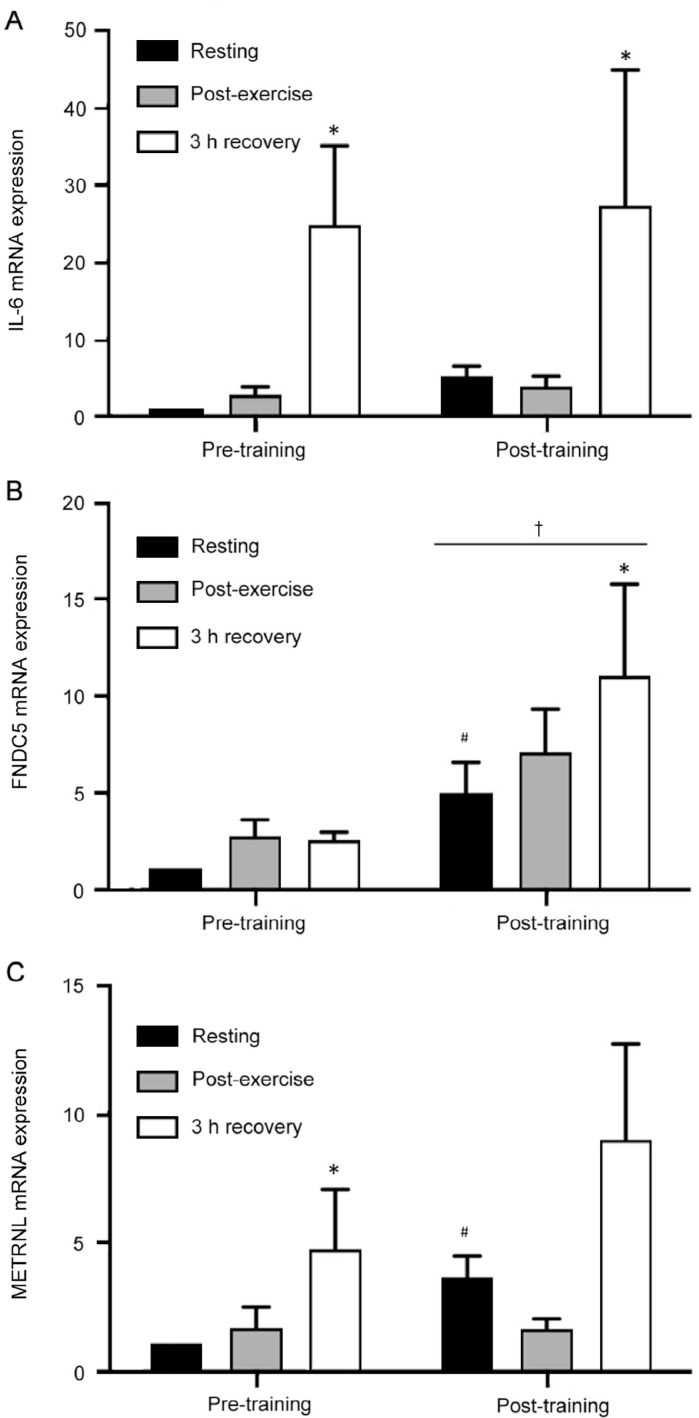
Before training, a single bout of HIIE increased IL-6 (<0.05) and METRNL (<0.05) mRNA expression measured at 3 h recovery when compared to rest. Following 20 days of HIIT, IL-6 and FNDC5 mRNA were increased at 3 h recovery from the standardized HIIE bout when compared to rest (both <0.05). Resting METRNL and FNDC5 mRNA expression were higher following training (<0.05), and there was an overall increase in FNDC5 mRNA post-training (main effect of training, <0.05).
In human skeletal muscle (1) an acute bout of HIIE can induce upregulation of skeletal muscle IL-6 mRNA both before and after a period of intensified HIIT; (2) Resting and overall FNDC5 mRNA expression is increased by 20 days of HIIT; and (3) METRNL mRNA expression is responsive to both acute HIIE and short-term intense HIIT. Future studies are needed to confirm these findings at the protein and secretion level in humans.
运动可促进骨骼肌发生多种表型适应性变化,有助于改善功能和代谢能力。越来越多的证据表明,骨骼肌在运动过程中也会释放大量因子,称为“肌动蛋白”。本研究的目的是探讨高强度间歇训练(HIIT)对几种肌动蛋白mRNA表达的急性调节作用,包括典型的肌动蛋白白细胞介素-6(IL-6),以及最近发现的肌动蛋白含III型纤连蛋白结构域蛋白5(FNDC5)(鸢尾素)和类陨石蛋白(METRNL)。
在为期20天、每天进行两次大运动量HIIT训练前后,9名健康男性(20.5±1.5岁)进行一次标准化的高强度间歇运动(HIIE;以约80%的训练前峰值功率输出进行5×4分钟运动),并在静息、运动结束后立即以及恢复3小时时采集骨骼肌活检样本(股外侧肌)。
训练前,与静息状态相比,单次HIIE运动后3小时恢复时IL-6(<0.05)和METRNL(<0.05)的mRNA表达增加。经过20天的HIIT训练后,与静息状态相比,标准化HIIE运动后3小时恢复时IL-6和FNDC5的mRNA增加(均<0.05)。训练后静息METRNL和FNDC5的mRNA表达更高(<0.05),训练后FNDC5的mRNA总体增加(训练的主要效应,<0.05)。
在人类骨骼肌中,(1)单次急性HIIE运动在强化HIIT训练前后均可诱导骨骼肌IL-6 mRNA上调;(2)20天的HIIT训练可增加静息和总体FNDC5的mRNA表达;(3)METRNL的mRNA表达对急性HIIE和短期高强度HIIT均有反应。未来需要在人体的蛋白质和分泌水平上证实这些发现。