Yang Yu, Ju Weina, Zhang Haining, Sun Li
Department of Neurology and Neuroscience Center, First Hospital of Jilin University, Changchun, China.
Front Behav Neurosci. 2018 Oct 9;12:229. doi: 10.3389/fnbeh.2018.00229. eCollection 2018.
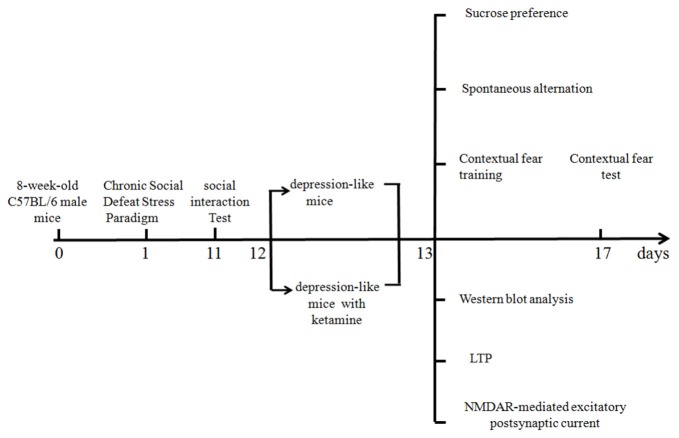
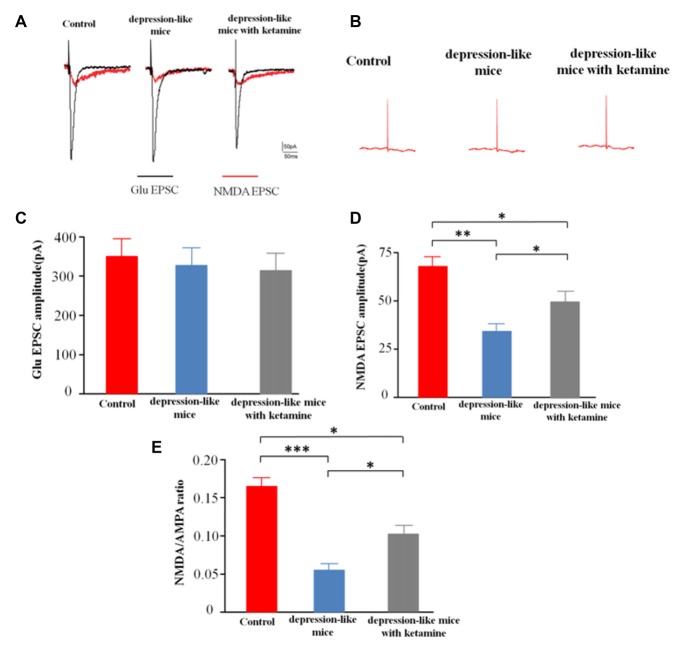
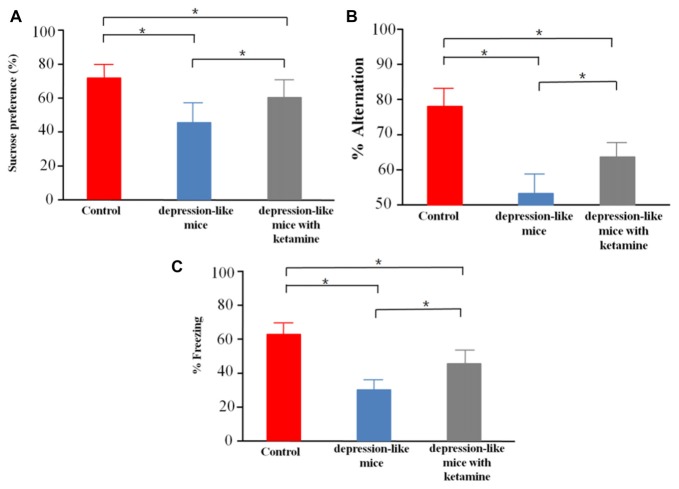
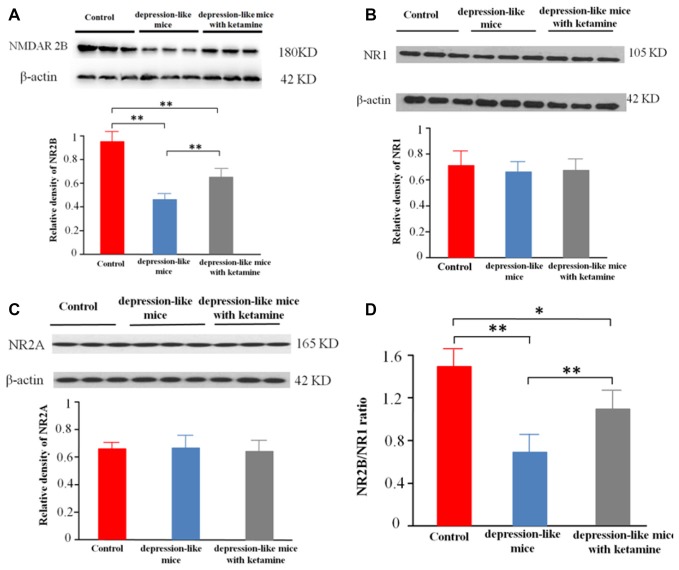
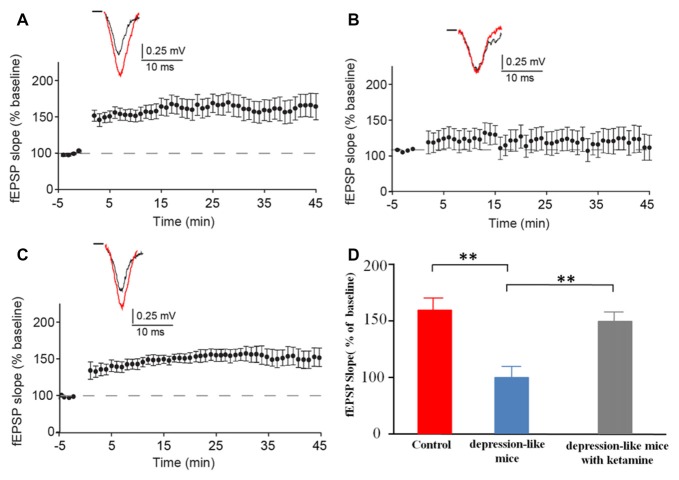
Depression is a common mental disorder that is associated with memory dysfunction. Ketamine has recently been demonstrated to be a rapid antidepressant. The mechanisms underlying how depression induces memory dysfunction and how ketamine relieves depressive symptoms remain poorly understood. This work compared three groups of male C57BL/6J mice: mice exposed to chronic social defeat stress (CSDS) to induce a depression-like phenotype, depression-like mice treated with ketamine, and control mice that were not exposed to CSDS or treated with ketamine. Spatial working memory and long term memory were assessed by spontaneous alternation Y-maze and fear conditioning tests, respectively. We used western blot to analyze the density of -methyl-D-aspartate receptor (NMDAR) subunits in the hippocampus. We recorded long term potentiation (LTP) and NMDA receptor-mediated excitatory postsynaptic currents (EPSCs) in hippocampal slices. We observed that compared with control mice, depression-like mice had significant reductions in spatial working memory and contextual fear memory. The level of NR2B, LTP and NMDA receptor-mediated EPSCs of depression-like mice were decreased. Ketamine treatment attenuated the memory impairment, and increased the density of NR2B and the amplitude of LTP and NMDA receptor-mediated EPSCs in the hippocampus of depression-like mice. In conclusion, depression-like mice have deficits in working memory and contextual fear memory. The decrease of NR2B, LTP induction and NMDA receptor-mediated EPSCs in the hippocampus may be involved in this process. Ketamine can improve expression of NR2B, LTP induction and NMDA receptor-mediated EPSCs in the hippocampus of depression-like mice, which might be part of the reason why ketamine can alleviate the memory dysfunction induced by depression.
抑郁症是一种与记忆功能障碍相关的常见精神障碍。氯胺酮最近已被证明是一种快速抗抑郁药。抑郁症如何导致记忆功能障碍以及氯胺酮如何缓解抑郁症状的潜在机制仍知之甚少。这项研究比较了三组雄性C57BL/6J小鼠:暴露于慢性社会挫败应激(CSDS)以诱导抑郁样表型的小鼠、用氯胺酮治疗的抑郁样小鼠以及未暴露于CSDS或未用氯胺酮治疗的对照小鼠。分别通过自发交替Y迷宫和恐惧条件反射试验评估空间工作记忆和长期记忆。我们使用蛋白质免疫印迹法分析海马体中N-甲基-D-天冬氨酸受体(NMDAR)亚基的密度。我们记录了海马体切片中的长时程增强(LTP)和NMDA受体介导的兴奋性突触后电流(EPSCs)。我们观察到,与对照小鼠相比,抑郁样小鼠的空间工作记忆和情境恐惧记忆显著降低。抑郁样小鼠的NR2B水平、LTP和NMDA受体介导的EPSCs降低。氯胺酮治疗减轻了记忆障碍,并增加了抑郁样小鼠海马体中NR2B的密度以及LTP和NMDA受体介导的EPSCs的幅度。总之,抑郁样小鼠存在工作记忆和情境恐惧记忆缺陷。海马体中NR2B的减少、LTP诱导和NMDA受体介导的EPSCs可能参与了这一过程。氯胺酮可以改善抑郁样小鼠海马体中NR2B的表达、LTP诱导和NMDA受体介导的EPSCs,这可能是氯胺酮能够缓解抑郁症诱导的记忆功能障碍的部分原因。