Colomé Àngels, Rodríguez-Ferreiro Javier, Tubau Elisabet
Section of Cognitive Processes, Department of Cognition, Development and Educational Psychology, Faculty of Psychology, University of Barcelona, Barcelona, Spain.
Institute of Neurosciences, University of Barcelona, Barcelona, Spain.
Front Psychol. 2018 Oct 9;9:1906. doi: 10.3389/fpsyg.2018.01906. eCollection 2018.
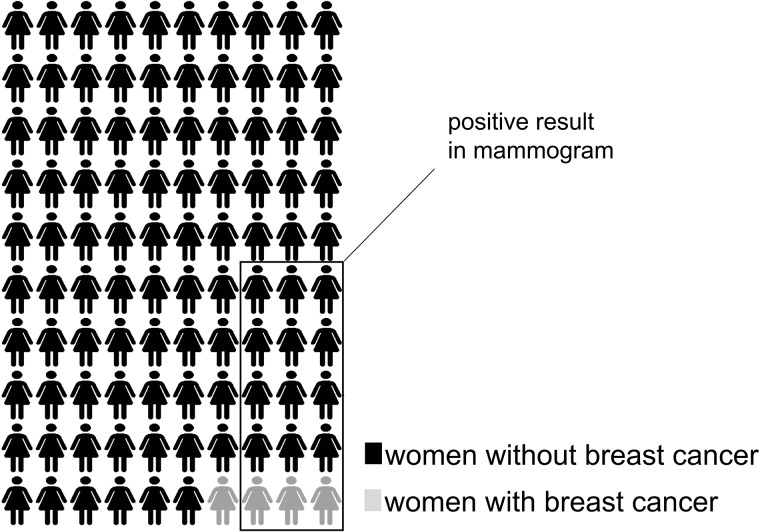
Ideally, decisions regarding one's health should be made after assessing the objective probabilities of relevant outcomes. Nevertheless, previous beliefs and emotional reactions also have a role in decision-making. Furthermore, the comprehension of probabilities is commonly affected by the presentation format, and by numeracy. This study aimed to assess the extent to which the influence of these factors might vary between different medical conditions. A sample of university students were presented with two health scenarios containing statistical information on the prevalence of breast cancer and hypertension either through icon arrays ( = 71) or natural frequencies ( = 72). They also received information regarding a preventive measure (mammogram/low-sodium diet) and the likelihood of a positive mammogram or a rich-sodium diet either when suffering or not suffering from the disease. Before seeing the data, participants rated the severity of the disease and the inconvenience of the preventive measure. After reading the health scenario, participants had to rate its difficulty, and how worrisome it was. They had also to rate the prior probability of suffering from this medical condition, and the posterior probability of it, provided a positive mammogram or a rich-sodium diet. Finally, they rated the extent to which they would recommend the preventive measures. All the rates used the same 1 (little)-8 (a great deal) scale. Participants' numeracy was also assessed. The scenarios differed significantly in perceived severity and worry, with the cancer scenario obtaining higher scores. Importantly, regression analyses showed that the recommendations in the two health scenarios depended on different variables. A model taking into consideration severity and worry rates best explained decisions in the cancer scenario; in contrast, in the hypertension scenario the model that best explained the recommendations comprised both the posterior probability estimate and the severity rate. Neither numeracy nor presentation format affected recommendation but both affected difficulty, worrying and probability rates. We conclude that previous perceptions of the severity of a health condition modulate the use of probabilistic information for decision-making. The roles of presentation format and numeracy in enabling patients to understand statistical information are also discussed.
理想情况下,关于个人健康的决策应该在评估相关结果的客观概率之后做出。然而,先前的信念和情绪反应在决策中也起到一定作用。此外,概率的理解通常会受到呈现形式和数学能力的影响。本研究旨在评估这些因素的影响在不同医疗状况之间可能存在的差异程度。向一组大学生展示了两个健康场景,通过图标阵列(n = 71)或自然频率(n = 72)呈现了乳腺癌和高血压患病率的统计信息。他们还收到了关于一种预防措施(乳房X光检查/低钠饮食)以及患病或未患病时乳房X光检查呈阳性或高钠饮食的可能性的信息。在查看数据之前,参与者对疾病的严重程度和预防措施的不便程度进行了评分。阅读健康场景后,参与者必须对其难度以及令人担忧的程度进行评分。他们还必须对患这种疾病的先验概率以及在乳房X光检查呈阳性或高钠饮食情况下的后验概率进行评分。最后,他们对推荐预防措施的程度进行了评分。所有评分都使用相同的1(很少)-8(很多)量表。还评估了参与者的数学能力。这些场景在感知到的严重程度和担忧程度上有显著差异,癌症场景得分更高。重要的是,回归分析表明,两个健康场景中的推荐取决于不同的变量。一个考虑严重程度和担忧评分的模型最能解释癌症场景中的决策;相比之下,在高血压场景中,最能解释推荐的模型包括后验概率估计和严重程度评分。数学能力和呈现形式都没有影响推荐,但两者都影响难度、担忧程度和概率评分。我们得出结论,先前对健康状况严重程度的认知会调节用于决策的概率信息的使用。还讨论了呈现形式和数学能力在使患者理解统计信息方面的作用。