Kremer Jody A, Robison Cara I, Karcher Darrin M
Department of Animal Science, Michigan State University, East Lansing, MI, United States.
Department of Animal Sciences, Purdue University, West Lafayette, IN, United States.
Front Vet Sci. 2018 Oct 9;5:241. doi: 10.3389/fvets.2018.00241. eCollection 2018.
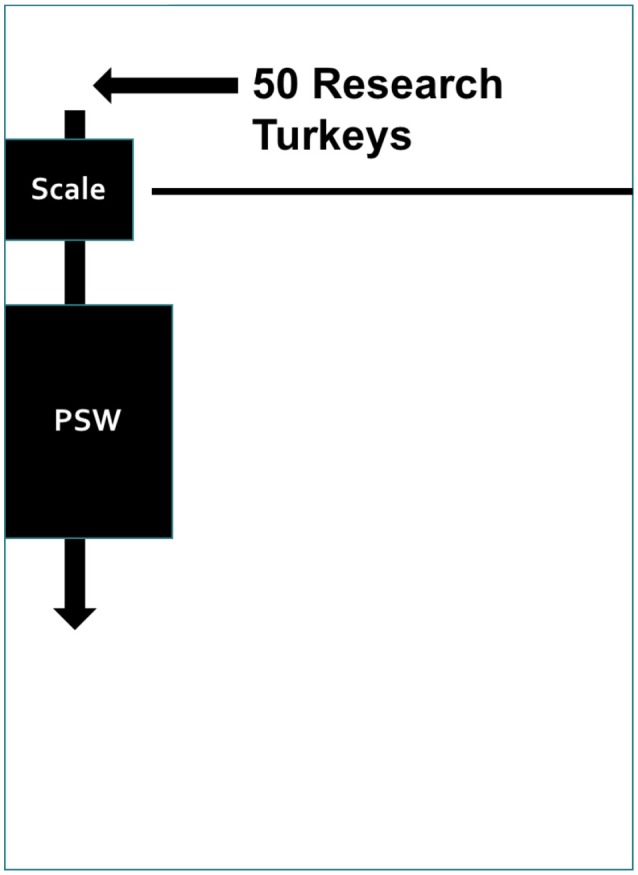
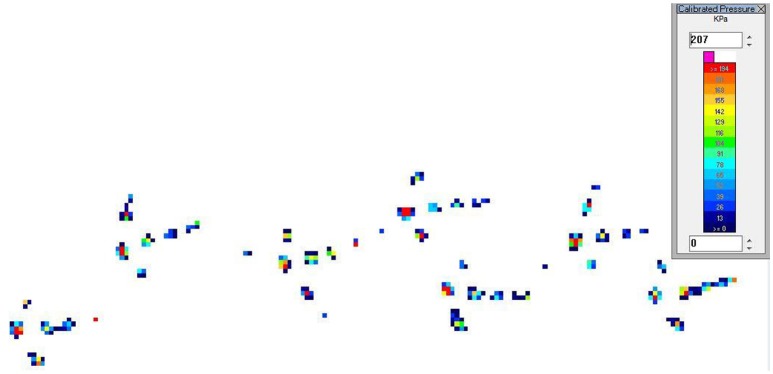
Genetic selection for rapidly growing turkeys has created an unfavorable consequence impacting the skeletal system resulting in long bone distortions. These distortions have resulted in locomotor problems, gait abnormalities, leg weakness, or lameness issues. These effects raise welfare concerns along with animal agriculture inefficiency in the form of lost product. The purpose was to determine baseline gait and force distribution in visibly unimpaired growing turkey hens. Hendrix commercial turkey hen poults ( = 100) were placed on pine wood shavings providing 0.78 m per bird with access to feed and water at the MSU Poultry Farm. Fifty hens were randomly selected at 5 weeks and identified with a leg band to ensure longitudinal data collection. The turkeys were walked across a pressure-sensing walkway (PSW, Tekscan, Boston, MA) and weighed at 5, 6, 8, and 10 weeks of age. PSW collected data on gait length, gait time, step force and step length, and the statistics were analyzed with SAS. Both temporospatial data, including step time and step length, and kinetic data, including peak downward force, and vertical impulse, were recorded. Body weight increased linearly with age ( < 0.001), demonstrating a typical growth pattern. Gait cycle time and peak vertical force (PVF) all displayed no difference between right and left sides, indicating that the hens had no detectable gait abnormalities. Gait velocity increased with age ( = 0.02) suggesting hens' growth impacted their gait velocity. The gait cycle time ( < 0.01) did not correspond with age. PVF increased linearly with age ( < 0.01) from 6 weeks (2.23 kg) to 10 weeks of age (5.91 kg). PVF/kg body weight ( < 0.01) increased from 6 weeks of age (96.9% BW) to 8 weeks of age (106%BW). Overall, the birds were not lame and some data was influenced by the hen's adjustment to the materials or stage of growth; in contrast, some temporospatial data did not coincide with age. The PSW could be used to detect locomotor issues in commercially produced turkey hens providing another tool for assessing well-being.
对快速生长的火鸡进行基因选择产生了一个不利后果,影响骨骼系统,导致长骨变形。这些变形导致了运动问题、步态异常、腿部无力或跛行问题。这些影响引发了对火鸡福利的担忧,以及动物养殖效率低下,造成产品损失。目的是确定外观未受损的生长中火鸡母鸡的基线步态和力分布。亨德里克斯商业火鸡母鸡雏鸡( = 100)被放置在松木屑上,每只鸡有0.78平方米的空间,在密歇根州立大学家禽农场可获取饲料和水。在5周龄时随机挑选50只母鸡,用腿环标记以确保纵向数据收集。这些火鸡走过一个压力感应通道(PSW,Tekscan,波士顿,马萨诸塞州),并在5、6、8和10周龄时称重。PSW收集步态长度、步态时间、步力和步长的数据,并用SAS进行统计分析。记录了包括步时和步长的时空数据以及包括向下峰值力和垂直冲量的动力学数据。体重随年龄呈线性增加( < 0.001),呈现出典型的生长模式。步态周期时间和峰值垂直力(PVF)在左右两侧均无差异,表明母鸡没有可检测到的步态异常。步态速度随年龄增加( = 0.02),表明母鸡的生长影响了它们的步态速度。步态周期时间( < 0.01)与年龄不对应。PVF从6周龄(2.23千克)到10周龄(5.91千克)随年龄呈线性增加( < 0.01)。PVF/体重( < 0.01)从6周龄(96.9%体重)增加到8周龄(106%体重)。总体而言,这些鸡没有跛行,一些数据受母鸡对材料的适应或生长阶段影响;相反,一些时空数据与年龄不一致。PSW可用于检测商业生产的火鸡母鸡的运动问题,为评估其健康状况提供了另一种工具。