Cornell Carolyn R, Marasini Daya, Fakhr Mohamed K
Department of Biological Science, The University of Tulsa, Tulsa, OK, United States.
Front Microbiol. 2018 Sep 28;9:2282. doi: 10.3389/fmicb.2018.02282. eCollection 2018.
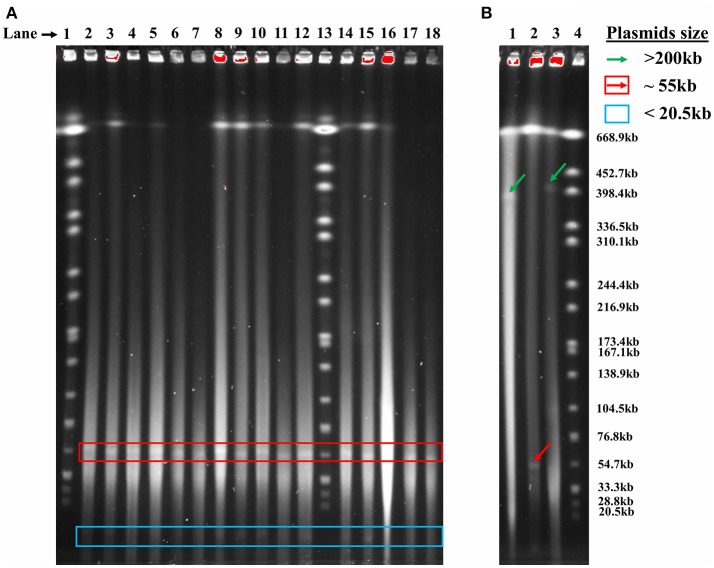
One of the unique features of actinomycetes, especially the genus , is the presence of linear plasmids. These range in size from 12 to 600 kb, and are often termed mega-plasmids. While many of the genes involved in secondary metabolite production reside in clusters on the chromosome, several studies have identified biosynthetic clusters on large linear plasmids that produce important secondary metabolites, including antibiotics. In this study, Pulse Field Gel Electrophoresis (PFGE) was used to screen 176 actinomycete isolates for the presence of plasmids; these bacterial strains were previously isolated from the Great Salt Plains of Oklahoma. Seventy-eight of the 176 actinomycete isolates (44%) contained plasmids. Several strains contained more than one plasmid, accounting for a total of 109 plasmids. Ten isolates showed extrachromosomal DNA larger than 200 kb, thus falling into the category of mega-plasmids. A subset of plasmids from 55 isolates was treated with S1 nuclease to determine topology; all plasmids examined appeared to be linear and ranged from ~55 to 400 kb. Eleven isolates were chosen for Whole Genome Next Generation Sequencing. From the 11 sequenced isolates, seven plasmids were partially assembled. While the majority of the genes identified on the plasmids coded for hypothetical proteins, others coded for general functions, stress response, and antibiotic and heavy metal resistance. Draft genome sequences of two mega-plasmid-bearing sp. strains, BF-3 and 4F, revealed the presence of genes involved in antibiotic production, antibiotic, and heavy metal resistance, osmoregulation, and stress response, which likely facilitate their survival in this extreme halophilic environment. To our knowledge, this is the first study to explore plasmids harbored by actinomycetes isolated from the Great Salt Plains of Oklahoma.
放线菌的独特特征之一,尤其是 属,是存在线性质粒。这些质粒大小从12到600 kb不等,通常被称为巨型质粒。虽然许多参与次生代谢产物合成的基因位于染色体上的簇中,但多项研究已在大型线性质粒上鉴定出产生重要次生代谢产物(包括抗生素)的生物合成簇。在本研究中,脉冲场凝胶电泳(PFGE)用于筛选176株放线菌分离株中是否存在质粒;这些细菌菌株先前是从俄克拉荷马州的大盐原分离得到的。176株放线菌分离株中有78株(44%)含有质粒。有几个菌株含有不止一个质粒,总共109个质粒。10个分离株显示出大于200 kb的染色体外DNA,因此属于巨型质粒类别。对55个分离株的一部分质粒用S1核酸酶处理以确定拓扑结构;所有检测的质粒似乎都是线性的,大小在~55到400 kb之间。选择了11个分离株进行全基因组下一代测序。从11个测序的分离株中,部分组装了7个质粒。虽然在质粒上鉴定出的大多数基因编码假设蛋白,但其他基因编码一般功能、应激反应以及抗生素和重金属抗性。两个携带巨型质粒的 属菌株BF-3和4F的基因组草图序列显示存在参与抗生素生产、抗生素和重金属抗性、渗透调节和应激反应的基因,这可能有助于它们在这种极端嗜盐环境中生存。据我们所知,这是第一项探索从俄克拉荷马州大盐原分离的放线菌所携带质粒的研究。