Department of Experimental, Diagnostic and Specialty Medicine, Institute of Hematology "L. & A. Seràgnoli", University of Bologna, Azienda Ospedaliero-Universitaria Policlinico S. Orsola-Malpighi Bologna, Via Massarenti 9, 40138, Bologna, Italy.
Stem Cell Res Ther. 2018 Oct 25;9(1):271. doi: 10.1186/s13287-018-1013-z.
Mesenchymal stromal cells (MSCs) are an essential element of the bone marrow (BM) microenvironment, playing a crucial function in regulating hematopoietic stem cell proliferation and differentiation. Recent findings have outlined a putative role for MSCs in hematological malignancy development. So far, conflicting results have been collected concerning MSC abnormalities in acute myeloid leukemia (AML) and myelodysplastic syndrome (MDS). In particular, a considerable amount of evidence has been accumulated strongly supporting a permissive role of MSCs in malignancy evolution to MDS, while a potentially causative or promoting function performed by MSCs in AML has not yet been fully clarified. Here, we compared MSCs isolated from healthy, MDS, and AML subjects to investigate MSC alterations and to emphasize putative common and/or diverse features.
We isolated and expanded MSCs from AML patients (AML-MSCs) and MDS patients (MDS-MSCs), and we analyzed and compared their phenotypic and functional properties with respect to each other and versus healthy donor-derived MSCs (HD-MSCs).
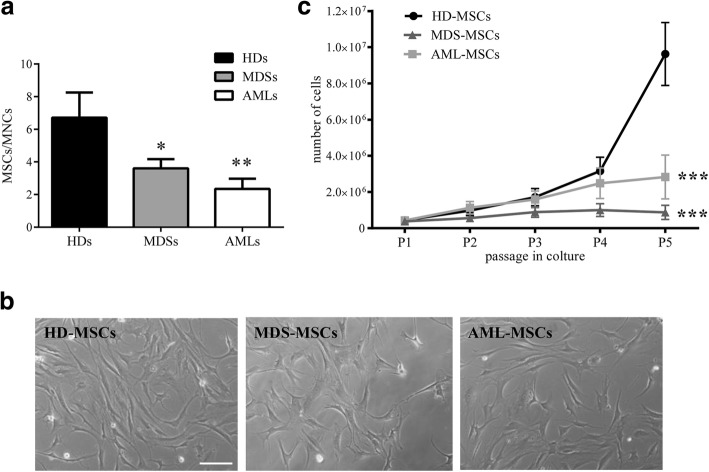
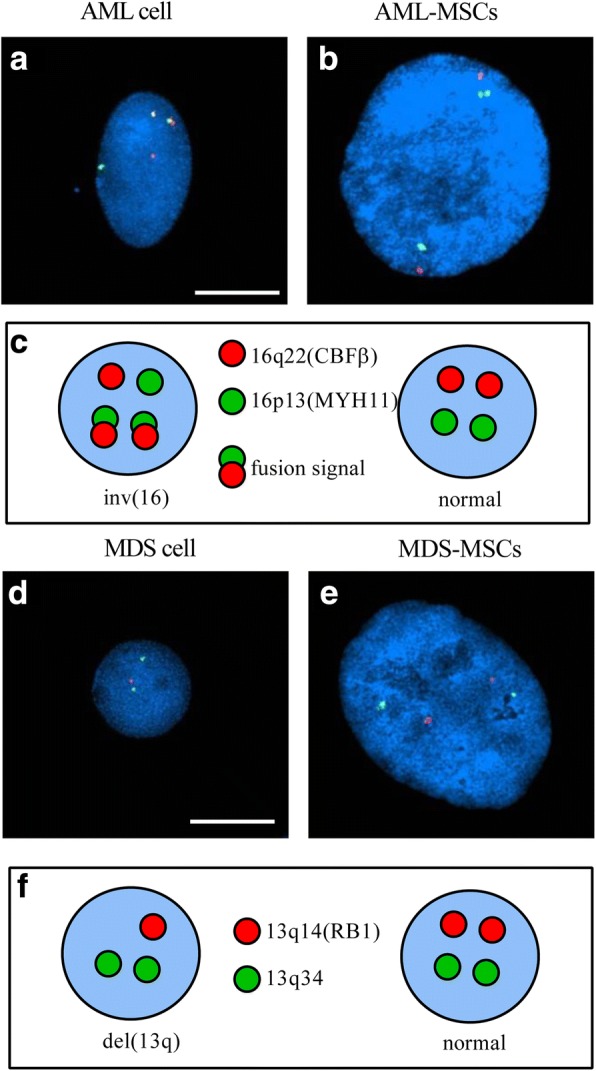
We found that stable MSC cultures could be easily established from HD and MDS mononuclear BM-derived cells, while a substantial fraction (25%) of AML patients failed to yield MSCs. Nevertheless, isolated MDS-MSCs and AML-MSCs, as well as HD-MSCs, contained the basic features of MSCs. Indeed, they displayed similar surface marker expression and efficient capacity to differentiate versus osteogenic and adipogenic lineage in vitro. We also proved that MDS-MSCs and AML-MSCs, analyzed by fluorescence in-situ hybridization, did not harbor leukemic cell cytogenetic abnormalities. Moreover, MDS-MSCs and AML-MSCs were similar in terms of ability to sustain AML cell viability and immune-regulatory capacity. However, we were also able to detect some differences between AML-MSCs and MDS-MSCs. Indeed, we found that the frequency of rescued MSCs was lower in the AML group than in the HD and MDS groups, suggesting that a reduced number of MSC precursors could inhabit AML BM. Instead, MDS-MSCs showed the lowest proliferative capacity, reflecting some intrinsic and particular defect.
Overall, our results elucidated that MDS-MSCs and AML-MSCs did not show macroscopic and/or tumor-related defects, but both displayed functional features potentially contributing to favor a leukemia-protective milieu.
间充质基质细胞(MSCs)是骨髓(BM)微环境的重要组成部分,在调节造血干细胞增殖和分化方面发挥着关键作用。最近的研究结果概述了 MSCs 在血液恶性肿瘤发展中的潜在作用。到目前为止,关于急性髓细胞白血病(AML)和骨髓增生异常综合征(MDS)中 MSC 异常的研究结果相互矛盾。特别是,大量证据强烈支持 MSCs 在 MDS 恶性肿瘤进化中起允许作用,而 MSCs 在 AML 中发挥的潜在因果或促进作用尚未完全阐明。在这里,我们比较了来自健康个体、MDS 患者和 AML 患者的 MSC,以研究 MSC 的改变,并强调潜在的共同和/或不同特征。
我们从 AML 患者(AML-MSCs)和 MDS 患者(MDS-MSCs)中分离和扩增 MSC,并分析和比较了它们彼此之间以及与健康供体衍生 MSC(HD-MSCs)的表型和功能特性。
我们发现,从 HD 和 MDS 单核 BM 衍生细胞中很容易建立稳定的 MSC 培养物,而 25%的 AML 患者未能产生 MSC。然而,分离的 MDS-MSCs 和 AML-MSCs 以及 HD-MSCs 都具有 MSC 的基本特征。事实上,它们表现出相似的表面标志物表达,并具有在体外向成骨细胞和脂肪细胞谱系分化的有效能力。我们还通过荧光原位杂交证明,MDS-MSCs 和 AML-MSCs 中没有白血病细胞细胞遗传学异常。此外,MDS-MSCs 和 AML-MSCs 在维持 AML 细胞活力和免疫调节能力方面相似。然而,我们还能够检测到 AML-MSCs 和 MDS-MSCs 之间的一些差异。事实上,我们发现 AML 组中获救 MSC 的频率低于 HD 和 MDS 组,这表明 AML BM 中 MSC 前体的数量减少。相反,MDS-MSCs 的增殖能力最低,反映出一些内在和特定的缺陷。
总体而言,我们的结果表明 MDS-MSCs 和 AML-MSCs 没有表现出宏观和/或与肿瘤相关的缺陷,但都表现出了潜在的功能特征,有助于促进白血病保护环境。