The Picower Institute for Learning and Memory, Department of Brain and Cognitive Sciences, Massachusetts Institute of Technology, Cambridge, MA 02139, USA.
The Picower Institute for Learning and Memory, Department of Brain and Cognitive Sciences, Massachusetts Institute of Technology, Cambridge, MA 02139, USA.
Neuron. 2018 Oct 24;100(2):463-475. doi: 10.1016/j.neuron.2018.09.023.
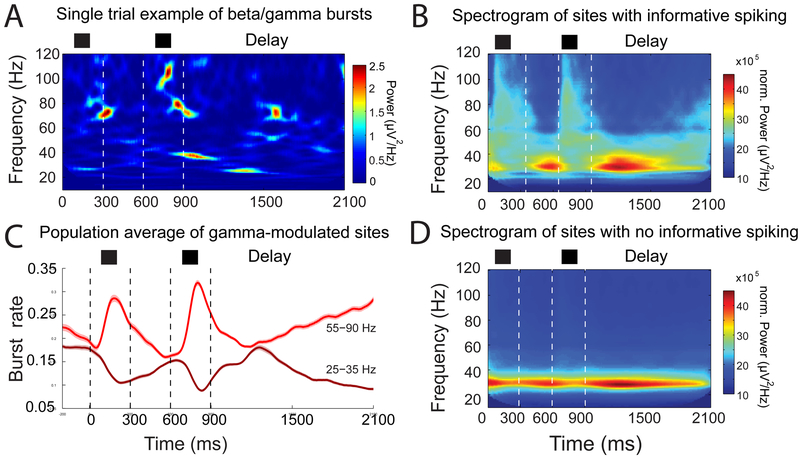
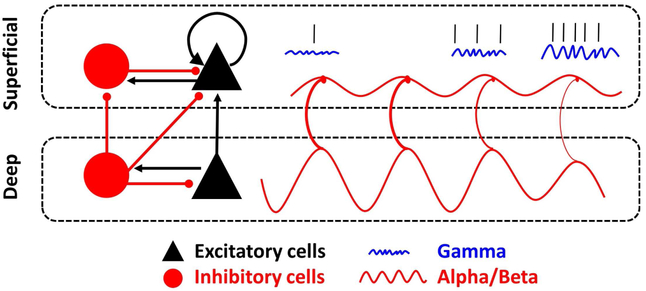
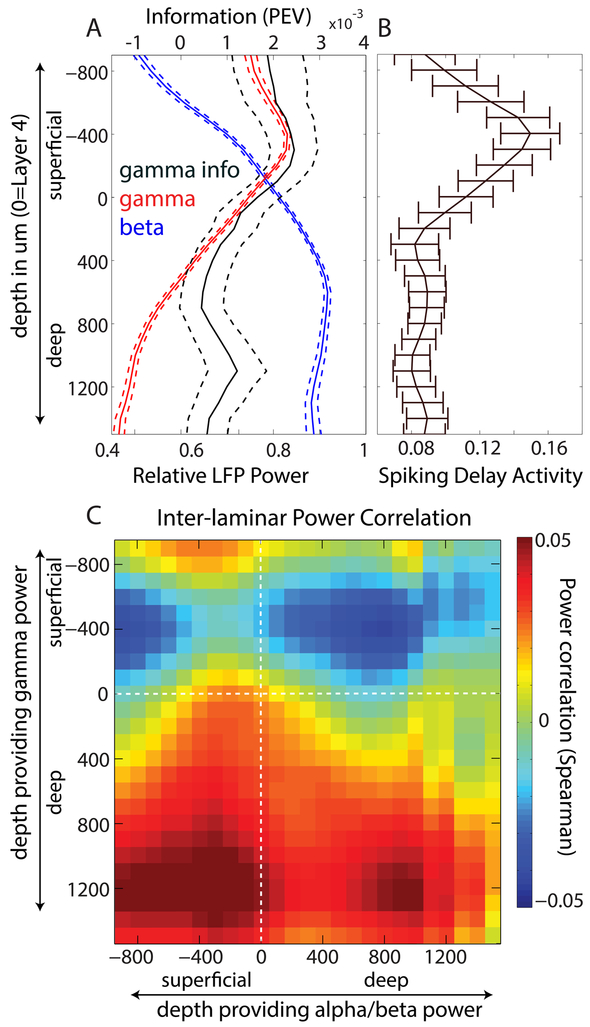
Working memory is the fundamental function by which we break free from reflexive input-output reactions to gain control over our own thoughts. It has two types of mechanisms: online maintenance of information and its volitional or executive control. Classic models proposed persistent spiking for maintenance but have not explicitly addressed executive control. We review recent theoretical and empirical studies that suggest updates and additions to the classic model. Synaptic weight changes between sparse bursts of spiking strengthen working memory maintenance. Executive control acts via interplay between network oscillations in gamma (30-100 Hz) in superficial cortical layers (layers 2 and 3) and alpha and beta (10-30 Hz) in deep cortical layers (layers 5 and 6). Deep-layer alpha and beta are associated with top-down information and inhibition. It regulates the flow of bottom-up sensory information associated with superficial layer gamma. We propose that interactions between different rhythms in distinct cortical layers underlie working memory maintenance and its volitional control.
工作记忆是一种基本功能,使我们能够摆脱反射性的输入-输出反应,从而对自己的思维进行控制。它有两种机制:信息的在线维持和其意志或执行控制。经典模型提出了持续的尖峰放电来维持,但没有明确解决执行控制问题。我们回顾了最近的理论和实证研究,这些研究表明经典模型需要更新和补充。稀疏尖峰爆发之间的突触权重变化增强了工作记忆的维持。执行控制通过浅层皮质层(第 2 层和第 3 层)中的γ(30-100 Hz)网络振荡与深层皮质层(第 5 层和第 6 层)中的α和β(10-30 Hz)之间的相互作用来发挥作用。深层的α和β与自上而下的信息和抑制有关。它调节与浅层γ相关的、来自于感觉信息的输入。我们提出,不同皮质层之间不同节律的相互作用是工作记忆维持及其意志控制的基础。