Department of Electrical and Mechanical Engineering, Nagoya Institute of Technology, Nagoya 466-8555, Japan.
Int J Environ Res Public Health. 2018 Oct 22;15(10):2320. doi: 10.3390/ijerph15102320.
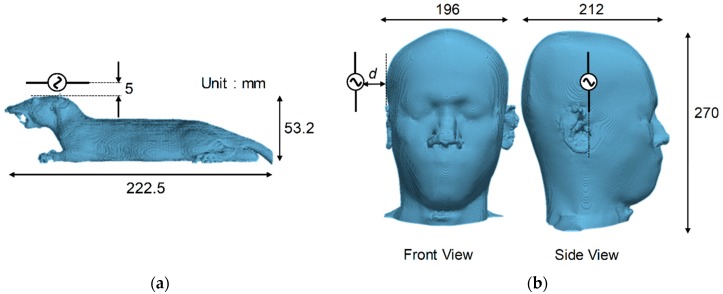
In the international guidelines/standards for human protection against electromagnetic fields, the specific absorption rate (SAR) is used as a metric for radio-frequency field exposure. For radio-frequency near-field exposure, the peak value of the SAR averaged over 10 g of tissue is treated as a surrogate of the local temperature elevation for frequencies up to 3⁻10 GHz. The limit of 10-g SAR is derived by extrapolating the thermal damage in animal experiments. However, no reports discussed the difference between the time constant of temperature elevation in small animals and humans for local exposure. This study computationally estimated the thermal time constants of temperature elevation in human head and rat models exposed to dipole antennas at 3⁻10 GHz. The peak temperature elevation in the human brain was lower than that in the rat model, mainly because of difference in depth from the scalp. Consequently, the thermal time constant of the rat brain was smaller than that of the human brain. Additionally, the thermal time constant in human skin decreased with increasing frequency, which was mainly characterized by the effective SAR volume, whereas it was almost frequency-independent in the human brain. These findings should be helpful for extrapolating animal studies to humans.
在国际人类电磁辐射防护标准中,比吸收率(SAR)被用作射频场暴露的度量标准。对于射频近场暴露,10 克组织平均的 SAR 峰值被视为 3-10GHz 频率下局部温升的替代值。10g SAR 的限值是通过对动物实验中的热损伤进行外推得出的。然而,没有报道讨论局部暴露中小动物和人类温升时间常数的差异。本研究通过计算,估算了 3-10GHz 偶极天线辐射下,人体头部和大鼠模型温升的热时间常数。人体大脑中的峰值温度升高低于大鼠模型,主要是因为距头皮的深度不同。因此,大鼠大脑的热时间常数小于人脑的热时间常数。此外,人体皮肤的热时间常数随频率的增加而降低,这主要与有效 SAR 体积有关,而在人脑内几乎与频率无关。这些发现有助于将动物研究外推到人类。