• 文献检索
  • 文档翻译
  • 深度研究
  • 学术资讯
  • Suppr Zotero 插件Zotero 插件
  • 邀请有礼
  • 套餐&价格
  • 历史记录
应用&插件
Suppr Zotero 插件Zotero 插件浏览器插件Mac 客户端Windows 客户端微信小程序
定价
高级版会员购买积分包购买API积分包
服务
文献检索文档翻译深度研究API 文档MCP 服务
关于我们
关于 Suppr公司介绍联系我们用户协议隐私条款
关注我们

Suppr 超能文献

核心技术专利:CN118964589B侵权必究
粤ICP备2023148730 号-1Suppr @ 2026

文献检索

告别复杂PubMed语法,用中文像聊天一样搜索,搜遍4000万医学文献。AI智能推荐,让科研检索更轻松。

立即免费搜索

文件翻译

保留排版,准确专业,支持PDF/Word/PPT等文件格式,支持 12+语言互译。

免费翻译文档

深度研究

AI帮你快速写综述,25分钟生成高质量综述,智能提取关键信息,辅助科研写作。

立即免费体验

用于检测急性髓系白血病和骨髓增生异常综合征中残留疾病的多色流式细胞术分析的临床验证机器学习算法。

Clinically validated machine learning algorithm for detecting residual diseases with multicolor flow cytometry analysis in acute myeloid leukemia and myelodysplastic syndrome.

机构信息

Department of Internal Medicine, National Taiwan University Hospital, Taipei, Taiwan.

Tai-Cheng Stem Cell Therapy Center, National Taiwan University, Taipei, Taiwan.

出版信息

EBioMedicine. 2018 Nov;37:91-100. doi: 10.1016/j.ebiom.2018.10.042. Epub 2018 Oct 22.

DOI:10.1016/j.ebiom.2018.10.042
PMID:30361063
原文链接:https://pmc.ncbi.nlm.nih.gov/articles/PMC6284584/
Abstract

BACKGROUND

Multicolor flow cytometry (MFC) analysis is widely used to identify minimal residual disease (MRD) after treatment for acute myeloid leukemia (AML) and myelodysplastic syndrome (MDS). However, current manual interpretation suffers from drawbacks of time consuming and interpreter idiosyncrasy. Artificial intelligence (AI), with the expertise in assisting repetitive or complex analysis, represents a potential solution for these drawbacks.

METHODS

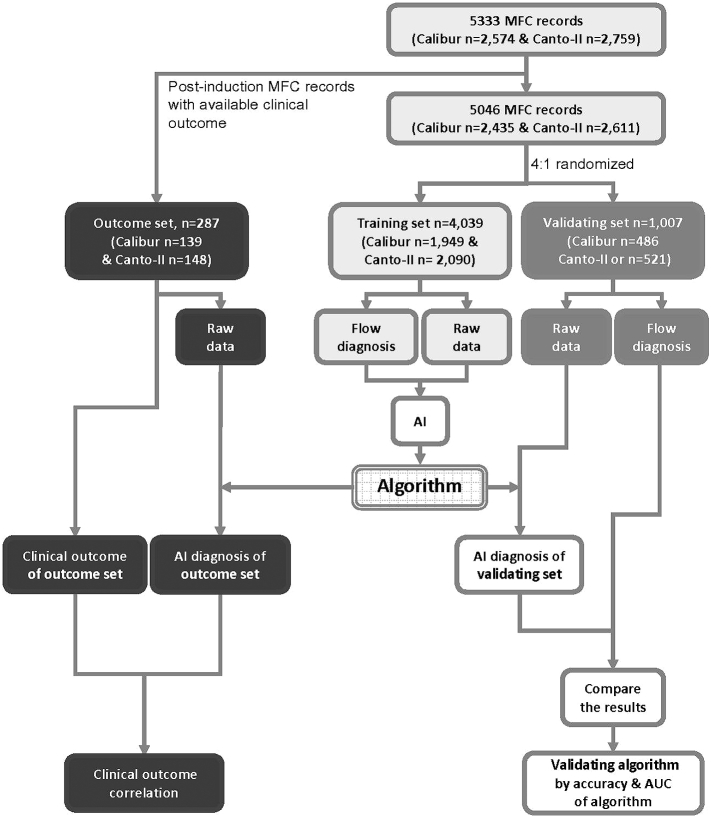
From 2009 to 2016, 5333 MFC data from 1742 AML or MDS patients were collected. The 287 MFC data at post-induction were selected as the outcome set for clinical outcome validation. The rest were 4:1 randomized into the training set (n = 4039) and the validation set (n = 1007). AI algorithm learned a multi-dimensional MFC phenotype from the training set and input it to support vector machine (SVM) classifier after Gaussian mixture model (GMM) modeling, and the performance was evaluated in The validation set.

FINDINGS

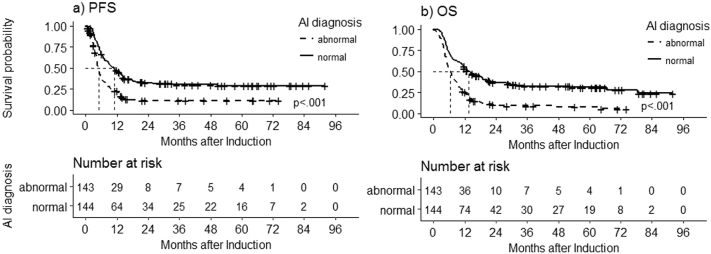
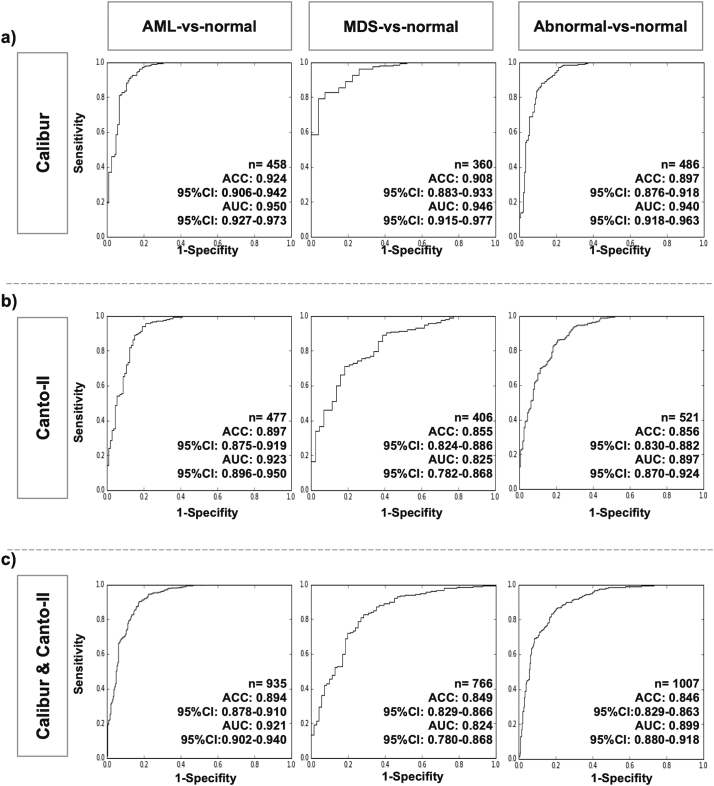
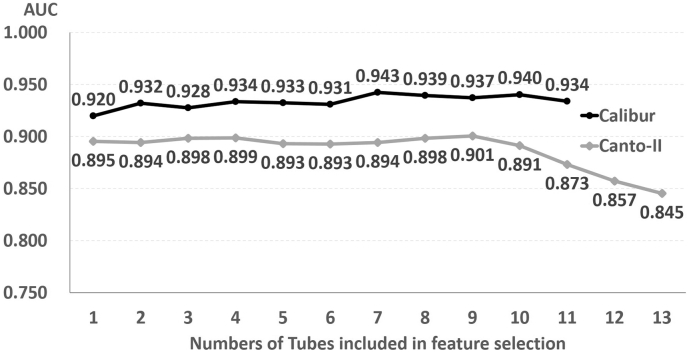
Promising accuracies (84·6% to 92·4%) and AUCs (0·921-0·950) were achieved by the developed algorithms. Interestingly, the algorithm from even one testing tube achieved similar performance. The clinical significance was validated in the outcome set, and normal MFC interpreted by the AI predicted better progression-free survival (10·9 vs 4·9 months, p < 0·0001) and overall survival (13·6 vs 6·5 months, p < 0·0001) for AML.

INTERPRETATION

Through large-scaled clinical validation, we showed that AI algorithms can produce efficient and clinically-relevant MFC analysis. This approach also possesses a great advantage of the ability to integrate other clinical tests. FUND: This work was supported by the Ministry of Science and Technology (107-2634-F-007-006 and 103-2314-B-002-185-MY2) of Taiwan.

摘要

背景

多色流式细胞术(MFC)分析广泛用于治疗急性髓细胞白血病(AML)和骨髓增生异常综合征(MDS)后的微小残留病(MRD)检测。然而,目前的手动解释存在耗时和解释者偏见的缺点。人工智能(AI)在协助重复性或复杂分析方面具有专业知识,代表了解决这些缺点的潜在解决方案。

方法

从 2009 年到 2016 年,收集了 1742 例 AML 或 MDS 患者的 5333 份 MFC 数据。选择 287 份诱导后 MFC 数据作为临床结果验证的结局集。其余数据按 4:1 随机分为训练集(n=4039)和验证集(n=1007)。AI 算法从训练集中学习多维 MFC 表型,在经过高斯混合模型(GMM)建模后将其输入支持向量机(SVM)分类器,并在验证集中评估性能。

发现

所开发算法的准确率(84.6%至 92.4%)和 AUC(0.921-0.950)均达到较高水平。有趣的是,即使是一个检测管的算法也能达到类似的性能。在结局集中验证了临床意义,由 AI 解释的正常 MFC 预测 AML 的无进展生存期(10.9 个月与 4.9 个月,p<0.0001)和总生存期(13.6 个月与 6.5 个月,p<0.0001)更好。

解释

通过大规模临床验证,我们表明 AI 算法可以产生高效且具有临床相关性的 MFC 分析。这种方法还具有整合其他临床检测的优势。

资金

这项工作得到了台湾科技部(107-2634-F-007-006 和 103-2314-B-002-185-MY2)的支持。
https://cdn.ncbi.nlm.nih.gov/pmc/blobs/aa80/6284584/8ab018f39b91/gr4.jpg
https://cdn.ncbi.nlm.nih.gov/pmc/blobs/aa80/6284584/de8baf8a06fc/gr1.jpg
https://cdn.ncbi.nlm.nih.gov/pmc/blobs/aa80/6284584/729fd0fda4fc/gr2.jpg
https://cdn.ncbi.nlm.nih.gov/pmc/blobs/aa80/6284584/79a574a1d0ed/gr3.jpg
https://cdn.ncbi.nlm.nih.gov/pmc/blobs/aa80/6284584/8ab018f39b91/gr4.jpg
https://cdn.ncbi.nlm.nih.gov/pmc/blobs/aa80/6284584/de8baf8a06fc/gr1.jpg
https://cdn.ncbi.nlm.nih.gov/pmc/blobs/aa80/6284584/729fd0fda4fc/gr2.jpg
https://cdn.ncbi.nlm.nih.gov/pmc/blobs/aa80/6284584/79a574a1d0ed/gr3.jpg
https://cdn.ncbi.nlm.nih.gov/pmc/blobs/aa80/6284584/8ab018f39b91/gr4.jpg

相似文献

1
Clinically validated machine learning algorithm for detecting residual diseases with multicolor flow cytometry analysis in acute myeloid leukemia and myelodysplastic syndrome.用于检测急性髓系白血病和骨髓增生异常综合征中残留疾病的多色流式细胞术分析的临床验证机器学习算法。
EBioMedicine. 2018 Nov;37:91-100. doi: 10.1016/j.ebiom.2018.10.042. Epub 2018 Oct 22.
2
How Do We Use Multicolor Flow Cytometry to Detect Minimal Residual Disease in Acute Myeloid Leukemia?我们如何使用多色流式细胞术检测急性髓系白血病中的微小残留病?
Clin Lab Med. 2017 Dec;37(4):787-802. doi: 10.1016/j.cll.2017.07.004. Epub 2017 Sep 28.
3
Pattern associated leukemia immunophenotypes and measurable disease detection in acute myeloid leukemia or myelodysplastic syndrome with mutated NPM1.伴有 NPM1 基因突变的急性髓系白血病或骨髓增生异常综合征中的相关白血病免疫表型和可测量疾病检测。
Cytometry B Clin Cytom. 2019 Jan;96(1):67-72. doi: 10.1002/cyto.b.21744. Epub 2018 Nov 12.
4
Next-generation sequencing-based minimal residual disease monitoring in patients receiving allogeneic hematopoietic stem cell transplantation for acute myeloid leukemia or myelodysplastic syndrome.基于下一代测序的急性髓系白血病或骨髓增生异常综合征患者接受异基因造血干细胞移植后微小残留病监测。
Curr Opin Hematol. 2018 Nov;25(6):425-432. doi: 10.1097/MOH.0000000000000464.
5
Bone Marrow WT1 Levels in Allogeneic Hematopoietic Stem Cell Transplantation for Acute Myelogenous Leukemia and Myelodysplasia: Clinically Relevant Time Points and 100 Copies Threshold Value.异基因造血干细胞移植治疗急性髓系白血病和骨髓增生异常综合征中的骨髓 WT1 水平:有临床意义的时间点和 100 拷贝阈值。
Biol Blood Marrow Transplant. 2018 Jan;24(1):55-63. doi: 10.1016/j.bbmt.2017.09.001. Epub 2017 Sep 20.
6
Prognostic impact of minimal residual disease analysis by flow cytometry in patients with acute myeloid leukemia before and after allogeneic hemopoietic stem cell transplantation.流式细胞术检测微小残留病对急性髓系白血病患者异基因造血干细胞移植前后的预后影响
Eur J Haematol. 2014 Sep;93(3):239-46. doi: 10.1111/ejh.12336. Epub 2014 Apr 29.
7
Minimal Identifiable Disease and the Role of Conditioning Intensity in Hematopoietic Cell Transplantation for Myelodysplastic Syndrome and Acute Myelogenous Leukemia Evolving from Myelodysplastic Syndrome.微小可识别疾病以及预处理强度在骨髓增生异常综合征及由骨髓增生异常综合征演变而来的急性髓系白血病造血细胞移植中的作用
Biol Blood Marrow Transplant. 2016 Jul;22(7):1227-1233. doi: 10.1016/j.bbmt.2016.03.029. Epub 2016 Apr 6.
8
The applicability of multiparameter flow cytometry for the detection of minimal residual disease using different-from-normal panels to predict relapse in patients with acute myeloid leukemia after allogeneic transplantation.多参数流式细胞术使用不同于正常的面板检测微小残留病在异基因移植后急性髓系白血病患者中的应用,以预测复发。
Int J Lab Hematol. 2019 Oct;41(5):607-614. doi: 10.1111/ijlh.13070. Epub 2019 Jun 4.
9
MAGIC-DR: An interpretable machine-learning guided approach for acute myeloid leukemia measurable residual disease analysis.MAGIC-DR:一种用于急性髓细胞白血病可测量残留病分析的可解释机器学习指导方法。
Cytometry B Clin Cytom. 2024 Jul;106(4):239-251. doi: 10.1002/cyto.b.22168. Epub 2024 Feb 28.
10
Measurement of minimal residual disease before and after myeloablative hematopoietic cell transplantation for acute leukemia.急性白血病患者在接受清髓性造血细胞移植前后微小残留病的测量。
Best Pract Res Clin Haematol. 2013 Sep;26(3):279-84. doi: 10.1016/j.beha.2013.10.008. Epub 2013 Oct 16.

引用本文的文献

1
Measurable residual disease (MRD) as a surrogate end point for clinical drug approval in acute myeloid leukemia (AML): Perspectives from the MRD Partnership and Alliance in AML Clinical Treatment Consortium.可测量残留病(MRD)作为急性髓系白血病(AML)临床药物批准的替代终点:AML临床治疗联盟MRD合作与联盟的观点
Cancer. 2025 Jul 1;131(13):e35960. doi: 10.1002/cncr.35960.
2
Applications of machine learning for immunophenotypic measurable residual disease assessment in acute myeloid leukemia.机器学习在急性髓系白血病免疫表型可测量残留病评估中的应用
Hemasphere. 2025 May 21;9(5):e70138. doi: 10.1002/hem3.70138. eCollection 2025 May.
3

本文引用的文献

1
Role of minimal residual disease in the management of acute myeloid leukemia-a case-based discussion.微小残留病在急性髓系白血病治疗中的作用——基于病例的讨论。
Ann Hematol. 2018 Jul;97(7):1155-1167. doi: 10.1007/s00277-018-3330-9. Epub 2018 Apr 27.
2
Minimal/measurable residual disease in AML: a consensus document from the European LeukemiaNet MRD Working Party.急性髓系白血病中的微小残留病:来自欧洲白血病网微小残留病工作组的共识文件。
Blood. 2018 Mar 22;131(12):1275-1291. doi: 10.1182/blood-2017-09-801498. Epub 2018 Jan 12.
3
Corrigendum: Dermatologist-level classification of skin cancer with deep neural networks.
Using Artificial Intelligence to Enhance Myelodysplastic Syndrome Diagnosis, Prognosis, and Treatment.
利用人工智能提升骨髓增生异常综合征的诊断、预后评估及治疗水平。
Biomedicines. 2025 Mar 31;13(4):835. doi: 10.3390/biomedicines13040835.
4
A machine learning approach for the rapid identification of measurable residual disease in acute myeloid leukemia.一种用于快速识别急性髓系白血病中可测量残留病的机器学习方法。
Haematologica. 2025 Mar 6. doi: 10.3324/haematol.2024.286019.
5
Machine Learning Methods in Clinical Flow Cytometry.临床流式细胞术中的机器学习方法
Cancers (Basel). 2025 Feb 1;17(3):483. doi: 10.3390/cancers17030483.
6
Computational assessment of measurable residual disease in acute myeloid leukemia using mixture models.使用混合模型对急性髓系白血病中可测量残留病进行计算评估。
Commun Med (Lond). 2024 Dec 19;4(1):271. doi: 10.1038/s43856-024-00700-x.
7
Optimization of diagnosis and treatment of hematological diseases via artificial intelligence.通过人工智能优化血液疾病的诊断与治疗
Front Med (Lausanne). 2024 Nov 7;11:1487234. doi: 10.3389/fmed.2024.1487234. eCollection 2024.
8
Comparison of three machine learning algorithms for classification of B-cell neoplasms using clinical flow cytometry data.三种机器学习算法在基于临床流式细胞术数据的 B 细胞肿瘤分类中的比较。
Cytometry B Clin Cytom. 2024 Jul;106(4):282-293. doi: 10.1002/cyto.b.22177. Epub 2024 May 9.
9
Measurable (Minimal) Residual Disease in Myelodysplastic Neoplasms (MDS): Current State and Perspectives.骨髓增生异常综合征(MDS)中的可测量(微小)残留病:现状与展望
Cancers (Basel). 2024 Apr 15;16(8):1503. doi: 10.3390/cancers16081503.
10
Using Artificial Intelligence to Interpret Clinical Flow Cytometry Datasets for Automated Disease Diagnosis and/or Monitoring.利用人工智能解读临床流式细胞术数据集,实现疾病的自动化诊断和/或监测。
Methods Mol Biol. 2024;2779:353-367. doi: 10.1007/978-1-0716-3738-8_16.
勘误:使用深度神经网络对皮肤癌进行皮肤科医生级别的分类。
Nature. 2017 Jun 28;546(7660):686. doi: 10.1038/nature22985.
4
Minimal Residual Disease in Acute Myeloid Leukemia: Still a Work in Progress?急性髓系白血病中的微小残留病:仍在进展中?
J Clin Med. 2017 Jun 3;6(6):57. doi: 10.3390/jcm6060057.
5
Artificial intelligence in medicine.医学中的人工智能。
Metabolism. 2017 Apr;69S:S36-S40. doi: 10.1016/j.metabol.2017.01.011. Epub 2017 Jan 11.
6
Dermatologist-level classification of skin cancer with deep neural networks.基于深度神经网络的皮肤癌皮肤科医生级分类。
Nature. 2017 Feb 2;542(7639):115-118. doi: 10.1038/nature21056. Epub 2017 Jan 25.
7
Artificial Intelligence With Deep Learning Technology Looks Into Diabetic Retinopathy Screening.运用深度学习技术的人工智能用于糖尿病视网膜病变筛查。
JAMA. 2016 Dec 13;316(22):2366-2367. doi: 10.1001/jama.2016.17563.
8
Development and Validation of a Deep Learning Algorithm for Detection of Diabetic Retinopathy in Retinal Fundus Photographs.深度学习算法在视网膜眼底照片糖尿病视网膜病变检测中的开发与验证。
JAMA. 2016 Dec 13;316(22):2402-2410. doi: 10.1001/jama.2016.17216.
9
Diagnosis and management of AML in adults: 2017 ELN recommendations from an international expert panel.成人急性髓系白血病的诊断与管理:2017年国际专家小组的欧洲白血病网络(ELN)建议
Blood. 2017 Jan 26;129(4):424-447. doi: 10.1182/blood-2016-08-733196. Epub 2016 Nov 28.
10
Automated analysis of acute myeloid leukemia minimal residual disease using a support vector machine.使用支持向量机对急性髓系白血病微小残留病进行自动化分析。
Oncotarget. 2016 Nov 1;7(44):71915-71921. doi: 10.18632/oncotarget.12430.