Bhuanantanondh Petcharatana, Nanta Pirun, Mekhora Keerin
Faculty of Physical Therapy, Mahidol University, Salaya, Nakhon Pathom, Thailand.
Saf Health Work. 2018 Mar;9(1):59-62. doi: 10.1016/j.shaw.2017.06.001. Epub 2017 Jun 15.
Several grip strength tests are commonly used for detecting sincerity of effort. However, there is still no widely accepted standardized sincerity of effort test. Therefore, this study aimed to examine whether grip strength test in three wrist positions could distinguish between maximal and submaximal efforts.
Twenty healthy individuals (10 men and 10 women) with a mean age of 26.7 ± 3.92 years participated in this study. All participants completed two test conditions (maximal and submaximal efforts) in three wrist positions (neutral, flexion, and extension) using both hands. Each participant exerted 100% effort in the maximal effort condition and 50% effort in the submaximal effort condition. The participants performed three repetitions of the grip strength test for each session.
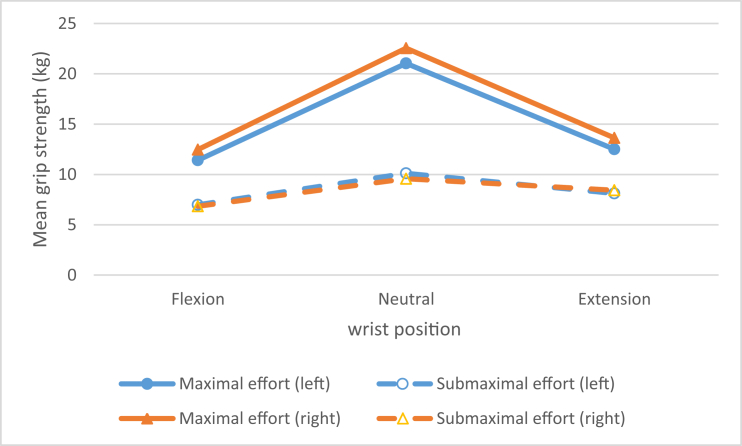
The results showed that there is a significant main effect of the type of effort ( < 0.001), wrist position ( < 0.001), and hand ( = 0.028). There were also significant types of effort and wrist position interactions ( < 0.001) and effort and hand interactions < 0.028). The results also showed that grip strength was highest at the wrist in neutral position in both the maximal and the submaximal effort condition. Grip strength values of the three wrist positions in the maximal effort condition were noticeably greater than those in the submaximal effort condition.
The findings of this study suggest that grip strength test in three wrist positions can differentiate a maximal effort from a submaximal effort. Thus, this test could potentially be used to detect sincerity of effort in clinical setting.
几种握力测试常用于检测用力的真实性。然而,目前仍没有被广泛接受的标准化用力真实性测试。因此,本研究旨在探讨在三种手腕位置进行握力测试是否能够区分最大用力和次最大用力。
20名健康个体(10名男性和10名女性)参与了本研究,平均年龄为26.7±3.92岁。所有参与者使用双手在三种手腕位置(中立位、屈曲位和伸展位)完成两种测试条件(最大用力和次最大用力)。在最大用力条件下,每个参与者使出100%的力量;在次最大用力条件下,使出50%的力量。每个参与者在每个测试环节进行三次握力测试重复。
结果表明,用力类型(<0.001)、手腕位置(<0.001)和手(=0.028)存在显著的主效应。用力类型和手腕位置之间也存在显著的交互作用(<0.001),用力和手之间也存在交互作用(<0.028)。结果还表明,在最大用力和次最大用力条件下,中立位手腕的握力最高。最大用力条件下三种手腕位置的握力值明显大于次最大用力条件下的握力值。
本研究结果表明,在三种手腕位置进行握力测试可以区分最大用力和次最大用力。因此,该测试有可能用于临床环境中检测用力的真实性。