Schiano Lomoriello Arianna, Meconi Federica, Rinaldi Irene, Sessa Paola
Department of Developmental and Social Psychology, University of Padova, Padova, Italy.
School of Psychology, University of Birmingham, Birmingham, United Kingdom.
Front Psychol. 2018 Oct 11;9:1824. doi: 10.3389/fpsyg.2018.01824. eCollection 2018.
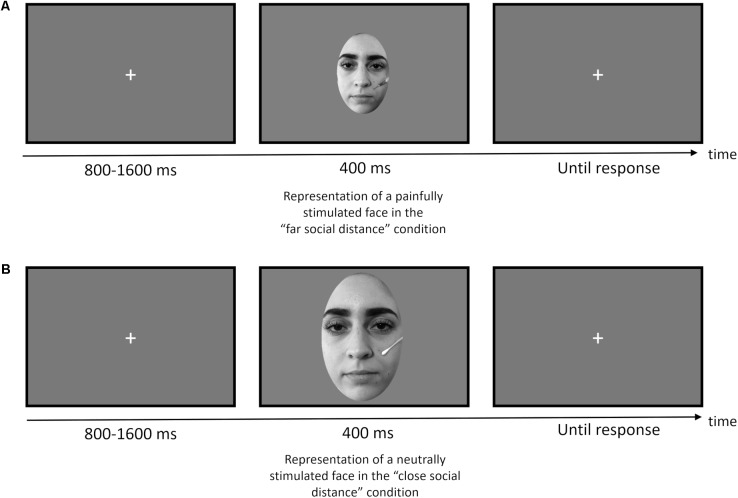
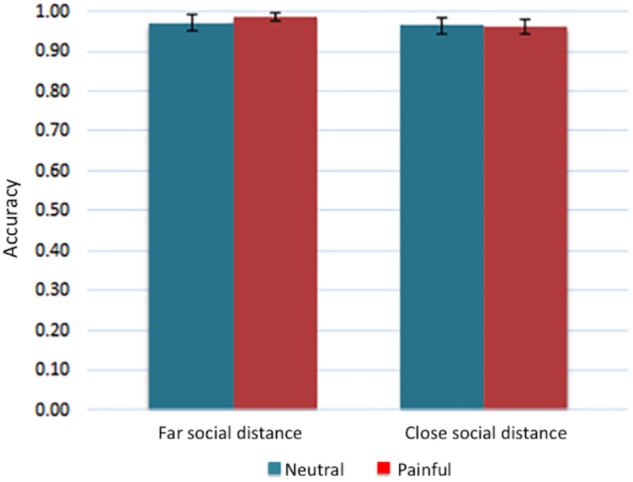
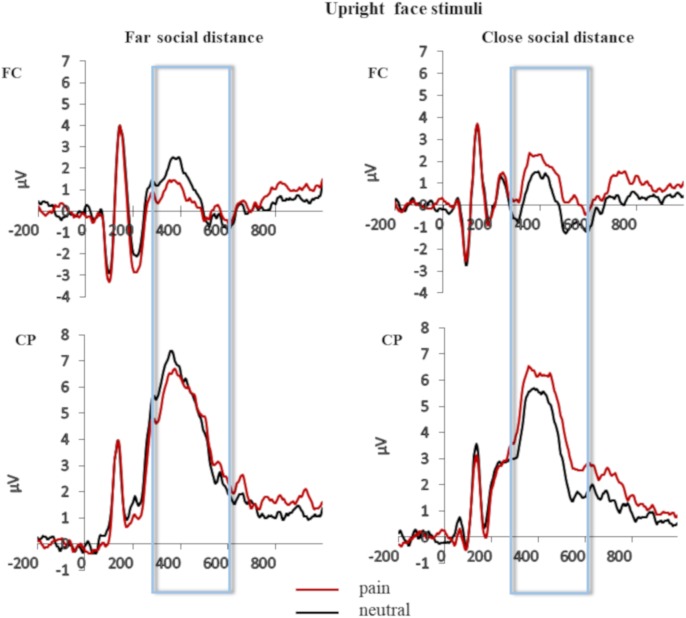
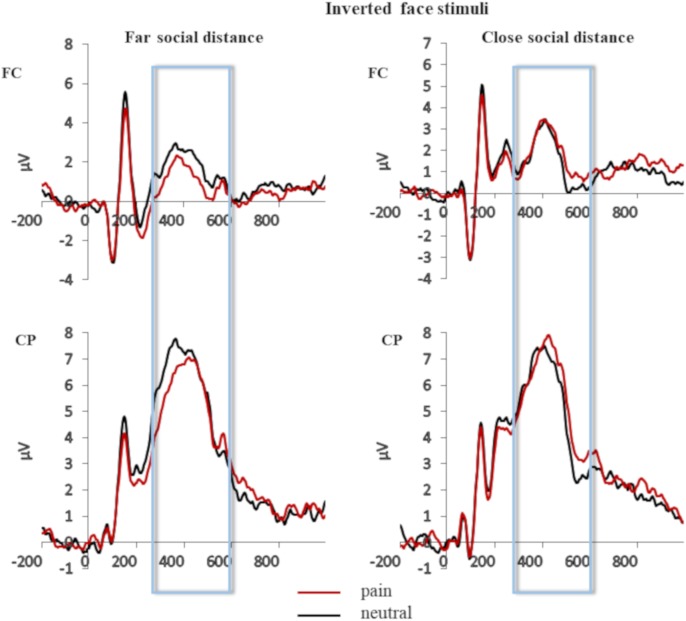
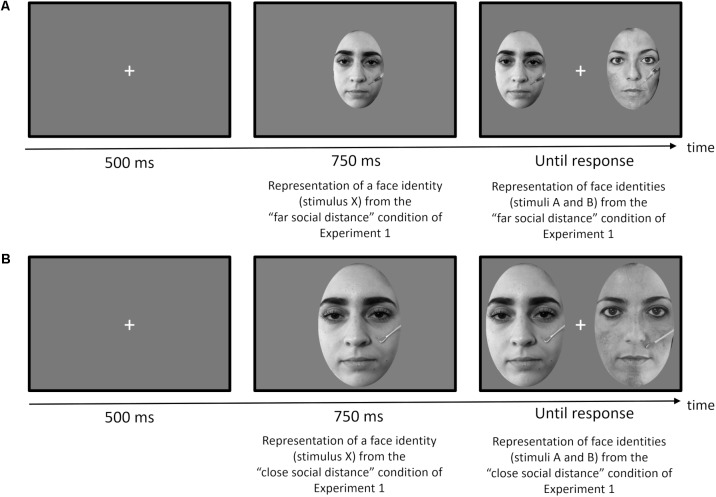
Social and affective relations may shape empathy to others' affective states. Previous studies also revealed that people tend to form very different mental representations of stimuli on the basis of their physical distance. In this regard, embodied cognition and embodied simulation propose that different physical distances between individuals activate different interpersonal processing modes, such that close physical distance tends to activate the interpersonal processing mode typical of socially and affectively close relationships. In Experiment 1, two groups of participants were administered a pain decision task involving upright and inverted face stimuli painfully or neutrally stimulated, and we monitored their neural empathic reactions by means of event-related potentials (ERPs) technique. Crucially, participants were presented with face stimuli of one of two possible sizes in order to manipulate retinal size and perceived physical distance, roughly corresponding to the close and far portions of social distance. ERPs modulations compatible with an empathic reaction were observed only for the group exposed to face stimuli appearing to be at a close social distance from the participants. This reaction was absent in the group exposed to smaller stimuli corresponding to face stimuli observed from a far social distance. In Experiment 2, one different group of participants was engaged in a match-to-sample task involving the two-size upright face stimuli of Experiment 1 to test whether the modulation of neural empathic reaction observed in Experiment 1 could be ascribable to differences in the ability to identify faces of the two different sizes. Results suggested that face stimuli of the two sizes could be equally identifiable. In line with the Construal Level and Embodied Simulation theoretical frameworks, we conclude that perceived physical distance may shape empathy as well as social and affective distance.
社会和情感关系可能会塑造对他人情感状态的同理心。先前的研究还表明,人们往往会根据刺激物的物理距离形成非常不同的心理表征。在这方面,具身认知和具身模拟提出,个体之间不同的物理距离会激活不同的人际加工模式,以至于近距离的物理距离往往会激活社会和情感亲密关系中典型的人际加工模式。在实验1中,两组参与者接受了一项疼痛决策任务,任务中涉及对直立和倒置的面部刺激进行疼痛或中性刺激,我们通过事件相关电位(ERP)技术监测他们的神经共情反应。至关重要的是,向参与者呈现两种可能大小之一的面部刺激,以操纵视网膜大小和感知到的物理距离,大致对应于社会距离的近和远部分。仅在暴露于似乎与参与者处于近距离社会距离的面部刺激的组中观察到了与共情反应相符的ERP调制。在暴露于对应于从远距离社会距离观察到的面部刺激的较小刺激的组中没有这种反应。在实验2中,另一组不同的参与者参与了一项样本匹配任务,该任务涉及实验1中的两种大小的直立面部刺激,以测试实验1中观察到的神经共情反应的调制是否可归因于识别两种不同大小面部的能力差异。结果表明,两种大小的面部刺激同样易于识别。与解释水平和具身模拟理论框架一致,我们得出结论,感知到的物理距离可能会塑造同理心以及社会和情感距离。